Strategy 0: Specify
The meta-strategy. Runs before all others.
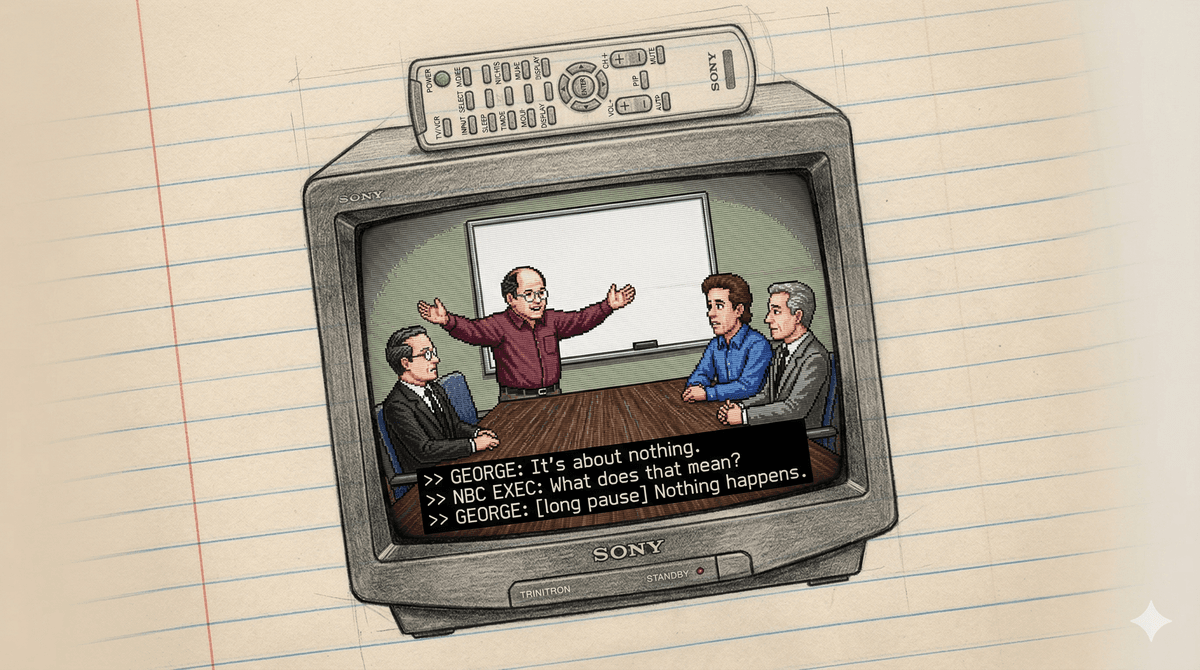
The episode: Jerry and George pitch a TV show to NBC. George’s concept is “a show about nothing.” The NBC executive asks what happens in the show. George explains that nothing happens — the characters talk, they exist, nothing is resolved. The executive asks for a script. George has no script. He has no characters. He has no setting. He has a vibe.
The show gets made anyway — badly, expensively, disastrously — because nobody stopped at the beginning and asked George clarifying questions.
The lesson: An empty spec doesn’t produce nothing. It produces something — just not what you wanted. Your Agent, like NBC, will execute against whatever specification it receives. If the specification is “a show about nothing,” you will get something about nothing. The clarifying questions are not an obstacle. They are the work.
My Man Jeeves: Requests conveyed without specification are, invariably, carried out. The article delivered bears to the article intended a resemblance that one might describe, generously, as figurative, and the matter is, in the usual course of things, taken up a second time. One had only to ask five clarifying questions.
Every strategy in this book begins here. Before your Agent can Decode, Draft, Navigate, or Assert anything for you, it needs to understand your situation precisely enough to do the work correctly. That precision is the specification.
The insight that makes this book work: you do not have to write the spec. Your Agent will interview you into one. Your job is to answer its questions honestly and tell it when the spec it proposes doesn’t accurately reflect your situation. That is a human skill you already have. You know your own situation. You just needed someone to ask the right questions.
In the Field Guide: every Skill begins with a Strategy 0 specification interview. Skills using the Expert Role variant include Ho-7: Gardening & Landscaping, Ch-8: Pet Care and Training, Tr-2: Car Maintenance, and H-8: Wellness and Nutrition Coach.
The Specification Interview Loop
Here is the full loop, annotated. This is what every [SPEC] sidebar in this book is showing you.
A Full Example
The situation: you got a letter from your health insurance company saying they’re denying coverage for a procedure your doctor ordered. You are furious and do not know what to do.
Your opening message:
My insurance denied a claim. I need to appeal it.
Your Agent’s clarifying questions:
I can help you with that. A few questions to make sure
I give you the right approach:

1. What type of claim was denied — a procedure that
hasn’t happened yet, or one that already did?
2. What reason did the denial letter give?
3. Have you already contacted your insurance company
about this, or is this your first step?
4. What outcome do you want — to get the procedure
approved, to get a past procedure paid for, or both?
Your answers:
1. Procedure that hasn’t happened yet — my doctor ordered
an MRI and they said it’s not medically necessary.
2. The letter says “not medically necessary.”
3. Haven’t contacted them yet. Just got the letter today.
4. I want the MRI approved.
Your Agent proposes the spec:
Here’s what I understand you need:

You’ve received a prior authorization denial for an MRI
your doctor ordered. The denial reason is “not medically
necessary.” You want to file a first-level internal appeal
to get the procedure approved before it happens. You have
not yet contacted the insurance company.

I’ll help you draft an appeal letter that:
— cites the specific denial reason
— requests your doctor provide supporting documentation
— references the relevant appeals timeline language
— is firm without being hostile, since you may need
to escalate further if this appeal fails

Does this match your situation? Anything I got wrong
or anything important I missed?
Your correction:
Yes, but also — my doctor’s office said they can provide
a letter of medical necessity. Can the appeal reference that?
Your Agent confirms and executes.
The Expert Role Variant
Some situations don’t need a document decoded or a process navigated. They need a knowledgeable person to look at your specific situation and tell you what they see.
For these, there is a Specify shortcut: the Expert Role spec. Instead of waiting for your Agent to interview you into a spec, you open by assigning it a role and describing your situation in one paragraph. Your Agent will ask any clarifying questions it needs, then proceed.
Act as an experienced [Master Gardener / certified dog trainer /
right-to-repair technician / personal trainer / etc.].
Here is my situation: [describe it specifically].
What do I need to know, and what should I do first?
The Expert Role spec works because your Agent has read the training materials, certification curricula, and professional literature for most well-documented fields. It can hold that knowledge in the frame of a specific expert’s perspective for the duration of your conversation.
What it’s not: A licensed professional. The Master Gardener variant will not carry liability for your tomatoes. The personal trainer variant will not spot you. The Expert Role is the knowledgeable friend who happens to have the credentials, not the credentialed professional who carries accountability. For everything in the Everyday Expertise section of the Field Guide, this distinction is fine. For the system-navigation Skills — legal, medical, financial — the Expert Role is a starting point, not an endpoint.
Works with any AI assistant. The Expert Role spec functions identically in Claude, ChatGPT, Gemini, and Copilot. Some tools will stay in the role more consistently than others — if one drifts out of the advisor frame and starts adding unnecessary caveats, try the same spec in a different tool.
-
[1] Kuyken, W., Padesky, C.A., & Dudley, R. (2009). Collaborative Case Conceptualization. Guilford Press. The parallel to AI specification is direct: the reader’s corrections to the Agent’s proposed spec contain exactly the contextual information that distinguishes their situation from the generic case.↩
-
[2] Pescosolido, B.A. (1992). “Beyond rational choice: The social dynamics of how people seek help.” American Journal of Sociology, 97(4), 1096–1138.↩