Strategy 3: Draft
Get past the blank page.
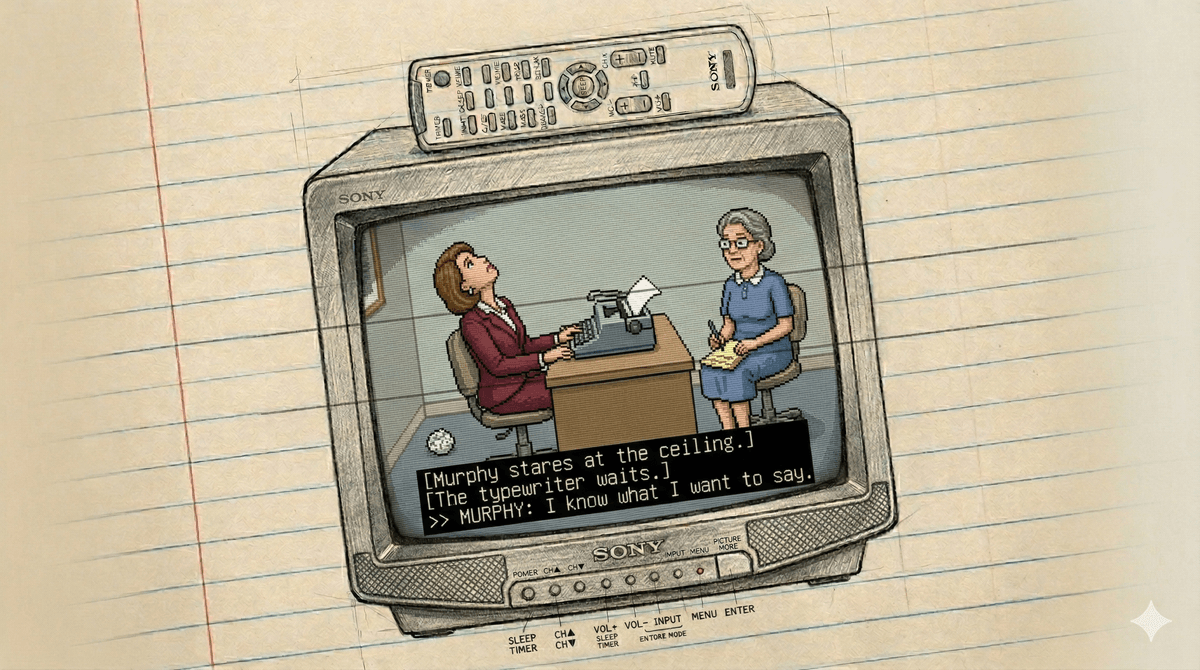
The episode: Murphy Brown returns from a 28-day stint at the Betty Ford Center to find her show in chaos and her latest secretary already resigned. She sits down to dictate a broadcast piece — something she does for a living, five days a week — and cannot start. The blank page is not a content problem. Murphy knows what she wants to say. It is a first-sentence problem. The first sentence will not come. The secretary waits. The page stays blank.
Murphy goes through 93 secretaries over the course of the series. The secretaries are not the problem. Murphy cannot specify what she needs clearly enough for anyone to deliver it, and she cannot get herself past the first draft alone.
The lesson: The blank page is not a writing problem. It is a starting problem. The first draft does not have to be right. It has to exist. Once it exists, you can fix it. Your Agent’s job is to hand you something to react to — a first draft you can edit into your voice, a structure you can accept or reject, a starting point that costs you nothing to improve. Murphy needed someone to write the first sentence. Now you have one.
My Man Jeeves: The obstacle is not the content of the memo but the first sentence of it. One knows what one wishes to say. One cannot begin. The remedy has always been a draft to correct rather than a page to fill — a service which, until recently, required keeping a secretary on staff and a certain degree of patience with the profession. The draft is no longer on salary.
The blank page is the most expensive piece of real estate in your life. It costs you hours of avoidance, low-grade anxiety, and the gradual accumulation of unfinished business that the Zeigarnik effect turns into a constant low-level drain on your mental bandwidth. Your Agent does not write the final version. It writes the first version, which is the only one that costs you anything.
The draft it produces will be competent and generic. That is the point. The competent generic draft is not your voice — it is a surface to push against. Your voice emerges in the editing, in the places where you cross out what your Agent wrote and replace it with what you actually mean. Your Agent has read ten thousand demand letters. It knows what a demand letter sounds like. It does not know what your demand letter sounds like — the specific weight of your anger, the particular history with this landlord, the sentence where you stop being polite. That part arrives when you edit. Your Agent brings the library. You bring the life. The draft is where they meet.
What Draft is for: Any writing task where the obstacle is starting. Demand letters. Appeal letters. Complaint emails. Eulogies. Apologies. HR grievances. Public comments. Performance self-reviews.
The core spec pattern:
I need to write [type of document] to [recipient]
about [situation].
I want to [specific goal].
I want to avoid [specific outcome].
Tone should be [formal/firm/warm/conciliatory].
Please write a first draft I can edit.
In the Field Guide: H-4 (Insurance Appeals), Li-2 (Eulogies), C-5 (Public Comments), L-3 (Demand Letters), W-1 (Getting a Job).
Worked examples: A counteroffer to a landlord. An insurance denial appeal. A public comment for a city council meeting.
Example 1: The Landlord Counteroffer
In Strategy 1: Decode, you found a new early termination clause buried in your lease renewal. Your Agent decoded it: $6,450 to leave early — two months’ rent plus forfeiture of your security deposit — and the landlord can deny the request even after you pay. You know exactly what’s wrong with the clause. You know which parts to push back on. You have been staring at a blank email for 20 minutes.
This is the gap Draft closes. You have the analysis. You have the position. You do not have the first sentence. The first sentence is the most expensive part of the email — not because it’s hard to write, but because the blank screen turns “I know what I want to say” into “I don’t know how to start.” Your Agent writes the first sentence. You write everything after that.
Your opening message:
In my last conversation with you, we decoded an early
termination clause in my lease renewal. You flagged the
“sole discretion” language and the $6,450 penalty as
aggressive. I want to push back, but I don’t want to
reject the renewal — I like the apartment and I want to
stay. I’ve been here two years and I have a good
relationship with my landlord.

Can you draft an email proposing modifications to the
early termination clause? I want to keep the tone
professional but not hostile. I’m not threatening to
leave. I’m proposing changes that make the clause fair.
Your Agent’s clarifying questions:
I can draft that. A few things will make the email
land better:

1. What tone do you want — formal business letter, or
more like how you’d normally communicate with this
landlord?
2. How’s the relationship? Have you had disagreements
before, and if so, how did they go?
3. Are you willing to walk if they won’t negotiate? Or
is staying your strong preference regardless?
4. Which parts of the clause bother you most? The sole
discretion, the penalty amount, the deposit
forfeiture, or all three?
5. Has your landlord shown flexibility before — on the
rent increase, maintenance requests, anything?
Your answers:
1. Firm but not hostile. I want them to take it
seriously but I don’t want to blow up the
relationship.
2. Good relationship. They’ve been responsive on
maintenance. No real disagreements.
3. I could move, but I’d rather stay. This apartment
is rent-stabilized compared to what’s on the market
right now.
4. The sole discretion part is the worst. Paying $6,450
and still not being able to leave is absurd. The
penalty amount and deposit forfeiture are also too
high, but the discretion clause is the dealbreaker.
5. Yes — they originally proposed a $100/month rent
increase and came down to $75 when I asked. So
there’s precedent for negotiation.
Your Agent drafts:
Here’s a draft. Read it, change anything that doesn’t
sound like you, and don’t send it until it does.

Subject: Lease Renewal — Question About New Early
Termination Clause

Hi [Landlord’s name],

Thanks for sending over the renewal. I’m happy to
continue the lease and the $2,175 rate works for me.

I did want to flag the new early termination clause on
page 4. I don’t have plans to leave early — I like the
apartment and I’ve been here two years — but I want to
make sure the terms are fair to both of us before I
sign.

Three things I’d like to propose:

1. Remove the “Landlord’s sole discretion” language.
If I’m paying an early termination fee, the
termination should be automatic upon payment and
proper notice. A fee I can pay but that you can
still deny doesn’t function as a real option — it
just creates uncertainty.
2. Reduce the penalty from two months’ rent to one
month ($2,175). Combined with 60 days’ notice,
that gives you enough time and money to find a
new tenant without the penalty being punitive.
3. Remove the security deposit forfeiture. The deposit
should be handled the same way it would be at
the end of a normal lease — returned minus any
legitimate deductions for damage. Forfeiture on
top of an early termination fee is doubling up.

I think these changes are fair. The clause still
protects you — you’d get 60 days’ notice plus a full
month’s rent as a fee. And I’d have an exit option that
actually works if my circumstances change.

Happy to discuss. I’d like to get the renewal signed
this week if we can work this out.

Best,
[Your name]

Read this out loud before you send it. If any sentence
sounds like someone else wrote it, rewrite that
sentence. The structure is right — the voice has to be
yours.
Your follow-up:
This is good but it sounds too formal. I usually just
text my landlord. Can you make it more casual but keep
the substance?
Your Agent:
Here’s a casual version. Same substance, different
register.

Hey [Landlord’s name],

Got the renewal — thanks. Rent increase is fine, happy
to sign.

One thing though — the new early termination clause
on page 4. I’m not planning to go anywhere, but I
read through it and some of it feels off. Three
things I’d want to change before I sign:

1. The “sole discretion” part — if I’m paying a fee
to leave early, it should actually let me leave.
Can we make it automatic with proper notice?
2. Two months’ rent is steep. Would you do one month?
That plus 60 days’ notice still gives you plenty
of time to find someone.
3. The deposit forfeiture — I’d rather the deposit
just get handled normally, like it would at the
end of the lease. Losing it on top of a fee feels
like a lot.

I think that’s fair for both of us. Let me know what
you think — I’d love to get this wrapped up this week.

[Your name]

The casual tone works because you have a good
relationship. If that changes — if they push back hard
or get hostile — switch to the formal version. Formal
language is a tool, not a personality.
Example 2: The Insurance Denial Appeal Letter
In Strategy 0: Specify, you worked through an insurance denial — an MRI your doctor ordered, denied as “not medically necessary.” Your Agent helped you understand what the denial meant, what a first-level internal appeal looks like, and how to file one. You filed it. Your doctor’s office provided a letter of medical necessity, just like they said they would. The appeal was denied. Now you need to write the next one.
You have been fighting this for weeks. The first appeal felt like filling out a form — follow the steps, attach the letter, submit. This one is different. The external appeal goes to an independent medical reviewer, not customer service. It is a formal document with real requirements and a real audience: a physician who will read your case and decide whether the denial stands. The blank page is harder this time because the stakes are higher, the format is less familiar, and you have already been told no twice.
Your opening message:
My internal appeal for the MRI was denied. Second denial
says the same thing — “not medically necessary” — but
adds this language: “The documentation provided does not
support medical necessity for the requested service.”

My doctor wrote a letter of medical necessity. I have 60
days to file an external appeal. I don’t know how formal
this needs to be or what to include. Can you help me
draft it?
Your Agent’s clarifying questions:
I can help you draft that. I need to understand exactly
what you’re working with:

1. What did the second denial letter say, word for word?
The exact language matters for the appeal.
2. Do you have your doctor’s letter of medical necessity?
What does it say specifically — what diagnosis, what
clinical reasoning?
3. Does the denial letter say “external review by an
independent review organization,” or does it say
“second-level internal appeal”? These are different
processes with different audiences.
4. What’s your deadline? You said 60 days — from when?
5. What’s the procedure and the clinical picture? MRI
of what body part, and what symptoms are you dealing
with?
Your answers:
1. Same reason: “not medically necessary.” Then it says
“The documentation provided does not support medical
necessity for the requested service.” That’s the new
part.
2. Yes, I have the letter. It says the MRI is needed to
rule out lumbar disc herniation based on eight weeks of
radiculopathy not responding to conservative treatment.
3. The denial letter says “You may request an external
review by an independent review organization.” So
external.
4. 60 days from the denial date. Letter is dated three
weeks ago.
5. MRI of the lumbar spine. Shooting pain down my left
leg for two months. Physical therapy hasn’t helped.
Your Agent drafts the appeal letter:
Here’s the appeal letter. It’s addressed to the external
review organization. Read it carefully — every claim in
this letter must be true and supported by your medical
records. If anything is wrong, tell me before you send it.

[DATE]

Independent Review Organization
[IRO Name and Address — check your denial letter]

RE: EXTERNAL REVIEW REQUEST
Patient: [YOUR FULL NAME]
Member ID: [YOUR MEMBER ID]
Plan: [YOUR PLAN NAME]
Claim/Reference Number: [FROM DENIAL LETTER]
Procedure: MRI Lumbar Spine Without Contrast (CPT 72148)
Date of Denial: [DATE FROM SECOND DENIAL LETTER]

APPEAL STATEMENT

I am requesting an external review of the denial of
coverage for an MRI of the lumbar spine (CPT 72148),
ordered by my treating physician, [DOCTOR’S NAME, MD].
The procedure was denied twice as “not medically
necessary.” The second denial states: “The documentation
provided does not support medical necessity for the
requested service.”

I respectfully submit that the documentation does support
medical necessity, and I request that this denial be
overturned.

CLINICAL HISTORY

I have experienced progressive radiculopathy — shooting
pain radiating from the lumbar spine down the left lower
extremity — for approximately eight weeks. Symptoms have
not responded to conservative treatment, including a
course of physical therapy. See attached physical therapy
treatment records.

CLINICAL INDICATION

My treating physician has determined that an MRI of the
lumbar spine is necessary to rule out lumbar disc
herniation as the cause of my symptoms. The clinical
basis for this determination is:

— Eight weeks of radiculopathy unresponsive to
conservative treatment
— Progressive symptoms despite physical therapy
— Need to identify or exclude a structural cause before
determining next treatment steps

See attached letter of medical necessity from [DOCTOR’S
NAME, MD], dated [DATE OF LETTER].

BASIS FOR APPEAL

The denial letter states that the documentation does not
support medical necessity. The attached letter of medical
necessity from my treating physician directly addresses
the clinical indication for this procedure. The American
College of Radiology Appropriateness Criteria rates
lumbar MRI as “usually appropriate” for patients
presenting with low back pain and radiculopathy that has
not improved with conservative management.

I have exhausted the internal appeals process. The
clinical picture has not changed: I continue to
experience radiculopathy that limits daily function, and
the MRI remains the appropriate diagnostic step to
determine the cause and guide treatment.

REQUESTED ACTION

I respectfully request that the independent reviewer
overturn the denial and authorize the MRI of the lumbar
spine (CPT 72148) as medically necessary. If expedited
review is available, I request it — I have been waiting
for this diagnostic procedure for over two months while
symptoms persist.

ENCLOSED DOCUMENTS

1. Letter of medical necessity from [DOCTOR’S NAME, MD]
2. Physical therapy treatment records
3. First denial letter, dated [DATE]
4. Second denial letter (internal appeal denial), dated
[DATE]

Sincerely,
[YOUR FULL NAME]
[YOUR ADDRESS]
[YOUR PHONE NUMBER]

Print this. Attach your doctor’s letter of medical
necessity and your physical therapy records. Send it
certified mail — you want proof of delivery and the
date it was received. Keep copies of everything you send.
Your follow-up:
This is really long. Will someone actually read all of
this?
Your Agent:
Yes. The external reviewer is a physician. They read
dozens of these. They are looking for three things:

1. THE CLINICAL QUESTION. What is wrong with you, and
what is the doctor trying to find out? Your letter
answers this in two sentences: radiculopathy for
eight weeks, need to rule out disc herniation.
2. THE TREATMENT HISTORY. What has already been tried?
Your letter says physical therapy, and it didn’t
work. The PT records prove it.
3. THE SUPPORTING DOCUMENTATION. Is there a letter from
the treating physician? Does it make a specific
clinical argument? Yours does.

The length is not the problem. Reviewers skim for
structure, not brevity. The headers let them find what
they need. A one-page letter that’s vague loses. A
two-page letter that’s specific wins.

That said — want me to cut this to one page? I can keep
the clinical argument and remove the background. Some
people prefer a tighter document. Your call.
Example 3: The Zoning Public Comment
In Strategy 1: Decode, you translated Measure H — a zoning downzone that would reduce housing supply in your neighborhood. You learned what it actually does: caps density at eight units per acre, requires conditional use permits for four or more units, and limits height to 35 feet in R-3 zones within 500 feet of single-family areas. You learned that “predatory developer” is campaign language, not a legal term. You learned the measure protects existing homeowners at the expense of future renters and housing supply. Now your city council is holding a public hearing before the vote. You have two minutes at the microphone. You’ve never spoken at a public hearing. You know what you think — the measure hurts renters — but you cannot get past the first sentence. The room will be full. A timer will count down. Your name and address go on the public record. Knowing the policy is one skill. Saying it out loud to a row of council members is a different one.
Your opening message:
Remember when we decoded Measure H — the zoning downzone on my ballot? The city council is holding a public hearing on it next Tuesday. I want to speak against it. I have two minutes. I’ve never spoken at a public hearing before. I don’t want to sound like a policy wonk — I want to sound like a person who lives there.
Your Agent’s clarifying questions:
I remember the Measure H analysis. Good — you already know the substance. Now we need to turn that into something you can say out loud under pressure. A few questions before I draft:

1. You’re a renter in an R-3 zone, correct? How long have you lived in your current apartment?
2. Do you want to read from notes or memorize your comment? I’d suggest notes — on your phone or a printed page. Memorized comments tend to fall apart when you’re nervous, and nerves at a public hearing are normal, not a sign of weakness.
3. What is the ONE thing you want the council to remember after you sit down? Not three things. One.
4. Are you comfortable being identified by name and address at the hearing? Public comment is public record — it goes in the minutes and sometimes gets recorded on video.
5. Do you know if anyone else is planning to speak against the measure, or will you be the only renter voice in the room?
Your answers:
Yes, renter in an R-3 zone. Four years in my apartment. This neighborhood is where I want to stay long-term.

Notes on my phone — I’ll freeze if I try to memorize anything.

The one thing: I want them to know that renters live here too and this measure protects homeowners at our expense.

Yes, fine with name and address.

Not sure if anyone else is going. I don’t know anyone else planning to speak against it.
Your Agent drafts:
Here’s a two-minute comment written for speaking, not reading. Practice it once out loud — time yourself. If it runs over 1:45, we’ll cut.

Good evening. My name is [YOUR NAME], and I live at [YOUR ADDRESS]. I’ve been a renter in this neighborhood for four years.

I’m here to ask you to vote no on Measure H.

This measure reduces the number of homes that can be built in my neighborhood. It caps density, adds permit requirements, and limits building heights in the R-3 zones where renters like me already live.

Fewer units means less competition for landlords. Less competition means higher rents. That’s not speculation — that’s how supply works.

Measure H is framed as protecting neighborhoods. But I live in this neighborhood. I’ve lived here for four years. The measure protects the homeowners next door. It does not protect me. It makes it harder for people like me to stay.

I’m asking you to vote no. Thank you.

This runs about a minute. You have margin. Do not fill it — short and clear beats long and thorough at a public hearing. The council has heard dozens tonight. Yours needs to be the one they remember because it was specific and human, not because it was comprehensive.
Your follow-up:
This sounds like a policy paper. I want to sound like a person who lives in the neighborhood, not someone who studied zoning law.
Your Agent:
Fair. Here’s the revision.

Good evening. My name is [YOUR NAME]. I live on [YOUR STREET] — been there four years. I walk to the coffee shop on the corner. I know my neighbors. This is my neighborhood.

Measure H makes it harder to build apartments where I live. Fewer apartments means landlords have less competition. Less competition means my rent goes up.

The yard signs say “Protect Our Neighborhoods.” I’m standing here telling you — I live in this neighborhood. This measure doesn’t protect me. It protects the homeowners. I’m a renter. I’m the one it hurts.

Vote no on Measure H. Thank you.

Read this version out loud. If you stumble on a sentence, it’s too long. Shorten it until you can say it without thinking about the words. At the microphone, you want to be thinking about the council members’ faces, not your script.
Three examples. Three blank pages. The landlord email, the appeal letter, the public comment — each one started the same way: you already knew what you wanted to say. The obstacle was never comprehension. It was the first sentence. Decode told you what the document says. Draft gets you past the blank page. You will use them together more often than you use them alone.
Your Agent brings the library. You bring the life. The draft is where they meet.
-
[1] Zeigarnik, B. (1927). “Über das Behalten von erledigten und unerledigten Handlungen.” Psychologische Forschung, 9, 1–85. Masicampo, E.J. & Baumeister, R.F. (2011). “Consider it done! Plan making can eliminate the cognitive effects of unfulfilled goals.” Journal of Personality and Social Psychology, 101(4), 667–683.↩
-
[2] Kaiser Family Foundation (2024). “Claims Denials and Appeals in ACA Marketplace Plans in 2024.” Fewer than 1% of denied claims are appealed; of those, roughly 34% of internal appeals succeed. Cross-state external review data shows approximately 45–50% of external appeals overturn the original denial. The AMA separately reports that over 80% of prior authorization appeals succeed when filed with full clinical documentation — see AMA (2022), “Over 80% of prior auth appeals succeed.”↩