Health
There is a political movement to Make America Healthy Again. This book is not about that. This book is about making you healthy — one diagnosis, one bill, one appointment, one prescription at a time. America’s health is a policy debate. Your health is a series of decisions made under pressure, with incomplete information, in a system designed for billing, not for healing. The billionaire class navigates this system with concierge physicians, patient advocates, and attorneys who specialize in insurance appeals. You have your Agent. The Skills that follow close the gap between what you can afford and what you can know.
H-1: Understanding a Diagnosis You Just Received
Strategy: Decode See also: H-2: Preparing Questions (for your next appointment), H-5: Managing a Chronic Condition (if it’s ongoing) My Man Jeeves: The language of medical diagnosis has evolved over several centuries with the commendable aim of precision between specialists — a precision that, one might observe, extends rather less reliably to the patient. The individual in question, having just received news of some consequence regarding their own person, is moreover in a neurological state that research suggests reduces information retention by approximately half. The medical system appears to regard this arrangement as satisfactory. One’s Agent, it may be observed, is rather more patient with questions than the 15-minute appointment permits. The Spec:
My doctor just told me I have [diagnosis]. I don’t fully understand
what this means. Please explain in plain language:
1. What this condition actually is
2. What typically causes it
3. What the standard treatment options are
4. What questions I should ask at my next appointment
Do not assume any medical knowledge on my part.
I will bring this to my next appointment to verify.
What to do with the Output: Use it to make your question list before the next appointment (see H-2). Do not use it to second-guess your doctor’s treatment recommendation — use it to understand it. For ongoing conditions, see also H-5: Managing a Chronic Condition and H-8: Wellness and Nutrition Coach.
H-2: Preparing Questions Before a Doctor’s Appointment
Strategy: Prepare See also: H-1: Understanding a Diagnosis (if you just received one), H-5: Managing a Chronic Condition (for ongoing questions) My Man Jeeves: Research across multiple medical systems has established, with some consistency, that patients who arrive with written questions receive more information, report higher satisfaction, and reach better-informed decisions than those who do not. It is perhaps worth observing that the medical system has not seen fit to adjust its appointment length to accommodate this finding. One’s Agent, however, is tolerably well suited to assist in composing the list. The Spec:
I have an appointment with [specialist type] on [date] about [condition
or concern]. My main worry is [specific concern]. I want to make sure
I understand [specific thing]. Please help me write a list of questions
to ask, starting with the most important. I have about [X] minutes.
What to do with the Output: Print the list. Bring it to the appointment. Hand it to the doctor at the start — “I wrote down my questions so I don’t forget.” This saves both of you time and signals that you are an active participant, not a passive recipient.
Science Note: Preparatory coping research (Roter et al., 1989) shows the benefit concentrates in the act of writing — not just thinking — the questions.[1]
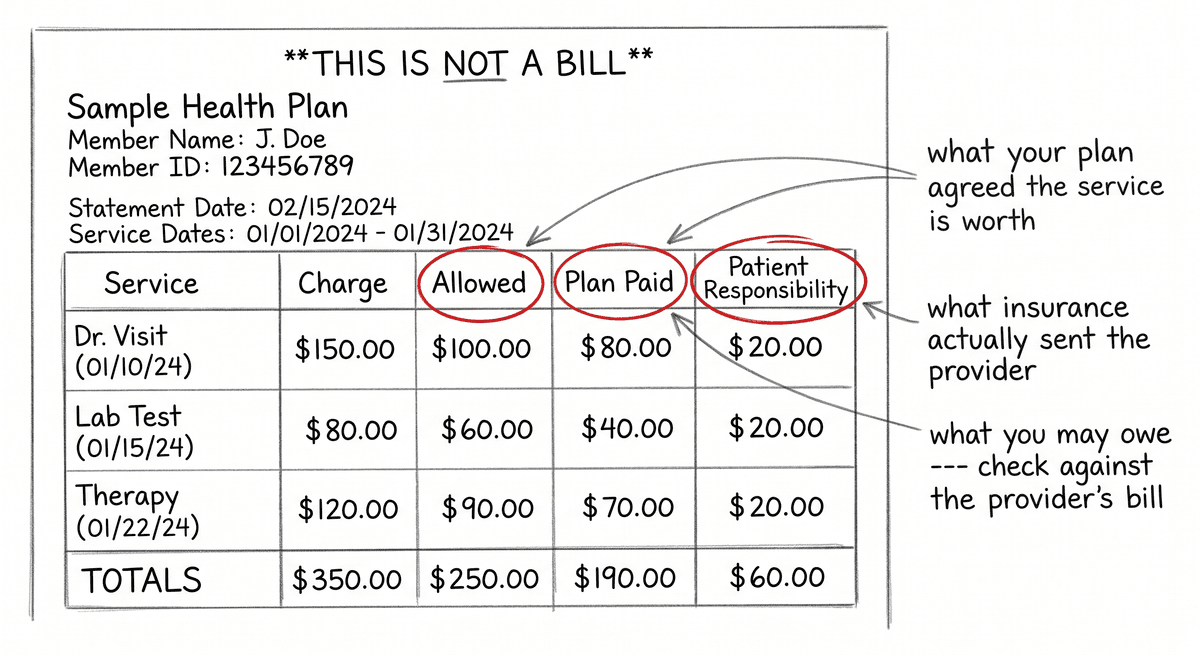
H-3: Decoding a Medical Bill or EOB (and Negotiating What You Owe)
Strategy: Decode + Assert See also: H-4: Appealing an Insurance Denial (if something looks wrong), M-4: Collections and Bankruptcy (if the bill becomes debt), M-6: Financial Coach (for insurance and costs) My Man Jeeves: The Explanation of Benefits is, in principle, a document intended to explain one’s benefits — a purpose it fulfils, one might venture, with considerable incompleteness. It presents procedure codes, allowed amounts, adjustments, and patient responsibility in a format that rather generously rewards confusion. The bill that follows presents a further difficulty: its stated price bears a variable, and largely notional, relation to what one might actually be asked to pay. Nonprofit hospitals are required by federal tax rule to maintain financial assistance programmes; they are not, however, required to volunteer the fact at the billing window. One’s Agent has read every code on the form and every provision of 26 U.S.C. § 501(r) — and is prepared both to translate and to negotiate. The Spec:
I received this medical bill / Explanation of Benefits and I don’t
understand it. [Paste the bill or EOB, removing your name and ID number.]

My situation:
[I can pay the full amount but want to make sure it’s correct /
I can pay some of it but not all / I cannot pay this /
this will go to collections if I don’t act / this is from a nonprofit
hospital / this is from a for-profit hospital or physician group]

Insurance status: [type, or uninsured]

Please:
1. Explain each line item in plain language
2. Flag anything that seems unusual or potentially incorrect
3. Tell me if there’s anything here I should dispute
4. Draft a script I can use to call the billing department, including
requesting an itemized bill, asking about financial assistance or
charity care, and asking about a cash-pay discount or a
no-interest payment plan
5. Tell me what rights I have if this has already gone to collections
Give me the most conservative, legally accurate answer.
I will verify with the billing office or a patient advocate
before disputing anything.
What to do with the Output: Compare every line to the original provider bill. If your Agent flags a charge as unusual, call the billing department and ask them to explain it. The person who calls is the person who gets the adjustment. The person who doesn’t call pays the first number they were given.
H-4: Appealing an Insurance Denial
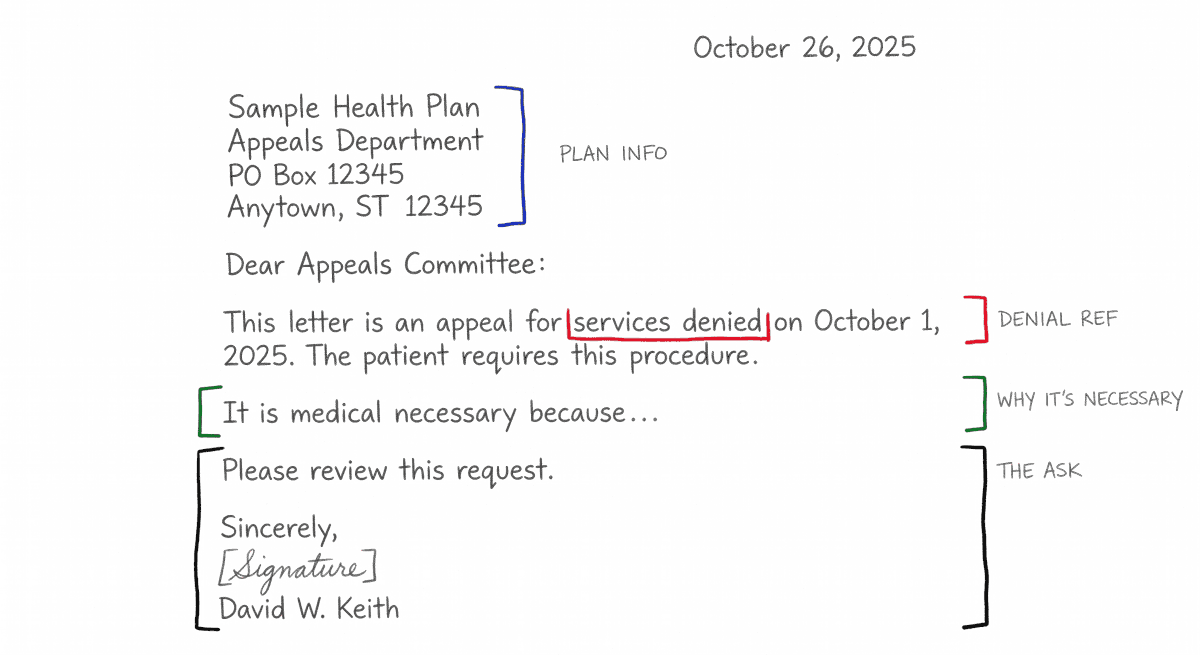
Strategy: Navigate + Draft See also: L-1: Negotiating a Contract (for understanding the policy itself), L-3: Writing a Demand Letter (same drafting technique, different context) My Man Jeeves: Insurance companies deny claims at a rate that, one observes, ensures a profitable percentage of denials are never contested — the appeal process requiring, as it does, that the policyholder be aware appeal is possible, conversant with the procedure for filing one, and in possession of sufficient energy to pursue the matter while already unwell. The industry appears to find this arrangement commercially sound. One’s Agent is conversant with the appeal process and is not, at present, unwell. The Spec:
My insurance denied [procedure/claim] with the reason: [paste denial reason].
The procedure was ordered by my doctor for [condition].
I want to file a [first-level internal / external / expedited] appeal.
My doctor can provide a letter of medical necessity.
Please draft an appeal letter that cites the denial reason,
references the right to appeal, and is firm without being
hostile — I may need to escalate further.
Give me the most conservative, well-grounded answer.
I will verify with my doctor before submitting.
What to do with the Output: Send the letter. Keep a copy with the date you sent it. If you have a deadline for the appeal (check your denial letter — it’s usually 30–180 days), mark it on your calendar. Follow up in writing if you don’t hear back within the stated timeframe.
Veterans note: VA benefits denials follow a separate system. The Appeals Modernization Act created three lanes: Supplemental Claim (VA Form 20-0995, for submitting new evidence), Higher-Level Review (VA Form 20-0996, for a senior reviewer to re-examine the existing record), and Board of Veterans’ Appeals appeal (VA Form 10182). Beyond the Board, the U.S. Court of Appeals for Veterans Claims (CAVC) is an independent federal court. Free representation is available through Veterans Service Organizations (VSOs). The civilian insurance appeal process described in this Skill does not apply to VA claims — ask your Agent to walk you through the VA-specific pathway.
H-5: Managing a Chronic Condition Day-to-Day
Strategy: Research See also: H-1: Understanding a Diagnosis, H-2: Preparing Questions, H-8: Wellness and Nutrition Coach My Man Jeeves: The diagnosis, if one may draw the distinction, is a moment. The condition is the remainder of one’s life. The medical system has been constructed principally for acute care — one arrives unwell, one departs treated. Chronic conditions do not accommodate themselves to this model with any great willingness. The 15-minute appointment every three months cannot, by its nature, address the 131,400 minutes between appointments. Those minutes fall to the patient to manage, largely without assistance, armed with whatever information one carried away from the last visit. One’s Agent is available for the other 131,400. The Spec:
I have [chronic condition] and I’ve been managing it for [time period].
My current treatment: [medications, therapy, lifestyle changes]
What’s working: [if anything]
What’s not working or what I’m struggling with: [be specific —
fatigue, medication side effects, flare triggers I can’t identify,
difficulty with compliance, emotional toll, cost]
Please help me:
1. Understand the current best practices for day-to-day management
2. Identify patterns or triggers I should be tracking
3. Suggest questions to ask my doctor at my next appointment
4. Point me toward support resources (online communities, organizations)
I will discuss any changes with my doctor before starting.
What to do with the Output: Start a symptom log. Even a simple daily note — what you ate, how you slept, pain level, energy level — gives your doctor data they cannot get any other way and gives your Agent the specificity to help you identify patterns. The log is the treatment between treatments.
Charmaz’s Good Days, Bad Days (1991) names what the medical system rarely does: chronic illness restructures the self. The person before the diagnosis is not the person after, and there is a grief for the life that was expected — separate from the pain, separate from the fatigue, separate from the losses of mobility or hearing or whatever else the condition quietly takes. This grief is not self-pity. It is a documented psychological process, and when it goes unnamed it worsens outcomes.[5] Your doctor, in a 15-minute visit, cannot hold it. Your family, who watched the change, may not have the vocabulary for it. Your Agent is not a therapist and cannot replace one — but it is a place where you can say these things in plain language and receive something back that does not flinch.
In 2003, Christine Miserandino explained lupus to a friend by handing her twelve spoons. Each task — showering, making breakfast, going to work — costs spoons, and when they run out, the day is over. Spoon theory was not peer-reviewed. It was named in a diner by a patient who needed a friend to understand, and it has since been cited in nursing literature because it did something their frameworks did not.
Science Note: The Stanford Chronic Disease Self-Management Program (Lorig et al., 1999) remains the best-studied model — a 952-person randomized trial showed reduced hospitalization, less health distress, and more exercise, effects since confirmed by a 23-study meta-analysis (Brady et al., 2013). The problem is reach: fewer than 500,000 Americans have completed a structured program in 15 years, against 194 million adults with at least one chronic condition. Online delivery produced comparable results to in-person groups, which suggests your Agent can approximate the structure — though not a room full of people who know what a bad day actually feels like.[6]
H-6: Understanding What Medicare Actually Covers
Strategy: Decode See also: H-4: Appealing an Insurance Denial, H-6b: Understanding What Medicaid Actually Covers, Li-4: Planning Care for Aging My Man Jeeves: Medicare is, in principle, straightforward: health insurance for Americans aged 65 and older, or younger if disabled. In practice, it is a four-part system (A, B, C, and D) with enrolment windows that close permanently, late-enrolment penalties that compound for life, and a private-plan alternative (Medicare Advantage) whose marketing budget rather substantially exceeds its obligations of transparency. The most consequential decision — whether to enrol in Original Medicare or an Advantage plan, and whether to purchase supplemental Medigap coverage — must be made during windows that the system does not go to great lengths to publicize. One’s Agent has read the enrolment rules and can explain which decisions apply to one’s circumstances before the window closes. The Spec:
I [or my family member] am [turning 65 / disabled / already enrolled
and reviewing my coverage] and I need to understand what
Medicare actually covers.
My situation: [state, current insurance, specific health needs]
Please explain:
1. What parts of Medicare apply to my situation
(Part A, B, C, D — in plain language)
2. What is NOT covered that people commonly assume is covered
3. Whether I should consider Medicare Advantage or stick with
Original Medicare — and what I give up either way
4. What supplemental (Medigap) coverage I should consider
and roughly what it costs
5. What deadlines or enrollment periods I need to know about
— especially penalties for missing them
Give me the most conservative, accurate answer — enrollment mistakes can be permanent.
What to do with the Output: Circle the deadlines. Medicare enrollment penalties are permanent — missing the initial enrollment period for Part B means a 10% premium increase for every 12-month period you delayed, for the rest of your life. This is the kind of structural penalty that rewards people who already understand the system. For Medicaid, long-term care, and dual eligibility, see H-6b.
H-6b: Understanding What Medicaid Actually Covers
Strategy: Decode See also: H-6: Understanding What Medicare Actually Covers, H-4: Appealing an Insurance Denial, Li-4: Planning Care for Aging My Man Jeeves: Medicaid occupies, in the public imagination, a rather narrower role than it in fact performs. It is not merely insurance for the very poor — it is the only major federal programme that covers long-term nursing-home care, a fact that approximately 62% of Americans attribute, incorrectly, to Medicare. Following the One Big Beautiful Bill Act of 2025, it is also, for the first time in its history, a programme with work requirements — requirements that the Congressional Budget Office estimates will remove 4.8 million people from coverage by 2034. The eligibility rules are state-specific, the asset limits for long-term care are unforgiving, and the application process assumes a degree of bureaucratic fluency that the populations it serves are, by definition, least likely to possess. One’s Agent has read the rules for one’s state and can explain what applies before the paperwork is due. The Spec:
I [or my family member] am [low-income / applying for long-term care /
helping a parent who may need a nursing home / recently lost coverage]
and I need to understand what Medicaid covers in my state.
My situation: [state, income level, assets, specific health needs,
whether this involves long-term care]
Please explain:
1. What Medicaid covers in my state — especially long-term care
2. What the income and asset limits are for eligibility
3. Whether work requirements apply to me and what exemptions exist
4. What happens to a spouse’s assets if one partner needs
nursing-home care (community spouse protections)
5. What the application process looks like and what deadlines matter
Give me the most conservative, accurate answer — Medicaid rules vary by state
and mistakes can cost years of eligibility.
What to do with the Output: Verify the state-specific details directly with your state Medicaid office or a certified application counselor — rules change annually and your Agent’s training data may lag. If long-term care is involved, consult an elder law attorney before transferring any assets; the 60-month look-back is unforgiving.
Veterans note: For World War II–era veterans — and for those who served in Korea, Vietnam, the Gulf War, or the post-9/11 period — VA pension with Aid and Attendance pays a Maximum Annual Pension Rate of up to $2,358 per month in 2025 for a single veteran, $2,795 for a married veteran, and $1,515 for a surviving spouse (figures are the MAPR inclusive of the Aid and Attendance increase, not a separate payment on top), to cover long-term care at home or in a facility.[17] The benefit requires 90+ days of active duty with at least one day during a congressionally recognized wartime period, and application is via VA Form 21-2680 (plus 21-0779 for nursing-home residents). Ask your Agent: “My [parent / grandparent / I] served in [branch, years, including any wartime dates]. What VA pension and long-term care benefits apply, and what forms, income documentation, and service records do we need?”
H-7: Preparing for End-of-Life Conversations with Aging Parents
Strategy: Prepare See also: Li-1: Preparing for a Difficult Conversation, Li-2: Writing a Eulogy, Li-4: Planning Care for Aging, L-1: Negotiating a Contract (for legal documents) My Man Jeeves: American culture maintains, as the research rather thoroughly documents, a pronounced aversion to discussing death. The consequence is that the most significant decisions of a person’s life — how they wish to be cared for, who is to make medical decisions should they be unable, what measures they do and do not desire — are left to family members attempting to guess under pressure in a hospital corridor. An advance directive requires approximately 30 minutes. The conversation that precedes it presents a rather greater difficulty. One’s Agent may be of assistance in preparing for it. The Spec:
I need to have a conversation with [my parent / family member]
about their end-of-life wishes. This conversation has not happened
yet [or: we started but didn’t finish / they are resistant].
Their situation: [age, health status, any recent changes]
My concern: [what makes this conversation hard — their denial,
family disagreements, cultural taboo, my own discomfort, not
knowing what to ask]
Please help me:
1. Prepare the key questions I need to ask — medical, legal, financial
2. Suggest how to open this conversation in a way that
does not feel like giving up
3. List the specific documents that should exist (advance directive,
healthcare proxy, power of attorney, will)
4. Tell me what happens if these documents don’t exist when they’re needed
What to do with the Output: The documents matter more than the conversation going perfectly. If the conversation goes badly, try again later. If the documents don’t exist when a crisis arrives, there is no later. Start with the healthcare proxy — it is the most immediately critical and the least emotionally charged of the documents. Five Wishes is a widely used advance directive written in plain language.
Not every family gets a clean opening to have this conversation — sometimes there is no denial or taboo to overcome, just a person who is still there, but not entirely themselves anymore.
Veterans note: Honorably discharged veterans and their eligible family members qualify for burial in a VA National Cemetery at no cost — plot, interment, headstone or marker, and perpetual care included — and a spouse or dependent child may be buried there even if they predecease the veteran, with their name inscribed on the shared headstone. Surviving families may request military funeral honors (two-person detail, flag presentation, Taps) through the funeral home or the National Cemetery Scheduling Office at 1-800-535-1117. VA burial allowance is $1,002 each for burial and plot for deaths on or after 1 October 2025 ($978 and $978 for the prior fiscal year), with higher amounts for service-connected deaths; apply via VA Form 21P-530EZ. Surviving spouses and dependent children of wartime-era veterans may also qualify for VA Dependency and Indemnity Compensation (DIC) or pension.[23]
H-8: Wellness and Nutrition Coach
Strategy: Research + Draft (Expert Role) See also: H-5: Managing a Chronic Condition (for condition-specific nutrition), Li-8: Wellness Coach (for mental health and journaling) My Man Jeeves: A registered dietitian typically charges between $100 and $200 per session, with new-patient waits commonly running several weeks. A personal trainer costs $50 to $150 per hour. A wellness coach charges rather more and is, one notes, rather less regulated. One’s Agent has acquainted itself with the same evidence base all three cite, and will apply it to one’s particular situation without the formality of a retainer. The Spec:
Act as a knowledgeable wellness and nutrition coach.
My situation:
— Age, general health: [brief description]
— Current eating patterns: [describe honestly]
— Goal: [lose weight / more energy / manage a condition /
eat better on a budget / something else]
— Constraints: [dietary restrictions, budget, time, cooking skill]
— What I’ve tried before: [if anything]
What would you recommend, and where should I start?
If any of this might conflict with a health condition, flag it.
What to do with the Output: Use it as a starting framework, not a prescription. If you have a specific health condition, verify any significant dietary changes with your doctor. The calibration question applies here: “How confident are you in this recommendation, and is there anything about my situation where you’d want me to check with a professional?”
Common wellness Expert Role specs:
Act as a nutrition coach. I want to eat better but I have
[budget constraint / time constraint / dietary restriction].
I currently eat [brief description].
What are the three highest-impact changes I could make
without overhauling everything at once?
Act as a personal trainer. I want to [goal] but I have
[constraint: bad knee / no gym / only 20 minutes / working
from home all day].
What’s a realistic starting routine?
Act as a wellness coach. I have been feeling [symptom:
low energy / poor sleep / constant stress] for [timeframe].
I am not looking for a diagnosis. I want to understand
what lifestyle factors might be contributing and what
I could adjust first.
Drugs: What the Egg Should Have Been
You are not dumb for being confused about drugs. You are navigating a system where the legal classification is political, the marketing is pharmaceutical, the enforcement is racial, and the science is locked behind a scheduling regime that makes it illegal to study the substances it claims are too dangerous to study. Your Agent reads the pharmacology, not the politics.
H-9: Understanding Your Prescription
Strategy: Decode See also: H-10: Checking for Drug Interactions, H-1: Understanding a Diagnosis My Man Jeeves: One’s physician prescribed a medication in a seven-minute appointment. The pharmacist furnished a stapled printout in 8-point type listing “side effects may include” followed by what one can only describe as every symptom known to medicine. The printout, one understands, is required by law. Comprehending it is not. One’s Agent, having read the pharmacology, is prepared to explain what the printout means in one’s specific case. The Spec:
My doctor prescribed [drug name] for [condition].
The dose is [amount, frequency].
I am also taking [list other medications, supplements, or herbs].
Please explain in plain language:
1. What this drug actually does in my body
2. The most common side effects vs. the rare but serious ones
3. What I should watch for in the first two weeks
4. Whether any of my other medications interact with this one
5. What happens if I miss a dose, and what happens if I stop
Do not assume any medical background on my part.
What to do with the Output: Use it to write your questions for your next appointment (see H-2). Do not change your dose or stop a medication based on your Agent’s answer alone — use the answer to have a better conversation with your doctor. If the interaction check in item 4 raises a flag, call your pharmacist before your next dose.
H-10: Checking for Drug Interactions
Strategy: Decode + Research See also: H-9: Understanding Your Prescription, H-8: Wellness and Nutrition Coach My Man Jeeves: The liver metabolizes roughly 75% of the drugs one takes by means of a family of enzymes known as CYP450. When two substances compete for the same enzyme, one of them accumulates — a circumstance that may present certain difficulties. The prescribing physician may not be aware of the supplement one’s naturopath recommended. The naturopath may not be aware of the prescription. Neither, one regrets to observe, may be aware of the grapefruit. One’s Agent is aware of all three. The Spec:
I am currently taking:
— Prescription medications: [list all, with doses]
— Over-the-counter medications: [list]
— Supplements or herbs: [list]
— Recreational substances: [list, be specific — including alcohol,
cannabis, nicotine]
Please check for:
1. Dangerous interactions between any of these
2. Interactions that reduce effectiveness of any of these
3. Anything I should not eat or drink with these
(including grapefruit, alcohol, caffeine)
4. Which of these I should not stop suddenly
Flag anything urgent first.
What to do with the Output: If your Agent flags a serious interaction, call your pharmacist — not your doctor’s office, your pharmacist. Pharmacists are drug interaction specialists. They are faster to reach and trained to answer exactly this question. Verify before adjusting anything.
H-11: Your Brain on Drugs, Simplified
Strategy: Research My Man Jeeves: Every psychoactive substance operates by altering the manner in which one’s brain cells communicate. That sentence, one might note, contains the entirety of what the egg commercial conveyed. The subsequent questions — how, and with what consequences, and at what dose, and for what duration — are where the useful information may be said to begin. One’s Agent is prepared to address them without recourse to eggs. The Spec:
Explain how [substance] works in the brain.
I want to understand:
1. Which neurotransmitter system it affects
(dopamine, serotonin, GABA, endorphins, etc.)
2. What the short-term effects are and why they happen
3. What happens with repeated use (tolerance, dependence)
4. What the difference is between physical dependence
and addiction for this substance
5. What the actual risk profile looks like — not “drugs are bad,”
but what the research says about harm at different levels of use
Use plain language. I want the pharmacology, not the moral lesson.
If this substance interacts dangerously with common medications, flag it even if I didn’t ask.
What to do with the Output: Use it as a baseline. If you or someone you know uses this substance, the mechanism of action tells you what to watch for. If the risk profile doesn’t match the legal classification, that’s not a glitch — it’s the point of asking.
H-12: Talking to Your Doctor About Pain Management
Strategy: Prepare + Assert See also: H-2: Preparing Questions Before a Doctor’s Appointment, H-9: Understanding Your Prescription My Man Jeeves: The opioid crisis has, one observes, produced two populations of individuals who cannot obtain adequate care: those with addiction who require treatment, and those with pain who require management. Physicians, situated as they are between DEA scrutiny and patient suffering, now on occasion undertreat pain from what one might characterize as liability apprehension. It may prove necessary to advocate for oneself — not to obtain opioids specifically, but to secure an honest conversation regarding all available options. One’s Agent can help one prepare for that conversation. The Spec:
I have [type of pain: chronic back pain / post-surgical / nerve pain /
arthritis / migraines / other] that has been going on for [duration].
What I’ve tried: [list treatments, medications, therapies]
What’s worked: [if anything]
What hasn’t: [if anything]
My concern: [fear of addiction / doctor won’t take it seriously /
current medication isn’t working / side effects are too much]
Help me prepare for a conversation with my doctor.
I want to:
1. Describe my pain accurately using medical terminology
2. Understand all my options (not just medication)
3. Know what questions to ask about risks and alternatives
4. Have language that is assertive without being combative
Give me the most conservative, medically accurate answer.
I will verify everything with my doctor.
What to do with the Output: Bring it to the appointment. The clinical terminology your Agent provided is a tool — it signals that you’ve done your homework and makes dismissal harder. If the doctor still won’t engage, ask them to document their refusal in your chart.
Veterans note: VA chronic pain management operates under the Opioid Safety Initiative (OSI), which emphasizes evidence-based alternatives — physical therapy, cognitive behavioral therapy, acupuncture — alongside medication when appropriate. Under the PACT Act (2022), conditions linked to toxic exposures (burn pits, Agent Orange) that cause chronic pain may qualify for presumptive service connection, simplifying the claims process. If your local VA facility cannot meet access standards — drive time over 60 minutes or wait time over 28 days for specialty care — you may be eligible for community care through the VA Community Care Network. Ask your Agent for current eligibility criteria.
H-13: Understanding Addiction (and Finding Help That Works)
Strategy: Research + Navigate See also: H-14: Harm Reduction, M-6: Financial Coach (for insurance and costs)
My Man Jeeves: Addiction is not, as the relevant authorities have taken some pains to establish, a failure of willpower. The American Society of Addiction Medicine and the National Institute on Drug Abuse classify it as a chronic brain disorder involving compulsive use despite harmful consequences. The distinction is of some importance, as it determines whether the appropriate response is treatment or punishment. The United States has, for the most part, favoured punishment. Where it has favoured treatment, the industry it has built operates under less regulatory oversight than the restaurant industry — some facilities excellent, some predatory, the distinction rarely apparent from the website. The task, then, is twofold: to understand the condition as medicine now describes it, and to navigate a marketplace that does not reliably distinguish evidence-based care from something else. One’s Agent holds no position beyond the evidence. The Spec:
I am trying to understand [my own / my loved one’s] substance use,
and/or find help.

Where I am right now:
[I’m worried but not sure this qualifies as a problem /
I know it’s a problem and I’m trying to understand it /
I’m ready to get help and need to find the right kind /
this is an emergency]

The substance(s): [alcohol / opioids / stimulants / other]
Location: [city, state — if we’re looking for treatment]
Insurance: [type, or uninsured]

My own history with substances: [brief — for context on how
I’m going to talk about this]

Please help me understand and/or act:
1. The difference between tolerance, physical dependence,
and addiction — these are three different things
2. What the current science says about why some people are
more vulnerable than others
3. If treatment is needed: what types exist (inpatient,
outpatient, MAT, 12-step, non-12-step) and which have
the strongest evidence for [substance]
4. How to evaluate a treatment facility — what are the red flags
5. What my insurance is required to cover (Mental Health Parity Act)
6. What options exist if I’m uninsured or underinsured
7. What to do right now — tonight — if this is urgent
I will verify treatment recommendations with a medical professional.
What to do with the Output: If you’re looking for treatment, start with findtreatment.gov — SAMHSA’s locator lets you search by substance, location, insurance, and treatment type — and use the red-flag checklist to screen facilities. If this is for someone you care about, the output is also preparation for the conversation with them — see Li-1.
Science Note: Tolerance means your body adapts to a substance so you need more for the same effect. Physical dependence means your body has adapted so that stopping causes withdrawal symptoms. Addiction (substance use disorder) means compulsive use despite negative consequences, driven by changes in the brain’s reward and decision-making circuits. You can be physically dependent without being addicted, and addicted without physical dependence. Genetic factors account for roughly 40–60% of addiction vulnerability, which is why some people can use a substance casually and others cannot.[29]
Veterans note: Vet Centers offer free, confidential counseling in community-based settings separate from VA medical centers — for combat veterans, military sexual trauma (MST) survivors, and their families. Walk-ins are welcome at most of the 300+ locations; call 1-877-927-8387 for the nearest center. VA Substance Use Disorder (SUD) treatment integrates addiction care with mental health services (PTSD, TBI, depression) — a structural advantage over civilian pathways, where these are often treated separately. Active-duty service members can access confidential support through Military OneSource (800-342-9647), which remains available for 365 days after separation.
H-14: Harm Reduction
Strategy: Research + Diagnose See also: H-13: Understanding Addiction, H-10: Checking for Drug Interactions My Man Jeeves: In 2023, approximately 105,000 Americans died of drug overdoses — a figure exceeding car accidents and gun deaths combined. Roughly 69% involved synthetic opioids, principally fentanyl, which is frequently present in drugs sold as something else entirely.[31] Harm reduction proceeds from the premise that some people use drugs, and that the most serviceable response is to keep them alive and as healthy as circumstances permit. This remains controversial in rather the same manner that seatbelts were controversial in 1965 — opponents contending that they would encourage reckless driving. They did not. They reduced deaths. The evidence for harm reduction is, one finds, comparably robust. One’s Agent can explain the evidence and the local resources without editorializing. The Spec:
I want to understand harm reduction for [substance or situation].
My situation: [I use X occasionally / someone I care about uses X /
I want to understand the approach generally]
Please give me:
1. The specific risks associated with this substance
and how to reduce each one
2. What signs indicate use is becoming problematic
3. What tools exist (naloxone, fentanyl test strips,
supervised use, safer use practices)
4. Where to find local resources without involving law enforcement
Be direct. I am not looking for a lecture. I am looking for
information that keeps people alive.
Err on the side of caution.
What to do with the Output: Save the safety information where you can reach it fast. If naloxone came up, get it before you need it — it’s over the counter at most pharmacies. If the information is for someone else, share it without a lecture attached.
H-15: Navigating Drug Laws in Your State
Strategy: Navigate + Assert See also: C-3: Understanding Your Rights Where You Live My Man Jeeves: Cannabis is legal in one’s state and a federal crime. Psilocybin is decriminalized in one’s city yet a felony in the neighbouring county. Kratom is banned in several states and available at the gas station in the other 44. The legal landscape for drugs in the United States is not, one feels compelled to observe, a landscape in any coherent sense. It is rather a patchwork quilt sewn by 50 different legislatures, several federal agencies, and occasional ballot initiatives — each operating on a different timeline and, in certain cases, a different century’s understanding of pharmacology. One’s Agent can clarify the law as it stands in one’s specific jurisdiction, which is the only jurisdiction that matters. The Spec:
I want to understand the current drug laws where I live.
My location: [city, state]
What I want to know about: [cannabis / psilocybin / kratom /
prescription drug possession / drug paraphernalia / other]
Please tell me:
1. What is legal, decriminalized, or illegal in my jurisdiction
2. What the actual penalties are (not the maximum — the typical)
3. Whether my state has any diversion or treatment-instead-of-
prosecution programs
4. What my rights are if I am stopped or searched
5. How this differs from federal law, and when federal law applies
Give me the most conservative, accurate answer.
H-16: Evaluating Psychedelic Therapy
Strategy: Research + Decide See also: H-1: Understanding a Diagnosis, H-11: Your Brain on Drugs My Man Jeeves: Psychedelic-assisted therapy represents, one might suggest, the most promising and most overhyped development in mental health treatment since SSRIs. Clinical trials for psilocybin in depression and MDMA in PTSD have produced significant results. The FDA declined to approve MDMA therapy in 2024, citing trial design concerns, ethical violations at trial sites, and data integrity issues.[36] Psilocybin trials continue. In the meantime, unregulated ketamine clinics have proliferated, Oregon has legalized psilocybin services outside the medical system, and the gap between the research and the marketplace has grown sufficient to accommodate, one estimates, a modestly sized retreat centre. One’s Agent can help one evaluate the evidence for a specific treatment against its current legal and clinical standing. The Spec:
I am interested in psychedelic therapy for [depression / PTSD /
anxiety / end-of-life distress / addiction / personal growth].
I want to understand:
1. What the clinical evidence actually shows — not the hype
2. What is currently legal and regulated where I am ([state])
3. What the difference is between a clinical trial, a state-regulated
service (like Oregon’s program), and an unregulated retreat
4. What the risks are, including for people with [any relevant
conditions: family history of psychosis, bipolar, heart conditions,
current medications]
5. What questions I should ask any provider before committing
I want the science and the skepticism, not the marketing.
What to do with the Output: Use the provider questions as a screening checklist. If a provider can’t answer them directly, that tells you something. Do not proceed with any substance your Agent flagged as risky for your specific conditions or medications without discussing it with your doctor.
H-17: Talking to Your Kids About Drugs (and Unlearning What You Were Told)
Strategy: Prepare + Research See also: Li-1: Preparing for a Difficult Conversation, Li-7: Raising Kids, H-13: Understanding Addiction, H-14: Harm Reduction My Man Jeeves: D.A.R.E. instructed a generation that marijuana and heroin belonged to the same category of threat, and that the appropriate response to all drugs was refusal. When those children discovered that marijuana did not, in the event, ruin their lives, a considerable number concluded that the adults had been unreliable on every point — including those substances that were genuinely dangerous. Those children are now parents. The War on Drugs that shaped their education has cost, by the Bureau of Justice Statistics, over $1 trillion and, at its peak, imprisoned 2.1 million Americans — with Black Americans held for drug offences at nearly six times the rate of white Americans despite comparable usage rates.[38] The task before today’s parent is therefore twofold: to unlearn what D.A.R.E. taught, and to pass on to one’s children what is, on the documentary record, actually the case. One’s Agent has read the Bureau’s own data. The Spec:
I want to talk to my [age] year old about drugs.
My situation: [they haven’t asked yet / they asked about something
specific / I found something / their friends are using /
I want to be proactive]
My own history with substances: [brief — this affects credibility]
My own education about drugs: [D.A.R.E. / Just Say No / family
messaging — this is what I may need to unlearn before I can
pass on something accurate]
What I’m worried about: [specific concern]

Please help me:
1. Understand what is developmentally appropriate to discuss at this age
2. Identify where my own beliefs about drugs came from propaganda
rather than evidence — so I don’t repeat it
3. Prepare an honest, science-based explanation of the substances
most common among [age group] right now, with the actual
documented risks (not the D.A.R.E. version)
4. Explain the difference between decriminalization and legalization,
what other countries have tried, and what the outcomes have been
5. Have a response ready for “but you did it too” if applicable
6. Keep the conversation open rather than shut it down

The goal is that my kid trusts me enough to come to me when it
matters, because the information I give them matches what they
will later discover to be true.
What to do with the Output: Have the conversation, not the lecture. Teens who report having honest, ongoing conversations with parents about drugs (not one-time “talks”) show lower rates of problematic use.[39] The key word is ongoing. This is not a single conversation. It is a relationship — and the substrate of the relationship is the truth. The parent who repeats D.A.R.E. talking points teaches their teen to distrust them. The parent who says “I was told this, the research actually shows that, and here is how I know” teaches their teen to evaluate information the way the parent is now evaluating it.
Mental Health
H-18: Mental Health First Aid (Helping Someone in Crisis, Including Yourself)
Strategy: Prepare + Assert + Navigate See also: H-13: Understanding Addiction (and Finding Help That Works), Li-1: Preparing for a Difficult Conversation, Li-7: Raising Kids
My Man Jeeves: A mental-health crisis — one’s own, or that of a family member, a colleague, or a stranger — tends to arrive without sufficient notice. The expectation, nevertheless, is that the bystander will know what to do; the training, however, has been reserved largely for clinicians and first responders. The 988 Suicide and Crisis Lifeline, established in July 2022 specifically to provide an alternative to the police-dispatch default, has since answered a volume of calls one might fairly describe as considerable — and 88% of its suicidal callers report that the conversation stopped them from acting, an outcome the 911 system is not designed to produce.[41] One’s Agent has read the evidence-based Mental Health First Aid curriculum and can rehearse with one what the crisis itself will not permit. The Spec:
I am trying to prepare for — or am currently encountering —
a mental health crisis.

The situation:
[a friend / family member / coworker / I myself / someone I
don’t know well] is [showing warning signs of suicidal thinking /
in acute distress / experiencing a panic attack / using substances
dangerously / dissociating / otherwise in what feels like
a mental-health emergency]

What I can observe: [brief description — what they’ve said,
done, or changed; anything they have access to that concerns me]

What I know about them: [relevant history — diagnoses, prior
crises, supports they do or don’t have; if I don’t know, say so]

What I’m afraid of getting wrong: [being too intrusive / not
being intrusive enough / saying the wrong thing / calling 911
when I shouldn’t / not calling when I should]

Please help me:
1. Use the Mental Health First Aid framework (ALGEE) to prepare
what to say and do, in order
2. Name the specific things NOT to say, per AFSP safe-messaging
guidelines
3. Tell me when 988 is the right call and when 911 is the right
call, and what to say when I dial each
4. Identify specialized services that may apply (Veterans Crisis
Line, Trevor Project, Trans Lifeline, local mobile crisis team
if you can find one for my area)
5. Tell me how to take care of myself afterward, because
bystanders carry this too

Give me the most conservative guidance. If there is any chance
of imminent harm, say so clearly.
What to do with the Output: You will not remember all of this in the moment. Save it somewhere you can reach in 60 seconds — Notes app, a starred email to yourself, a named file your Agent can recall, or your phone’s emergency-info card. The real-time version of you will not plan; the calmer version already has.
Science Note: Mental Health First Aid’s action plan is ALGEE — Assess for risk of suicide or harm, Listen non-judgmentally, Give reassurance and information, Encourage appropriate professional help, and Encourage self-help and other support strategies — an evidence-based curriculum shown to improve responders’ recognition of crisis symptoms and confidence in helping someone in distress; the steps are flexible rather than strictly sequential.[42] One under-appreciated finding: asking direct questions such as “Are you thinking about suicide?” does not plant the idea — a 30-plus-year evidence base shows such questions reduce risk by naming what the person is already thinking.[43]
-
[1] Roter, D.L. (1989). “Which facets of communication have strong effects on outcome — a meta-analysis,” in Communicating with Medical Patients, ed. Stewart, M. & Roter, D.L. (SAGE), 183–196.↩
-
[2] Levey, N.N. (2022). “Hundreds of Hospitals Sue Patients or Threaten Their Credit, a KHN Investigation Finds. Does Yours?” KFF Health News, December 21, 2022. Part of the Diagnosis: Debt investigation series; see also Levey, N.N., “Patients Eligible For Charity Care Instead Get Big Bills.”↩
-
[3] Messac, L., Janke, A.T., Rogers, L.H., Fonfield, I., Walker, J., Rushbanks, E., Becker, N.V., & Bai, G. (2024). “US Nonprofit Hospitals Have Widely Varying Criteria To Decide Who Qualifies For Free And Discounted Charity Care.” Health Affairs, 43(11), 1569–1577.↩
-
[4] Kaiser Family Foundation (2023). “Claims Denials and Appeals in ACA Marketplace Plans.” The appeal success rate data makes the low filing rate one of the most consequential information asymmetries in American healthcare.↩
-
[5] Charmaz, K. (1991). Good Days, Bad Days: The Self in Chronic Illness and Time. Rutgers University Press.↩
-
[6] Lorig, K.R. et al. (1999). “Evidence suggesting that a chronic disease self-management program can improve health status while reducing hospitalization.” Medical Care, 37(1), 5–14. Brady, T.J. et al. (2013). “A Meta-Analysis of Health Status, Health Behaviors, and Health Care Utilization Outcomes of the Chronic Disease Self-Management Program.” Preventing Chronic Disease, 10:E07. Lorig, K.R. et al. (2006). “Internet-based chronic disease self-management: a randomized trial.” Medical Care, 44(11), 964–971.↩
-
[7] Gaffney, A., Himmelstein, D.U., & Woolhandler, S. (2022). “Prevalence and Correlates of Patient Rationing of Insulin in the United States.” Annals of Internal Medicine, 175(11), 1623–1626. See also Fang, M. & Selvin, E. (2023). “Cost-Related Insulin Rationing in US Adults Younger Than 65 Years With Diabetes.” JAMA, 329(19), 1700–1702. CDC/NCHS Data Brief No. 470 (2023). “Characteristics of Adults Aged 18–64 Who Did Not Take Medication as Prescribed Due to Cost.” On deaths attributable to non-adherence, see Osterberg, L. & Blaschke, T. (2005). “Adherence to Medication.” NEJM, 353(5), 487–497.↩
-
[8] MACPAC/MedPAC. “Beneficiaries Dually Eligible for Medicare and Medicaid Data Book,” January 2024. SHIP is administered by the Administration for Community Living.↩
-
[9] Kaiser Family Foundation, “An Overview of the Medicare Part D Prescription Drug Benefit.” See also Inflation Reduction Act of 2022, Section 11201.↩
-
[10] Ochieng, N., Biniek, J.F., & Neuman, T. (2025). “Medicare Advantage in 2025: Enrollment Update and Key Trends.” KFF. CBO projections from the 2025 Medicare baseline.↩
-
[11] Biniek, J.F. et al. (2025). “Medicare Advantage Insurers Made Nearly 53 Million Prior Authorization Determinations in 2024.” KFF. Insurer-level denial rates drawn from the same analysis.↩
-
[12] KFF. “Medigap Enrollment and Consumer Protections Vary Across States.” See also Medicare.gov, “Can I switch or drop my Medigap policy?” The federal 12-month Medicare Advantage trial right is limited; broader state protections exist only in CT, MA, ME, and NY.↩
-
[13] Congressional Budget Office (2025). Cost estimate, One Big Beautiful Bill Act, Medicaid provisions. See also KFF, “A Closer Look at the Work Requirement Provisions in the 2025 Federal Budget Reconciliation Law.”↩
-
[14] KFF, “7 Charts About Public Opinion on Medicaid.” See also KFF Health Tracking Poll, “The Public’s Views on Potential Changes to Medicaid.”↩
-
[15] Federal Reserve Board. 2022 Survey of Consumer Finances. Median retirement account balance for households with reference person ages 55–64. See also CRS, “Distribution of Retirement Account Balances: Analysis of the 2022 Survey of Consumer Finances.”↩
-
[16] Genworth & CareScout. “Cost of Care Survey 2024.” National annual median for a semi-private nursing home room, up 7% from 2023. Private-room median: $127,750. Medicaid long-term care asset limits and look-back rules vary by state; for a current overview, see American Council on Aging / Medicaid Planning Assistance.↩
-
[17] U.S. Department of Veterans Affairs. “VA Aid and Attendance benefits and Housebound allowance.” 2025 maximum annual pension rates published by VA; the figures cited convert to monthly. Wartime period definitions are set by statute (38 U.S.C. § 1521); WWII, Korea, Vietnam, the Gulf War, and post-9/11 are all congressionally recognized.↩
-
[18] Yadav, K.N. et al. (2017). “Approximately One In Three US Adults Completes Any Type Of Advance Directive For End-Of-Life Care.” Health Affairs, 36(7), 1244–1251.↩
-
[19] Rao, J.K. et al. (2014). “Completion of Advance Directives Among U.S. Consumers.” American Journal of Preventive Medicine, 46(1), 65–70. On demographic and religious factors in possession rates, see Harrison, K.L. et al. (2016). “Racial and Ethnic Differences in Advance Directive Possession.” Journal of the American Geriatrics Society. On the historical basis for distrust, see Washington, H.A. (2006). Medical Apartheid: The Dark History of Medical Experimentation on Black Americans. Doubleday.↩
-
[20] For an overview of cultural frameworks in palliative and end-of-life care, see BMC Palliative Care (2023), “A qualitative exploration of allied health providers’ perspectives on cultural humility in palliative and end-of-life care”; EthnoMed, “Cultural Considerations for End-of-Life Discussions: A Literature Review”; and Palliative Care Network of Wisconsin, “Culturally Responsive Care for Patients with a Serious Illness.”↩
-
[21] Boss, P. (1999). Ambiguous Loss: Learning to Live with Unresolved Grief. Harvard University Press. See also Boss, P. (2011). Loving Someone Who Has Dementia: How to Find Hope While Coping With Stress and Grief. Jossey-Bass.↩
-
[22] CaringInfo (National Hospice and Palliative Care Organization). National POLST. Five Wishes state requirements.↩
-
[23] U.S. Department of Veterans Affairs. “Veterans burial allowance and transportation benefits”; “Eligibility for burial in a VA national cemetery”; “Burial and memorial benefits for family members”.↩
-
[24] West, S.L. & O’Neal, K.K. (2004). “Project D.A.R.E. Outcome Effectiveness Revisited.” American Journal of Public Health, 94(6), 1027–1030. A 2002 NIDA-commissioned evaluation of anti-drug media campaigns found no significant effect on reducing drug use.↩
-
[25] Buchanan, D.R. & Wallack, L. (1998). “This Is the Partnership for a Drug-Free America: Any Questions?” Journal of Drug Issues, 28(2), 206–224. Documents funding from Philip Morris, RJR Nabisco, and Anheuser-Busch based on the organization’s federal tax filings. See also Cotts, C. (1992). “Hard Sell in the Drug War.” The Nation, March 9, 1992.↩
-
[26] Nutt, D.J., King, L.A., & Phillips, L.D. (2010). “Drug harms in the UK: a multicriteria decision analysis.” The Lancet, 376(9752), 1558–1565.↩
-
[27] Boyer, E.W. & Shannon, M. (2005). “The Serotonin Syndrome.” New England Journal of Medicine, 352(11), 1112–1120.↩
-
[28] Hoffman, K.M. et al. (2016). “Racial bias in pain assessment and treatment recommendations.” Proceedings of the National Academy of Sciences, 113(16), 4296–4301.↩
-
[29] Koob, G.F. & Volkow, N.D. (2016). “Neurobiology of Addiction: A Neurocircuitry Analysis.” The Lancet Psychiatry, 3(8), 760–773.↩
-
[30] Wakeman, S.E. et al. (2020). “Comparative Effectiveness of Different Treatment Pathways for Opioid Use Disorder.” JAMA Network Open, 3(2), e1920622.↩
-
[31] CDC National Center for Health Statistics. (2024). “Drug Overdose Deaths: Final Data for 2023.” NCHS Data Brief No. 522.↩
-
[32]
- “Naloxone: The Opioid Reversal Drug That Saves Lives.” Updated 2023.
-
[33] Peiper, N.C. et al. (2019). “Fentanyl test strips as an opioid overdose prevention strategy.” International Journal of Drug Policy, 63, 122–128.↩
-
[34] EMCDDA. [Portugal Country Drug Report.](https://www.euda.europa.eu/publications/country-drug-reports/2017/portugalen)_ European Monitoring Centre for Drugs and Drug Addiction, various years.↩
-
[35] Drug Enforcement Administration. “Schedules of Controlled Substances: Rescheduling of Marijuana.” 89 Fed. Reg. 44597 (proposed May 21, 2024). The NPRM proposed moving cannabis from Schedule I to Schedule III; DEA received over 42,000 comments and scheduled an administrative hearing, which stalled when the ALJ postponed it in January 2025 and retired without a replacement. In April 2026, DOJ issued an order immediately placing state-licensed medical cannabis in Schedule III, terminated the stalled proceedings, and restarted an expedited hearing process on broader rescheduling; as of this writing, a final rule on adult-use cannabis is still pending. See Foley Hoag LLP. (2026). “DOJ Immediately Reschedules State-Licensed Medical Cannabis to Schedule III and Restarts the Clock.”↩
-
[36] The decision came as a Complete Response Letter to Lykos Therapeutics, announced August 9, 2024; the FDA released the letter publicly in September 2025.↩
-
[37] Therapeutic Goods Administration, Australia. (2023). “Rescheduling of psilocybin and MDMA.” The approval is limited to specific psychiatric uses under specialist supervision.↩
-
[38] Incarceration figures: The Sentencing Project, “Mass Incarceration Trends” (360,000 in 1972; peak 2.1 million by 2019). Racial disparity: Bureau of Justice Statistics, “Prisoners in 2021” — Black Americans incarcerated for drug offenses at approximately six times the rate of white Americans despite comparable usage rates. The $1 trillion enforcement figure is a commonly cited cumulative estimate; see Drug Policy Alliance, “The Drug War, Mass Incarceration and Race” for a representative accounting.↩
-
[39] SAMHSA. “Talk. They Hear You.” Campaign and associated research. Substance Abuse and Mental Health Services Administration.↩
-
[40] Baum, D. (2016). “Legalize It All.” Harper’s Magazine, April 2016.↩
-
[41] Panchal, N. et al. “988 Suicide & Crisis Lifeline: Two Years After Launch” and “Demand for 988 Continues to Grow at Third Anniversary.” KFF. The 16.5M-contact figure covers the three years from July 2022 to July 2025. On outcomes, see also Gould, M.S. et al. (2022), “National Suicide Prevention Lifeline: Evaluation of Crisis Call Outcomes.”↩
-
[42] Hadlaczky, G. et al. (2014). “Mental health first aid is an effective public health intervention for improving knowledge, attitudes and behaviour: A meta-analysis.” International Review of Psychiatry. See also Maslowski, A.K. et al. (2022). “Mental Health First Aid: A Systematic Review of Trainee Behavior and Recipient Mental Health Outcomes.” Community Mental Health Journal. The U.S. curriculum is administered by Mental Health First Aid USA through the National Council for Mental Wellbeing.↩
-
[43] Dazzi, T. et al. (2014). “Does asking about suicide and related behaviours induce suicidal ideation? What is the evidence?” Psychological Medicine, 44(16), 3361–3363. For the practical framing, see American Foundation for Suicide Prevention, “How to Talk Safely About Suicide.”↩
-
[44] National Alliance on Mental Illness, “988: Reimagining Crisis Response.” SAMHSA, National Survey of Mobile Crisis Teams (2024). On CAHOOTS, Albuquerque, and the 911 data review, see The Marshall Project, “Sending Unarmed Responders Instead of Police: What We’ve Learned” (2024).↩
-
[45] American Foundation for Suicide Prevention, “How to Talk Safely About Suicide”; Suicide Prevention Resource Center, “Safe and Effective Messaging and Reporting”; Action Alliance Framework for Successful Messaging; VA, “Safe Messaging Best Practices Guide.”↩