Strategy 8: Assert
Know and exercise your rights in a situation where the other party is betting you don’t.
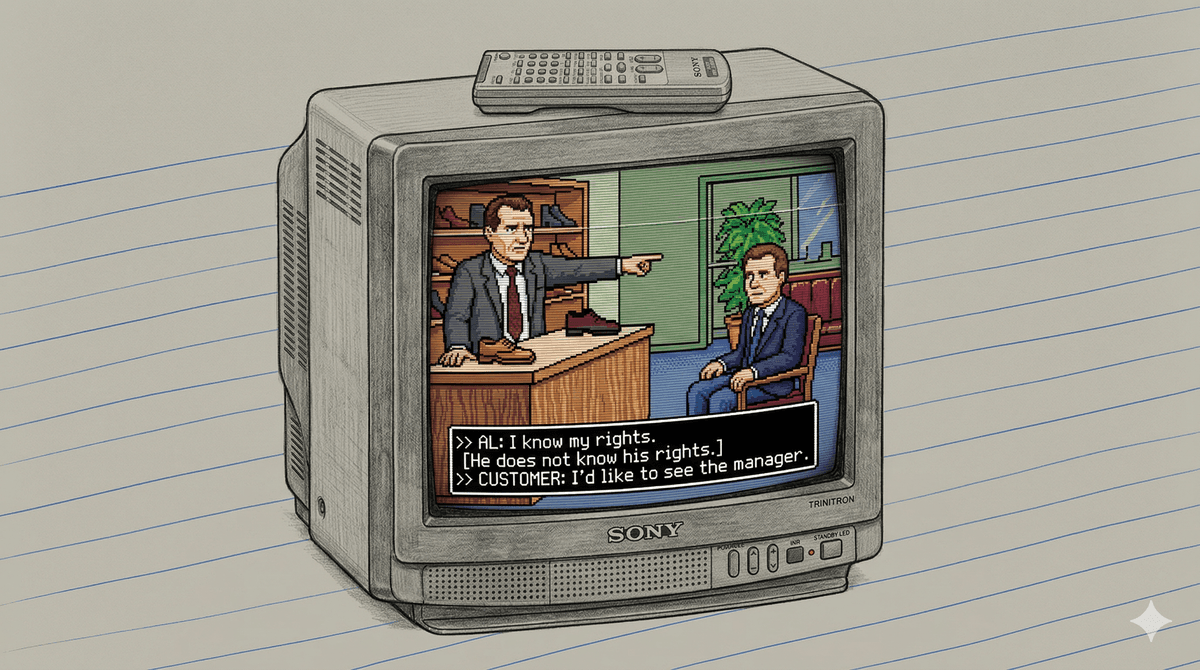
The episode: Every episode. Al Bundy, shoe salesman, patriarch of a household on the wrong side of every system he encounters, spends eleven seasons of television being correct about the unfairness of his situation and almost entirely unable to do anything about it. His employers underpay him. His neighbors outmaneuver him. The institutions he deals with assume he doesn’t know his rights, and they are correct — not because he doesn’t have them, but because he cannot specify, document, or exercise them in a form that produces outcomes.
Al knows he’s being treated unfairly. He cannot translate that knowledge into action. Knowing you have rights and knowing how to exercise them are two different skills. Al has the first one.
The lesson: The insurance company, the landlord, the employer, and the HOA all operate with a shared assumption: that you don’t know what the law actually says about your situation. The billionaire class does not deal with institutions on these terms. Their lawyers know the statute. Their HR departments know the employment code. Their property managers know the tenant rights ordinance — specifically so they can operate right up to its edge. Your Agent has read the same law. The other party already knows what it says. Now you can too.
My Man Jeeves: Mr. Bundy’s observation, that the institutions he dealt with were not configured in his favour, was entirely correct, and his inability to do anything about it was not for lack of principle — he had principles in abundance — but for the rather more practical circumstance that knowing one possesses a right and knowing the form one fills out to exercise it are skills which bear only a distant relation to one another. The second skill is the one the institution is, on most days, wagering one does not have.
They are right often enough that the assumption is profitable. Every appeal that never gets filed, every deposit that never gets disputed, every fee that gets paid because arguing felt hopeless confirms the bet the institution is making on your ignorance. Assert is about changing the odds — not by hiring a lawyer, but by walking into the exchange knowing exactly what the other party already knows.
What Assert is for: Any situation where you suspect the other party is relying on your ignorance of your rights to get an outcome they want.
The core spec pattern:
I am a [tenant/employee/consumer/patient] in [state] and
[situation]. I believe [other party] may be [action that
seems unfair or illegal]. I want to know:
1. What are my actual legal rights in this situation?
2. What would I need to document or preserve?
3. What is the first step I should take?
Please give me the most conservative, well-grounded answer —
I’ll verify with a legal aid organization before acting.
In the Field Guide: Ho-4 (Renter Rights), W-2 (Leaving a Job), M-4 (Collections), C-1 (Police Encounters), H-15 (Drug Laws).
Worked examples: Tenant rights when a landlord refuses repairs. Employee rights when let go without a clear reason. Consumer rights when disputing a charge.
Example 1: A Landlord Who Won’t Fix the Heat
The situation: your heat has been out for 11 days. It’s been below freezing outside for most of them. You’ve texted your landlord three times; the only reply was “I’ll look into it.” You don’t want to sue anyone. You want the heat fixed — or to know exactly what you’re allowed to do if it isn’t.
Your opening message:
My landlord hasn’t fixed my heat in 11 days. I’ve texted
three times. It’s [state], it’s been below freezing.
What can I actually do?
Your Agent’s clarifying questions:
Eleven days without heat in freezing weather is a serious
habitability problem, not just an inconvenience. A few
questions before I lay out your options:

1. What state and city are you in?
2. Is this a month-to-month lease or a fixed term?
3. Have any of your requests been in writing — email,
tenant portal — or only texted?
4. Does your lease say anything about how repair requests
are supposed to be made?
5. What do you actually want — heat fixed fast, or are you
open to breaking the lease if this keeps happening?
Your answers:
1. Ohio.
2. Month-to-month.
3. Only texts so far.
4. Lease doesn’t say anything about a repair process.
5. I want it fixed fast. I’m not ruling out moving if
this keeps up.

Give me the most conservative, legally accurate answer.
I will verify with a tenant rights organization or attorney.
Your Agent’s assessment:
Ohio law requires your landlord to supply reasonable heat
and recognizes an implied warranty of habitability — this
is illegal, not just frustrating.[2] But here is the
part most people get wrong: Ohio does not let you withhold
rent or pay for repairs yourself and deduct the cost. The
actual mechanism is different, and more procedural:

1. WRITTEN NOTICE, TODAY. Your texts probably count, but
a dated email or certified letter starts the legal
clock cleanly. Describe the outage and cite the statute.
2. THE CURE PERIOD. Ohio generally gives a landlord “a
reasonable time” or 30 days, whichever is sooner — but
for a condition that threatens health, like no heat in
freezing weather, courts and tenant advocates treat
that window as far shorter, commonly around 14 days.
3. IF 14 DAYS PASS WITHOUT ACTION: you deposit your rent
with the clerk of courts — not with the landlord, and
not by simply withholding it. From there, the court can
order the repair, authorize you to fix it and deduct
the cost, or release the funds. Stopping payment
outright, instead of depositing it with the court, is
what exposes tenants to an eviction filing they didn’t
need to risk.
4. RETALIATION IS SEPARATELY ILLEGAL. Once you’ve sent
written notice, your landlord cannot respond with a
rent increase, a non-renewal, or a sudden eviction
filing without it looking exactly like what it is.

Send the written notice today. That is the step that
starts every clock protecting you.
Your follow-up:
I sent the written notice. Landlord texted back “stop
harassing me, I’ll get to it when I get to it.” Is that
retaliation?
Your Agent:
Hostility alone isn’t retaliation in the legal sense —
retaliation is a specific adverse action, like an eviction
notice, a rent hike, or cutting off a service, taken
because you asserted a right. That text is still worth
saving: it’s a timestamp proving he received notice and
chose not to act. But the clock you actually care about is
the 14 days, not his tone. Fourteen days from today, if the
heat is still out, you deposit the rent with the clerk of
courts. That’s the step, regardless of what he texts you
between now and then.
Example 2: Let Go With No Clear Reason
The situation: you’ve been at the company four years. You’re called into a meeting with HR and your manager, told the position is “being restructured,” and handed a severance agreement and a pen. “We’d like this back by Friday” — three business days away. Nobody says why you specifically. Nobody mentions anything resembling a WARN Act notice.
Your opening message:
I was let go today. Restructuring, they said. I have a
severance agreement and they want it back Friday — that’s
three days. Is that normal?
Your Agent’s clarifying questions:
Three days is worth questioning before you do anything
else. A few questions:

1. What state are you in?
2. Roughly how big is the company at this location, and
were other people let go the same day — do you know
roughly how many?
3. Are you 40 or older? This changes which waiver rules
apply.
4. What does the severance offer actually include — amount,
continued benefits, any non-disparagement or non-compete
language?
5. Did they say anything specific about why you, beyond
“restructuring”?
Your answers:
1. California.
2. About 300 people at this location. I think somewhere
around 60 of us got the same meeting today.
3. Yes, I’m 44.
4. Four weeks’ pay plus a release of claims. Nothing else.
5. No, just restructuring.

Give me the most conservative answer. I will verify with
an employment attorney or legal aid organization.
Your Agent’s assessment:
Two things are wrong with “sign by Friday,” and both are
worth acting on before you sign anything.

THE REVIEW PERIOD. Because you’re over 40 and this
agreement releases age-discrimination claims, federal law
sets a floor of 21 days to consider it — and because you
were let go as part of a group, that floor rises to 45
days, not 3.[4] Your employer also owes you a written
disclosure listing the job titles and ages of everyone
selected for the layoff, and everyone who wasn’t. Either
way, you get 7 days to change your mind after signing. The
Friday deadline isn’t enforceable against any of that. Ask
for the full 45 days, and the disclosure, in writing today.

THE LAYOFF ITSELF. Around 60 people let go the same day at
a 300-person site raises a WARN Act question, and the
answer is more interesting than a simple yes or no. Federal
WARN requires 100 or more full-time employees at the
company, and at that size a mass layoff generally has to
hit both a 50-employee floor and roughly a third of the
site’s workforce — 60 out of 300 falls under that
percentage, so federal WARN likely doesn’t apply here.
California’s Cal-WARN Act is broader on exactly this point:
it covers employers with 75 or more employees and triggers
on a layoff of 50 or more, with no percentage test at
all.[4] At around 60 people, this almost certainly
clears the Cal-WARN trigger even though it may not clear
the federal one. Cal-WARN requires 60 days’ advance written
notice — if none was given, you and your co-workers may be
owed back pay and benefits for that period, independent of
anything in this severance agreement.

Don’t sign yet. Ask for the 45 days in writing, and ask
whether a 60-day WARN notice was issued for today’s layoff.
Your follow-up:
They came back and said four weeks is “the standard
formula, one week per year.” I was here four years and
four months. Does the extra four months count?
Your Agent:
“One week per year, rounded down” is a choice your employer
made, not a law of physics. Ask directly: does the formula
prorate partial years, or round them down? Four months is a
meaningful fraction of a year at this rate. The move here
isn’t to argue for special treatment — it’s to ask what the
standard formula actually is for someone with your tenure,
and whether it’s being applied consistently. That’s a much
harder question to wave off than “can I have more money.”
Example 3: A Collections Call About a Debt You Don’t Recognize
The situation: an unknown number has called three times in two days, including once at your workplace — after you told the caller, directly, not to call you there. The caller says you owe $890 to a company you’ve never heard of, for an account you don’t remember opening. You’re rattled and close to just paying it to make the calls stop.
Your opening message:
A debt collector keeps calling about $890 I don’t
recognize. They called my work today after I told them
yesterday not to call there. I don’t know if I owe this or
what to do.
Your Agent’s clarifying questions:
Don’t pay anything yet. A few questions first:

1. What did the caller say the debt is for, and did they
name the original creditor?
2. Have you received anything in writing yet — letter,
email, text?
3. What state are you in?
4. What exactly did you say when you told them not to call
your workplace?
5. Have you ever had an account with the creditor they
named?
Your answers:
1. They said it’s an old cell phone account from a carrier
I switched away from about six years ago.
2. Nothing in writing yet.
3. Illinois.
4. I said “please don’t call me at work” directly to the
caller yesterday.
5. I might have — I’m honestly not sure if I still owed
anything when I switched providers.

Give me the most conservative, legally accurate answer.
I will verify with a consumer rights attorney.
Your Agent’s assessment:
Two separate things are happening here, and the second one
matters more than you’d think.

THE DEBT ITSELF. You have the right to demand written proof
this debt is real and is actually yours — debt validation
under the Fair Debt Collection Practices Act. Once you
request it in writing, they’re required to stop collection
activity until they provide it. Nothing has arrived in
writing yet, so watch for it — once it does, you have 30
days to send a written validation request. Don’t confirm,
acknowledge, or pay anything before that letter arrives;
even a small payment can restart a debt-age clock you
haven’t confirmed is still running, given the six-year gap.

THE PHONE CALLS. Calling your workplace after you directly
told them not to is very likely its own FDCPA violation,
completely separate from whether the $890 turns out to be
valid. An FDCPA suit can carry statutory damages of up to
$1,000 plus attorney’s fees — and the attorney’s fees are
why consumer lawyers take these cases at no cost to you.
You may be sitting on a real claim here regardless of how
the debt question resolves.

WHAT TO DO TODAY: send the written validation request the
moment anything arrives in writing. Until then, keep a
log — date, time, number, what was said — for every call,
including the ones you’ve already gotten.
Your follow-up:
They just called again, at work again, and said if I don’t
pay by Friday they’ll “take further action.” Is that
allowed?
Your Agent:
A vague threat of “further action” isn’t automatically
illegal on its own. But a second workplace call after you
told them not to call there is a strong, specific violation
by itself — and a threat of action they don’t actually
intend or have standing to take is separately prohibited.
Log this call exactly like the others: date, time, exact
words. That log is what turns “this is annoying” into a
claim with a dollar value attached.
Al Bundy was right, every episode, about the shoe store, the neighbors, and the DMV clerk holding the better hand. He was right about that more often than he was wrong. What he never had was the form, the deadline, or the phrase that turned “this isn’t fair” into a claim someone else had to answer. The heat gets fixed, or the rent goes into escrow — legally, on a schedule the landlord doesn’t control. The severance clock is 45 days, not 3. The phone call that rattled you is worth something, on paper, dated. None of it required a lawyer on retainer. It required knowing what the other side already knew.
-
[1] Herd, P. & Moynihan, D.P. (2018). Administrative Burden: Policymaking by Other Means. Russell Sage Foundation.↩
-
[2] Ohio Revised Code § 5321.07 (tenant remedies); landlord’s duty to supply heat under ORC § 5321.04.↩
-
[3] Turner, M.A., Levy, D.K., Wissoker, D.A., Aranda, C.L., et al. (2013). “Housing Discrimination Against Racial and Ethnic Minorities 2012.” U.S. Department of Housing and Urban Development, Office of Policy Development and Research.↩
-
[4] The 21-day review period (45 days, plus a written disclosure of the ages and job titles of those selected and not selected, when the termination is part of a group program) and 7-day revocation window are required by the Older Workers Benefit Protection Act (OWBPA), 29 U.S.C. § 626(f). Federal WARN Act: 29 U.S.C. § 2101 et seq. (100+ full-time employees; generally 50+ affected and one-third of site workforce). California’s Cal-WARN Act: Cal. Labor Code §§ 1400–1408 (75+ employees; 50+ affected, no percentage test); see also California EDD, “Worker Adjustment and Retraining Notification (WARN).”↩
-
[5] Bowles, H.R., Babcock, L., & Lai, L. (2007). “Social Incentives for Gender Differences in the Propensity to Initiate Negotiations: Sometimes It Does Hurt to Ask.” Organizational Behavior and Human Decision Processes, 103(1), 84–103.↩