Civic
Democracy was designed as a participatory system. In practice, participation requires reading ballot measures written by lawyers, attending meetings held during work hours, understanding zoning codes that predate your grandparents, and navigating bureaucracies that treat citizen input as a compliance requirement rather than a design constraint. The billionaire class participates through lobbyists, counsel, and staff who track every hearing and filing deadline. You participate by showing up after a full workday and hoping you understand the agenda. The Skills that follow give you the preparation the lobbyist already has.
C-1: Knowing Your Rights During a Police Encounter
Strategy: Assert + Research See also: C-3: Understanding Your Rights Where You Live My Man Jeeves: A difficulty presents itself in the matter of police encounters: the distance between what an officer may legally do and what officers routinely do during a stop constitutes one of the more consequential information asymmetries in American civic life. A knowledge of one’s rights does not, it must be acknowledged, guarantee that those rights will be respected. It does, however, establish a record — verbal or otherwise — that assumes considerable importance afterward. One would venture to suggest that the appropriate moment for acquiring this knowledge is well before the occasion arises. One’s Agent can provide it now. The Spec:
I want to understand my rights during a police encounter.
My situation: [traffic stop / stopped while walking / police
at my door / detained at a protest / witnessing an arrest /
general preparation]
My state: [state]
Please explain:
1. What I am legally required to do and say
2. What I am NOT required to do or say
3. What phrases I should use to clearly invoke my rights
without escalating the situation
4. What I should document and how
5. What to do immediately after the encounter
Give me the most conservative, legally accurate answer.
What to do with the Output: Memorize three phrases: “Am I being detained or am I free to go?” “I am invoking my right to remain silent.” “I do not consent to a search.” These are legally significant sentences. Practice saying them calmly. The calm is the point — rights exercised in anger are still legal, but de-escalation is a survival strategy, not a concession.
Science Note: Acute stress degrades exactly the deliberative reasoning that rights-assertion requires, which is why the three phrases above need to be memorized, not recalled under duress — the body doesn’t distinguish a routine stop from a threat.[3]
C-2: Knowing Your Voter Rights
Strategy: Assert + Research See also: C-4: Understanding a Ballot Measure (know what you’re voting on), C-6: Advocating for Change My Man Jeeves: One might observe that voter suppression in America does not, as a general matter, present itself as someone blocking the door. It assumes the form of a polling place relocated without notice, a registration purge conducted quietly, an identification requirement that carries a cost to satisfy, and a queue that extends three hours in one neighbourhood while lasting 15 minutes in another. An awareness of one’s rights as a voter serves, in effect, as a defence against a system that — one could not avoid noticing — renders participation most difficult for precisely those persons who would alter it. One’s Agent can verify one’s registration, locate one’s polling place, and explain what is on the ballot before one arrives. The Spec:
I want to make sure I can vote and that my vote counts.
My state: [state]
My situation: [first-time voter / recently moved / unsure if I’m
registered / had problems at the polls before / ex-felon /
want to vote by mail / need accessibility accommodations]
Please explain:
1. How to verify my registration and what to do if it’s been purged
2. What ID I need and what to do if I don’t have it
3. What provisional ballots are and when to insist on one
4. What to do if I’m turned away, challenged, or intimidated
5. The deadlines I cannot miss
Give me the most conservative, legally accurate answer.
I will verify with my county election office or a voter
protection hotline.
What to do with the Output: Check your registration now — not the week before the election. If your status is incorrect, you have more options to fix it before Election Day than on it. Your Agent can walk you through your state’s specific process. Save the deadlines to your calendar.
Two structural barriers deserve a closer look: identification requirements and felony disenfranchisement.
C-3: Understanding Your Rights Where You Live
Strategy: Research + Assert See also: C-1: Knowing Your Rights During a Police Encounter, C-2: Knowing Your Voter Rights, L-1: Negotiating a Contract (for lease and employment agreements) My Man Jeeves: It would be uncontroversial to observe that every human on Earth possesses rights. Some are inalienable — the Universal Declaration of Human Rights enumerates 30 of them. Some are constitutional. Some are statutory. Some depend upon one’s state, county, city, employer, and landlord. The practical experience of those rights varies so dramatically by jurisdiction that two persons holding the same citizenship may find themselves living under meaningfully different legal regimes depending upon which side of a state line they happen to sleep on. The billionaire class is, one might note, well aware of this circumstance — it is the reason they select their residence with such care. It would seem prudent for one to be similarly informed. One’s Agent can explain which rights apply in one’s specific jurisdiction. The Spec:
I want to understand what rights and protections I actually have
where I live [or: where I’m considering moving].
My situation: [citizen / permanent resident / visa holder /
undocumented / unsure of my status]
My location: [city, state]
I’m concerned about [discrimination, housing rights, employment
protections, police conduct, healthcare access, education access,
family law, or “I just want to understand the landscape”]
Please:
1. Explain what federal rights apply to everyone regardless
of status — and where the gaps are
2. Tell me what my state and local laws add or subtract
from those protections (anti-discrimination, tenant rights,
employment law, healthcare access, education)
3. Flag the biggest differences between where I live and
national norms — what’s better here, what’s worse
4. Point me toward free or low-cost legal resources in my area
Give me the data, not the vibe. I want specifics I can act on.
Give me the most conservative, legally accurate answer.
I will verify with a legal aid organization or attorney
before acting on anything.
What to do with the Output: This is research, not legal advice. For any situation where enforcement of a right is at stake — discrimination, housing, employment, immigration — a legal aid organization or attorney should get involved. Many offer free consultations and pro bono representation for civil rights cases. Your Agent can help you find them: “What legal aid organizations in [city/state] handle [type of case] and offer free consultations?”
Legal aid exists but does not reach everyone who needs it. LSC-funded legal aid organizations serve approximately 1.8 million people annually — but that is only about 20% of eligible low-income Americans.[8] Start with: your local legal aid society (LSC maintains a national directory), your state bar association’s lawyer referral service, and law school clinics in your area (free representation by supervised law students). For emergencies, call 211 or visit 211.org. Ask your Agent: “What free or low-cost legal resources in [city, state] handle [type of case]?”
C-4: Understanding a Ballot Measure in Plain Language
Strategy: Decode See also: C-2: Knowing Your Voter Rights (for the voting process), C-5: Writing a Public Comment (for weighing in before it’s on the ballot) My Man Jeeves: One might observe that ballot measure language is composed by attorneys whose principal concern is surviving legal challenge rather than informing the electorate. The official title, it would appear, frequently describes something approaching the opposite of what the measure accomplishes. The fiscal analysis, while commendably accurate, presupposes a familiarity with the very system it purports to analyse. That this arrangement is regarded as democratic participation is, perhaps, a matter upon which reasonable persons might reflect. One’s Agent, having no particular allegiance to either side of the measure, is tolerably well equipped to render the language into English. The Spec:
I am trying to understand [Measure/Proposition name or number]
on my ballot. [Paste the official text or describe what you know about it.]
Please explain:
1. What this measure actually does, in plain language
2. Who supports it and why
3. Who opposes it and why
4. What happens if it passes vs. fails
Present both sides fairly — I want to make up my own mind.
What to do with the Output: Save the summary to your phone. Review it the night before you vote. If you are mailing your ballot, open the summary side by side with the ballot — the measure numbers are your anchor. Share the plain-language version with one other person who is also voting. Information compounds.
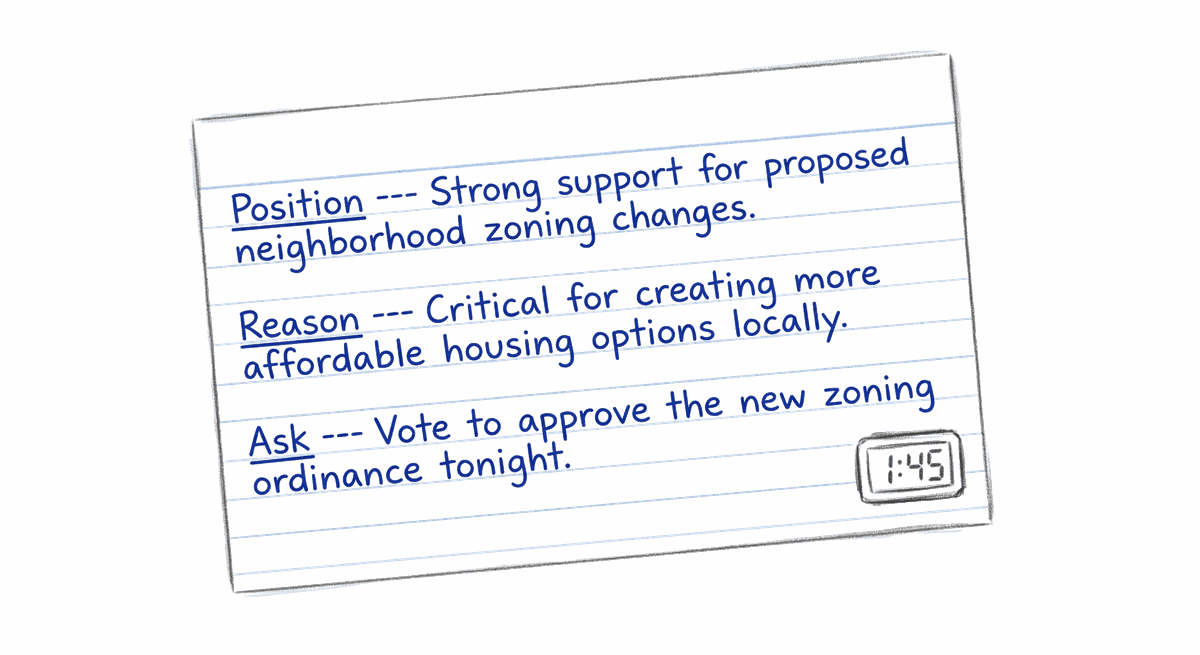
C-5: Writing a Public Comment for a City Council Meeting
Strategy: Draft See also: C-4: Understanding a Ballot Measure (for understanding what you’re commenting on), C-6: Advocating for Change (for sustained advocacy beyond a single meeting) My Man Jeeves: It may be worth noting that public comment periods exist as a matter of law, though one could not help but observe that they are scheduled at hours that present considerable difficulty for persons who are employed. The allotted time — two to three minutes, as a rule — is not generous. They remain, however, among the few mechanisms through which a citizen may address local decisions that bear directly upon daily life. The distinction between having prepared a written comment and having merely attended is, one finds, the distinction between participation and presence. One’s Agent can draft that comment. The Spec:
My city council is voting on [issue] at their meeting on [date].
I want to speak during public comment.
My position is: [support/oppose] because [your main reasons].
I have [2/3] minutes.
Please write a public comment that states my position clearly,
gives my strongest reason, and asks the council for a specific action.
Write it to be spoken aloud — conversational, not formal.
What to do with the Output: Print it. Read it out loud three times at home. Time yourself — if it runs over two minutes, cut the weakest point, not the ask. Bring two copies to the meeting: one to read from, one to hand to the clerk for the record. Written comments entered into the record become part of the public file on that decision.
C-6: Advocating for Change
Strategy: Draft + Navigate See also: C-5: Writing a Public Comment, C-4: Understanding a Ballot Measure, W-5: Unions (collective action uses the same skills) My Man Jeeves: The most frequently offered political counsel in America is “vote.” One would not wish to dispute the necessity of this advice, merely to observe that it is, by itself, wildly insufficient. Between elections, decisions are made by those persons who attend meetings, submit comments, telephone offices, organize their neighbours, and apply sustained pressure to specific officials regarding specific matters. These individuals are not, it would appear, possessed of any extraordinary qualities. They are informed, persistent, and — a point that merits emphasis — typically fewer in number than one might suppose. In most local decisions, the margin between prevailing and not is measured in single-digit persons. One’s Agent can help one become one of them. The Spec:
I want to advocate for [specific change] in my [city / county /
school district / state / workplace].
What I know about the issue: [describe]
What has been tried: [if anything — petitions, past votes, etc.]
Who makes the decision: [if you know — city council, school board,
specific official, or “I don’t know”]
What I can contribute: [time per week, skills, connections, money]
Please help me:
1. Identify who actually has the power to make this decision
2. Map out what has worked for similar changes elsewhere
3. Draft a strategy — not just a letter, but an actual plan:
who to contact, in what order, with what message
4. Help me write the first communication
What to do with the Output: Start local. National change requires millions of people. Local change requires dozens, sometimes fewer. Your school board member has fewer constituents than your congressperson by a factor of a thousand. The math is in your favor at the local level. Political efficacy — the belief that your actions can influence government — is one of the strongest predictors of political participation.[9] The decline in efficacy correlates with the rise of national media and the decline of local media: when your news is all national, every problem feels unsolvable, but local news reveals the leverage points. The feeling of helplessness is a symptom of scale, not reality — shrink the scale and it recedes. Most successful social change in American history has been gradual, local, boring, and persistent, not dramatic or national; the civil rights movement succeeded through years of organizing and coalition-building before the marches made the news.[10]
Knowing what to say is only useful once you know who needs to hear it.
C-7: Understanding Jury Duty
Strategy: Decode + Navigate See also: C-3: Understanding Your Rights Where You Live (for jurisdiction-specific requirements), C-1: Knowing Your Rights During a Police Encounter (for understanding the criminal justice system) My Man Jeeves: It may not be widely appreciated that jury duty represents the sole context in American civic life in which ordinary citizens exercise direct, binding power over an outcome that the government cannot override. A jury’s acquittal, one might note, is not subject to appeal. This power is entirely real, it belongs to the juror, and one cannot help but observe that the system takes some pains to present it as an inconvenience — an informed jury being, perhaps, rather more difficult to predict than an uninformed one. One’s Agent can explain the process, the terminology, and the law before one walks in. The Spec:
I [received a jury duty summons / am currently serving on a jury /
want to understand the jury system].
My state: [state]
My situation: [general curiosity / first time / hardship concern /
currently serving — no case details]
Please explain:
1. What the process actually looks like from summons to verdict
2. What my rights and responsibilities are as a juror
3. How to evaluate evidence and testimony — what to weigh,
what to question
4. What I should know that the orientation video doesn’t cover
Do not give me legal advice about any specific case.
What to do with the Output: If you are currently serving, do not share case details with your Agent or anyone else — that is a legal obligation, not a suggestion. Use your Agent for general education about the process, evidence evaluation, and your rights. After a verdict, ask: “What just happened in that process, and what should I understand about it?”
Science Note: Jurors build narratives and fit evidence into them rather than weighing each piece independently — Pennington and Hastie’s Story Model of jury decision-making documents how, once a story forms, new evidence gets judged by fit rather than merit. Noticing when you’re building a story is the corrective.[12]
C-8: Participating in AI Policy
Strategy: Research + Draft + Navigate See also: C-5: Writing a Public Comment (the core skill), C-6: Advocating for Change (for sustained engagement), C-4: Understanding a Ballot Measure (for decoding proposals) My Man Jeeves: It would appear that governments at every level are, at this moment, determining how AI will be regulated, who will have access to it, and what guardrails will be established. These decisions proceed through the same mechanisms as every other policy matter: legislative hearings, agency rulemaking, public comment periods, and lobbying. The companies building AI maintain full-time policy teams who draft language, attend hearings, and submit comments measured in hundreds of pages. The public comment period is, one might mention, open to oneself as well. It is not a formality — agencies are legally required to consider substantive comments, and a carefully specified comment from a person who will actually live under the rule carries a weight that a form letter, one ventures to suggest, does not. One’s Agent can help one write one. The Spec:
I want to participate in AI policy decisions that affect me.
My level: [I’m new to this / I’ve been following AI policy /
I have a specific regulation I want to comment on]
My concern: [job displacement / privacy / algorithmic bias /
children’s safety / access and affordability / government
use of AI / something else: describe]
My location: [state — for state-level legislation]
Please help me:
1. Identify what AI-related legislation or rulemaking is currently
active at the federal and state level that relates to my concern
2. Explain where I can submit public comment or testimony,
and the deadlines
3. Help me understand the proposed language — what does it
actually require, what does it leave unspecified, and
who benefits from the gaps
4. Help me draft a public comment that addresses the specific
regulatory language, states my position, and provides
a concrete recommendation
What to do with the Output: Submit your comment through the official channel — regulations.gov for federal rules, your state legislature’s website for state bills. Written comments become part of the public record. For state and local hearings, the same rules apply as C-5: print it, practice it, show up. A single informed comment from a constituent who will live under the rule is worth more than a thousand form letters. Agencies know the difference. The federal Notice and Comment process, established by the Administrative Procedure Act of 1946, requires agencies to publish proposed rules, accept public comments, and respond to substantive concerns before finalizing regulations.[14] This is not performative — courts have struck down rules where agencies failed to adequately consider public input, and research on federal rulemaking confirms that substantive comments, those addressing specific provisions with evidence or lived experience, are more likely to influence final rules than form letters. Comment participation on federal rules is typically in the hundreds to low thousands, out of a population of 330 million — the reader who submits one substantive comment on one AI regulation has done more than 99% of the population. That is not hyperbole.
Understanding what a proposal does is only half of it — knowing who’s actually being heard is the other half.
-
[1] Pierson, E., Simoiu, C., Overgoor, J., et al. (2020). “A large-scale analysis of racial disparities in police stops across the United States.” Nature Human Behaviour, 4, 736–745. Data from the Stanford Open Policing Project (openpolicing.stanford.edu).↩
-
[2] Terry v. Ohio, 392 U.S. 1 (1968); Miranda v. Arizona, 384 U.S. 436 (1966); Salinas v. Texas, 570 U.S. 178 (2013). The Salinas holding is narrow — it applies to pre-custodial, voluntary encounters — but the practical lesson is universal: state your invocation clearly.↩
-
[3] Starcke, K. & Brand, M. (2012). “Decision making under stress: A selective review.” Neuroscience & Biobehavioral Reviews, 36(4), 1228–1248. On intergenerational effects of trauma exposure: Yehuda, R., et al. (2016). “Holocaust Exposure Induced Intergenerational Effects on FKBP5 Methylation.” Biological Psychiatry, 80(5), 372–380.↩
-
[4] Shelby County v. Holder, 570 U.S. 529 (2013). The Leadership Conference Education Fund. (2019). Democracy Diverted: Polling Place Closures and the Right to Vote. See also Meredith, M. & Morse, M. (2014). “Do Voting Rights Notification Laws Increase Ex-Felon Turnout?” Annals of the American Academy of Political and Social Science, 651, 220–249.↩
-
[5] See the Brennan Center for Justice (brennancenter.org) and the bipartisan Election Assistance Commission for voter rights resources by state.↩
-
[6] Uggen, C., Larson, R., Shannon, S., & Stewart, R. (2022). Locked Out 2022: Estimates of People Denied Voting Rights. The Sentencing Project.↩
-
[7] United Nations General Assembly. (1948). “Universal Declaration of Human Rights.” The UDHR is not a treaty and is not legally binding, but its principles are reflected in the International Covenant on Civil and Political Rights (1966), which the U.S. ratified in 1992.↩
-
[8] Legal Services Corporation. (2022). The Justice Gap: The Unmet Civil Legal Needs of Low-Income Americans. For every client served by LSC-funded programs, another is turned away for lack of resources.↩
-
[9] Bandura, A. (1997). Self-Efficacy: The Exercise of Control. W.H. Freeman. See also the American National Election Studies time-series data on political efficacy, which tracks the decline from the 1960s to present.↩
-
[10] Ganz, M. (2009). Why David Sometimes Wins: Leadership, Organization, and Strategy in the California Farm Workers Movement. Oxford University Press. The best practical framework for civilians who want to organize.↩
-
[11] Bushell’s Case, 124 Eng. Rep. 1006 (C.P. 1670); United States v. Dougherty, 473 F.2d 1113 (D.C. Cir. 1972) for the court’s explicit acknowledgment of jury nullification power. On the Zenger trial: Katz, S.N. (1968). Newcastle’s New York: Anglo-American Politics, 1732–1753. Belknap Press of Harvard University Press.↩
-
[12] Pennington, N. & Hastie, R. (1992). “Explaining the Evidence: Tests of the Story Model for Juror Decision Making.” Journal of Personality and Social Psychology, 62(2), 189–206.↩
-
[13] Robertson, N., Davies, G., & Nettleingham, A. (2009). “Vicarious traumatisation as a consequence of jury service.” Howard Journal of Criminal Justice, 48(1), 1–12. On juror compensation: National Center for State Courts, “Jury Manager’s Toolbox.”↩
-
[14] Administrative Procedure Act, 5 U.S.C. § 553. On comment effectiveness: Coglianese, C. (2006). “Citizen Participation in Rulemaking: Past, Present, and Future.” Duke Law Journal, 55, 943–968. Farina, C.R., et al. (2012). “Rulemaking vs. Democracy: Judging and Nudging Public Participation That Counts.” Michigan Journal of Environmental and Administrative Law, 2(1), 123–172. See also regulations.gov for currently open comment periods.↩