IRL Interactions
In Real Life Interactions
Your Agent can draft the letter, research the law, prepare the argument, and rehearse the conversation. Then you have to walk into the room. The room has a person in it — behind a counter, across a desk, at the other end of a phone tree — and that person operates within a system that has rules you may not know, discretion they may or may not use, and a queue of people behind you. The Skills in this domain are about the moment where preparation meets reality: the face-to-face encounters with systems and people where knowing what to expect, what to say, and what you are entitled to makes a material difference in the outcome.
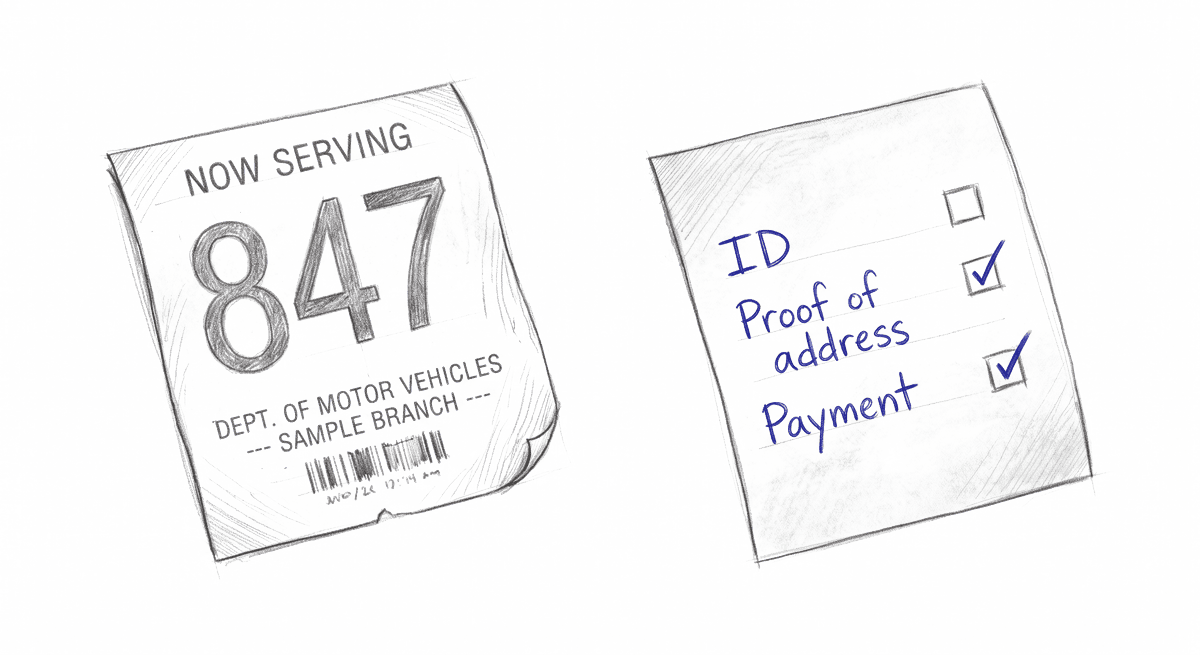
IRL-1: Navigating Government Offices
Strategy: Prepare + Navigate See also: C-3: Understanding Your Rights Where You Live, H-6: Understanding What Medicare Actually Covers My Man Jeeves: One might observe that the DMV, the Social Security office, the county clerk, the courthouse, and the unemployment office represent the physical interfaces of government — designed, it would appear, with the same attentiveness to the visitor’s experience as a website of the 1997 vintage. The forms are available online, though the answers, regrettably, are not. The hours are limited. The queues are considerable. The individual behind the counter has fielded one’s question some four hundred times previously and may or may not possess the authority to be of assistance. A difficulty presents itself: the distinction between a single visit and three lies entirely in knowing what to bring, what to request, and what to say when the initial response is “no.” One’s Agent can tell one all three before one walks in. The Spec:
I need to go to [DMV / Social Security office / county clerk /
courthouse / unemployment office / other government office]
for [specific reason: renew license, apply for benefits,
file paperwork, contest a decision, get a document].
My state: [state]
Please help me:
1. What documents do I need to bring — the complete list,
not just the obvious ones?
2. What should I expect the process to look like — steps, wait times,
what happens at the counter?
3. What are the common mistakes people make that force a second visit?
4. What should I say if I’m told [I need a different form /
I’m missing a document / I need to come back / my request is denied]?
5. Is there anything I can do online first to reduce the in-person time?
What to do with the Output: Print the document checklist. Bring everything. The single most common reason for a wasted government office visit is a missing document. The second most common is arriving at the wrong office. The third is not knowing that what you need can be done online. Your Agent can prevent all three.
IRL-2: Getting Help from Customer Service
Strategy: Prepare + Assert See also: L-3: Writing a Demand Letter (when the call doesn’t work), H-4: Appealing an Insurance Denial (same escalation technique) My Man Jeeves: It would not be inaccurate to characterize customer service as a system arranged to resolve the least costly complaints while gently exhausting those individuals whose difficulties prove more expensive. The first-tier representative is authorized to perform approximately three actions. The supervisor, perhaps six. The retention department — which one reaches only by employing certain specific phrases — is capable of considerably more. The architecture, one might note, rewards those who are familiar with the escalation path. One’s Agent is familiar with the escalation path. The Spec:
I need to resolve a problem with [company] about [issue:
billing error, defective product, canceled service, denied claim,
broken promise, poor service].
What happened: [describe factually — dates, amounts, what
was promised vs. what was delivered]
What I’ve tried so far: [called, chatted, emailed, nothing yet]
What I want: [specific outcome — refund, replacement, credit,
escalation, cancellation without fee]
Please help me:
1. Draft what to say when I call — an opening statement
that is clear, factual, and firm
2. Tell me the escalation path for this type of company
3. Give me the specific phrases that trigger escalation
(“I’d like to speak with a supervisor,” “I’d like to
file a formal complaint,” “Please connect me to retention”)
4. Tell me what to do if the call doesn’t resolve it —
next steps including regulatory complaints and dispute options
What to do with the Output: Call, don’t chat. Phone representatives have more authority than chat agents. Be polite, be specific, be documented. Write down the representative’s name and the call reference number. If the first call doesn’t resolve it, ask your Agent to draft a written complaint — the paper trail is what makes the second call work.
IRL-3: First-Time Situations
Strategy: Prepare + Research See also: Li-5: Planning Trips (same preparation pattern), H-2: Preparing Questions Before a Doctor’s Appointment My Man Jeeves: There exists a variety of apprehension that has, to date, received no clinical designation, yet it would appear to affect nearly everyone: the discomfort of not knowing how a place operates. Upon entering a courtroom, a therapist’s office, a car dealership, a parent-teacher conference, a funeral home, a real estate closing, a voting booth, or a gymnasium for the first time, one finds oneself uncertain where to stand, what to say initially, what the unwritten conventions are, or what everyone else seems already to know. This apprehension, one might observe, suppresses action. Individuals delay medical appointments, forgo voting, avoid the gymnasium, and accept less favourable terms in negotiations — the unknown procedure proving more daunting than the known unsatisfactory outcome. One’s Agent, however, has attended all of these situations. It is in a position to describe precisely what to expect. The Spec:
I am about to [go to / do / attend] [specific situation] for
the first time and I don’t know what to expect.
The situation: [describe — first apartment viewing, first
mortgage closing, first therapy session, first time in court,
first parent-teacher conference, first gym visit, first time
flying, first time voting in person, etc.]
What I’m nervous about: [not knowing the process / saying
the wrong thing / looking stupid / missing something important]
Please:
1. Walk me through exactly what will happen, step by step
2. Tell me what to bring, what to wear, and where to go
3. Tell me the unwritten rules — the things everyone else
seems to know but nobody explains
4. Give me the three things that will make the biggest
difference between a good experience and a bad one
Be specific. I want the “what will actually happen” version,
not the official description.
What to do with the Output: Read it the night before. The preparation reduces anxiety not because it eliminates uncertainty — you will still encounter surprises — but because it reduces the amount of uncertainty to a manageable level. Research on anticipatory anxiety (Grupe & Nitschke, 2013) consistently shows that intolerance of uncertainty is a better predictor of anxiety than the actual threat level of the situation.[1]
IRL-4: Negotiating a Price
Strategy: Prepare + Assert See also: Tr-1, M-3, H-3. Read This and You Will Be Happier (Guardian, 2026) on Monkey/T-Rex/Lion/Mouse personality types (reading the person across the table) My Man Jeeves: One observes that every price in the American economy falls into one of two categories: the fixed and the negotiable. The distinction, however, is rarely advertised. The sticker on the car, the estimate from the surgeon, the first month’s rent, the figure on the mattress tag — each represents not a fact but an opening position. The party who knows this negotiates. The party who does not pays the posted amount and is regarded, by the system, as having consented. It is perhaps worth noting that the billionaire class does not pay sticker price for anything, including, one might add, their tax obligations. One’s Agent has read the negotiation research. It can tell one the fair price, the walk-away number, and the sentence that moves the conversation.
The Spec:
I need to negotiate a price for [car / furniture / medical bill /
rent renewal / appliance / contractor work / other].
The situation:
— What I’m buying or paying: [describe item or service]
— The asking price: [amount]
— My budget or target price: [amount, or “I don’t know what’s fair”]
— My leverage: [paying cash, willing to walk, competing offers,
long-term tenant, insurance patient, buying multiple items,
or “I don’t think I have any”]
Please help me:
1. What is the fair market price for this? Give me a range
2. What is my actual leverage in this situation — be honest
3. Draft my opening offer and the explanation I give with it
4. Give me responses for the three most likely counter-arguments
5. What is my walk-away point, and how do I signal it
without bluffing?
What to do with the Output: Practice the opening line out loud. It sounds ridiculous and it works. The reason negotiation feels unnatural is that you haven’t rehearsed. The car salesperson has done this eight times today. You’ve done it zero times this year. Reading the script once closes most of that gap. Print the counter-arguments. Bring them.
IRL-5: Rehearsing What to Say
Strategy: Prepare + Draft See also: Li-1: Preparing for a Difficult Conversation, IRL-2: Getting Help from Customer Service, IRL-4: Negotiating a Price My Man Jeeves: One might observe that the individuals with whom one interacts in the course of daily commerce — the customer service representative, the mechanic, the landlord, the administrator behind the counter — have rehearsed their side of the exchange. If not formally, then through repetition: the representative has recited the refusal script two hundred times this quarter; the landlord has fielded the repair request before; the doctor has delivered the diagnosis to someone who was not oneself. The individual on the other side of the encounter, however — which is to say, oneself — is performing without benefit of a single rehearsal. It is perhaps unsurprising that the party who has practised maintains composure while the party who has not does not. One’s Agent, one might note, is capable of playing the opposing role with some conviction — permitting one to rehearse the encounter as many times as necessary before entering the room where it matters. The Spec:
I want to practice a conversation before I have it for real.
The situation: [describe — returning a defective product,
calling about a medical bill, asking my landlord to fix
something, requesting a raise, complaining at a restaurant,
calling my insurance company, talking to a contractor]
The other person: [their role — customer service rep, landlord,
boss, doctor, mechanic, school administrator, store manager]
What I want: [specific outcome — a refund, a repair, an
explanation, a correction, an escalation]
What I’m worried about: [going blank, getting emotional,
being dismissed, not knowing what to say when they push back]
Please play the role of [the other person]. Be realistic —
give me the responses I’m most likely to actually hear,
including pushback and deflection. Don’t make it easy.
After 3–4 exchanges, stop and tell me:
1. What I said that was effective
2. Where I lost ground or could be clearer
3. The one thing to change before I try it for real
What to do with the Output: Use voice mode for this. Open your Agent’s mobile app, switch to voice, and talk. Voice mode is available on all major AI tools’ mobile apps (see Appendix G) — for this Skill, it is not a convenience feature, it is the exercise. Reading a script silently is preparation. Saying the words to someone who talks back is rehearsal. They are not the same thing. The first time you say “I need to speak with a supervisor” out loud to something that responds like a bored customer service representative, you will hear how you sound. That is the point. Run it two or three times. Each round, your Agent will adjust — harder pushback, different deflections. When you can handle the third round without freezing, you’re ready. After the real conversation, come back: “Here’s how it went: [describe]. What should I do differently next time?”
Science Note: Pham and Taylor (1999) found that mentally rehearsing the process of a task — the steps, the responses, the decision points — outperformed visualizing a successful outcome by a significant margin; the benefit was reduced anxiety and better adaptive responses when the situation deviated from the plan, not increased confidence.[3]
IRL-6: Navigating a Hospital Visit
Strategy: Prepare + Navigate See also: H-2: Preparing Questions Before a Doctor’s Appointment, H-3: Decoding a Medical Bill or EOB, H-7 My Man Jeeves: The hospital is, one might observe, the only institution in which an individual is expected simultaneously to make consequential decisions about their own care, recall unfamiliar terminology under duress, track which of the several individuals entering the room is authorized to make which determinations, and do so while wearing a garment that opens at the back. The system presumes an advocate — a spouse, a parent, a friend who knows what questions to ask. Many individuals arrive without one. One’s Agent cannot accompany one into the room, but it can tell one, beforehand, everything the advocate would have known.
The Spec:
I [am going to the hospital / am accompanying someone] for
[scheduled surgery / ER visit / labor and delivery /
diagnostic procedure / outpatient procedure / extended stay].
The situation:
— Why: [diagnosis, procedure, or reason for visit]
— When: [date, or “it just happened”]
— Insurance: [type, or “uninsured,” or “I don’t know what it covers”]
— Support: [alone / have someone with me / need to coordinate family]
Please help me:
1. What should I bring — documents, medication list, comfort items,
phone charger, insurance cards, advance directive if I have one
2. Who will I interact with, and what does each person’s role mean?
(attending vs. resident vs. nurse practitioner vs. hospitalist)
3. What questions should I ask before any procedure —
the ones that change outcomes
4. What are my rights as a patient — including the right to
refuse, to get a second opinion, and to see my records
5. What should I watch for after discharge — when to call
back vs. when to go to the ER
Give me the most conservative, medically accurate answer.
I will verify with my care team.
What to do with the Output: Print it. Bring it. Hospitals are loud, exhausting, and disorienting. You will not remember what your Agent told you at 2 a.m. when the hospitalist asks whether you want to proceed. A printed list in your bag is worth more than a memorized briefing. If you’re the advocate for someone else, this is your script.
IRL-7: Talking to a Mechanic
Strategy: Prepare + Decode See also: Tr-2, Ch-2 My Man Jeeves: The automobile repair industry operates upon a remarkably efficient information asymmetry: the mechanic possesses specialized knowledge regarding the vehicle’s condition, and the vehicle’s owner possesses, in the main, the awareness that a sound has begun that was not previously present. Into this gap, one observes, a considerable amount of revenue flows. Not all of it is unwarranted — the profession is skilled and the work is genuinely necessary. But the distinction between “your brake pads are worn and you will die” and “this cabin air filter could be fresher” is one the owner ought to be equipped to make. One’s Agent has read every Technical Service Bulletin for one’s vehicle. The mechanic may not expect that.
The Spec:
I need to take my car to a mechanic and I want to be prepared.
The situation:
— Car: [year, make, model, mileage]
— The problem: [describe the symptom — noise, warning light,
smell, performance issue, or “it’s just due for maintenance”]
— What the mechanic said (if I’ve already been): [describe
their diagnosis and quote]
— My budget: [amount, or “I need to prioritize”]
Please help me:
1. Based on my car and symptoms, what are the most likely causes?
2. What is the fair price range for the repair they’re suggesting?
3. Which items on this list are safety-critical (do now) vs.
recommended (do soon) vs. upsell (can wait or skip)?
4. What questions should I ask the mechanic to show I’ve
done my homework — without being adversarial?
5. Is this a repair I should get a second opinion on?
What to do with the Output: Get the diagnosis first. Most reputable mechanics will diagnose for free or for a nominal fee. Get the diagnosis in writing before you authorize the repair. Then ask your Agent to evaluate it. The conversation you want with the mechanic is: “I understand this is the issue. I’ve looked up the fair price. Let’s talk about the work.” That’s a different conversation than “I don’t know what’s wrong with it. Fix it.”
IRL-8: Navigating a Parent-Teacher Conference
Strategy: Prepare + Assert See also: Li-7, IRL-3: First-Time Situations My Man Jeeves: The parent-teacher conference presents itself as a collaborative exchange regarding the child’s progress. In practice, one observes, it is a 20-minute encounter in which the teacher has prepared remarks and the parent is expected to receive them. The parent who arrives with questions — specific, informed, documented — shifts the conversation from monologue to dialogue. When the matter involves an IEP or a 504 plan, the shift is not merely social but legal: the parent is a required member of the team, with rights established by federal statute, and the school is obligated to respond to their concerns in writing. Many parents are not informed of this. The school system does not appear to regard the omission as urgent. One’s Agent has read IDEA. It can prepare one to exercise rights one may not know one has.
The Spec:
I have a parent-teacher conference coming up for my
[age/grade] child.
The situation:
— What’s going on: [academic concerns, behavioral issues,
social difficulties, gifted program, IEP/504 review,
general check-in, or “the school called me”]
— My concern: [specific worry or goal for the meeting]
— Current support: [IEP, 504 plan, tutoring, none, or
“I don’t know what these are”]
— What I want: [better communication, specific accommodations,
a plan, answers, to understand my rights]
Please help me:
1. What questions should I ask — specific to my child’s situation
2. If this involves an IEP or 504: what are my legal rights
as a parent, and what is the school required to provide?
3. What should I document during and after the meeting?
4. What phrases signal that I’m an informed advocate without
being combative — I want collaboration, not conflict
5. What are the red flags — things the school might say that
I should push back on?
What to do with the Output: Bring notes. Take notes. The single most important thing you can do in a parent-teacher conference is write down what was agreed to and email a summary afterward: “Thank you for meeting today. Here’s my understanding of what we discussed and the next steps.” That email is a record. If the school doesn’t respond to correct it, it stands.
IRL-9: Handling a Car Accident
Strategy: Prepare + Navigate See also: Tr-1, L-4, M-8 My Man Jeeves: The 15 minutes following a motor vehicle collision are, one might venture, among the least suitable for clear decision-making in the entire human experience — and yet they are precisely the interval during which the decisions that determine the subsequent six months of insurance negotiations, potential litigation, and financial exposure are made. What one says to the other driver, to the police officer, and to one’s insurance company in those first minutes becomes the record. The record is remarkably difficult to amend. One’s Agent cannot be consulted at the moment of impact, but it can be consulted 10 minutes later, in the passenger seat, while one is waiting for the police to arrive.
The Spec:
I was just in a car accident. [Or: I want to be prepared
in case I’m in one.]
The situation:
— What happened: [describe briefly — rear-ended, intersection
collision, parking lot, single car, hit and run]
— Injuries: [none / minor / serious / not sure yet]
— Other driver: [cooperating / not cooperating / left the scene]
— Police: [on scene / called / not called]
— Photos: [taken / not yet]
Please help me:
1. What do I do right now, step by step — in order of priority
2. What do I say to the other driver — and what do I NOT say
3. What do I say to the police officer
4. What do I photograph and document before I leave the scene
5. What do I tell my insurance company — and what do I not
volunteer
6. Do I need a lawyer? When does it make sense to get one?
Give me the most conservative, legally accurate answer.
What to do with the Output: Do not say “I’m sorry” to the other driver. Do not say “it was my fault.” Do not speculate about what happened. Exchange insurance information, take photos of everything (both cars, the scene, license plates, road conditions, traffic signs), and get the police report number. Then sit in your car and read what your Agent told you before you call your insurance company.
IRL-10: Attending a Funeral or Memorial
Strategy: Prepare + Navigate See also: Li-2, IRL-3: First-Time Situations My Man Jeeves: There exists no social occasion at which the fear of saying the wrong thing is more acute, or at which the wrong thing is more frequently said. Funerals and memorial services operate according to customs that vary by religion, culture, region, and family — and one is expected to navigate these customs while managing one’s own grief, or supporting someone else who is managing theirs. The system provides no orientation. One arrives, one is uncertain whether to speak or remain silent, whether to bring food or flowers or neither, what to wear, what to say to the family, and what, precisely, one does with one’s hands. One’s Agent cannot grieve on one’s behalf. It can tell one what to expect so that one’s attention is free for the only thing that matters: being present.
The Spec:
I am attending a funeral or memorial service and I want to
be prepared.
The situation:
— My relationship to the person: [close family / friend /
colleague / acquaintance / I’m supporting someone who’s grieving]
— The tradition: [Catholic, Jewish, Muslim, Hindu, Baptist,
secular, military, celebration of life, “I don’t know”]
— What I’m worried about: [what to say, what to wear,
whether to bring something, the logistics, my own emotions]
Please help me:
1. What should I expect — walk me through the structure of
this type of service
2. What do I wear? What do I bring?
3. What do I say to the family — and what should I absolutely
not say? Give me specific sentences, not platitudes
4. What are the cultural or religious customs I should know —
things that would be obvious to someone raised in this
tradition but not to an outsider?
5. What do I do after — follow-up, checking in, the part
that actually matters most?
What to do with the Output: Read it. Showing up is the thing that matters. The fear of doing it wrong keeps people from showing up at all, and absence is always worse than awkwardness. If you don’t know what to say, “I’m here” is enough. If you don’t know the customs, follow the people around you. Your Agent handles the logistics so you can handle the being human.
IRL-11: Job Interviews in Person
Strategy: Prepare + Assert See also: W-1, Li-1 My Man Jeeves: The in-person interview is, one might observe, a performance in which both parties have agreed to pretend that the exchange of pleasantries, the firm handshake, and the question regarding one’s greatest weakness constitute a reliable method of evaluating professional competence. Research suggests they do not. The interview persists, nevertheless, because the hiring manager believes in it, and the hiring manager is the audience. What this means, practically, is that preparation for an interview is not preparation to demonstrate competence — it is preparation to demonstrate the appearance of competence to a specific person, in a specific room, for approximately forty-five minutes. One’s Agent has read every question they are likely to ask. It can rehearse one’s answers until they sound unrehearsed.
The Spec:
I have an in-person job interview coming up and I want to
be fully prepared.
The situation:
— The role: [job title, company, industry]
— What I know about the interview: [who I’m meeting,
format — panel, one-on-one, multiple rounds, presentation]
— My background: [brief relevant experience]
— What I’m nervous about: [specific concern — tough questions,
salary discussion, gaps in resume, industry switch,
body language, what to wear, small talk]
Please help me:
1. Research this company — what should I know going in,
and what should I reference in conversation?
2. Give me the 10 most likely questions for this role
and help me draft answers that sound natural, not rehearsed
3. What do I wear, what do I bring, and what do I do
with my hands?
4. What questions should I ask them — the ones that signal
I’m serious and that also get me information I actually need?
5. Walk me through the logistics: arrival time, who to ask for,
the handshake, the small talk, the close, the follow-up
6. Help me draft a follow-up email I can send within 2 hours
of leaving
What to do with the Output: Rehearse out loud. Answers that exist only in your head sound different from answers you’ve said to a room. Practice with your Agent using voice mode if available — tell it to ask you the questions one at a time and give you honest feedback on your answers. Print the company research and your question list. Arrive 10 minutes early. Bring two copies of your resume, a pen, and a notebook. The follow-up email is the most overlooked part: send it the same day, reference something specific from the conversation, and keep it to three sentences.
-
[1] Grupe, D.W. & Nitschke, J.B. (2013). “Uncertainty and anticipation in anxiety: an integrated neurobiological and psychological perspective.” Nature Reviews Neuroscience, 14(7), 488–501.↩
-
[2] Galinsky, A.D. & Mussweiler, T. (2001). “First offers as anchors: The role of perspective-taking and negotiator focus.” Journal of Personality and Social Psychology, 81(4), 657–669.↩
-
[3] Pham, L.B. & Taylor, S.E. (1999). “From Thought to Action: Effects of Process- Versus Outcome-Based Mental Simulations on Performance.” Personality and Social Psychology Bulletin, 25(2), 250–260.↩
-
[4] Weingart, S.N. et al. (2005). “What Can Hospitalized Patients Tell Us About Adverse Events? Learning from Patient-Reported Incidents.” Journal of General Internal Medicine, 20(9), 830–836. Patient-reported safety events identified errors missed by clinical surveillance, particularly medication-related incidents.↩
-
[5] Individuals with Disabilities Education Act (IDEA), 20 U.S.C. §1414(d)(1)(B) — parental participation in IEP development.↩
-
[6] Sackett, P.R. et al. (2022). “Revisiting meta-analytic estimates of validity in personnel selection.” Journal of Applied Psychology, 107(11), 2040–2068.↩