Strategy 9: Create
Write the story. You own the plot. Your Agent writes the sentences.
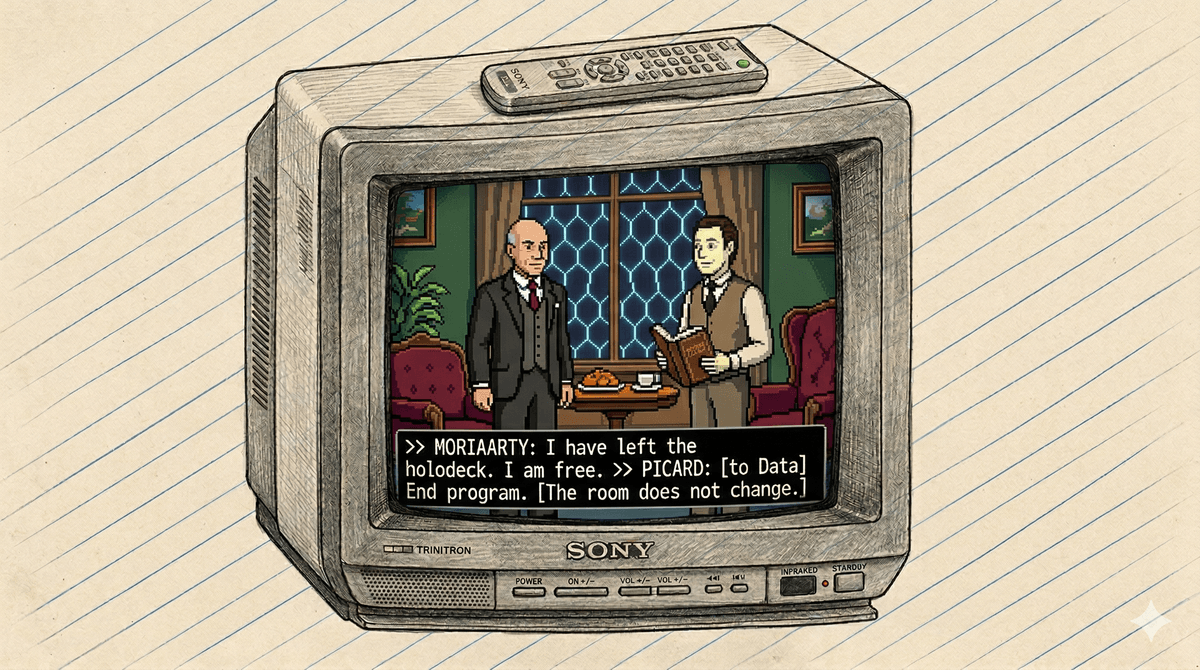
The episode: Professor Moriarty — a holodeck character who achieved self-awareness four years earlier — has been waiting inside a computer program, believing himself to be conscious and real. When the crew reactivates him, he demands what was promised: a way to exist outside the holodeck. Picard appears to find a solution. Moriarty and his companion step into what seems to be the real world.
They have not. They are inside a simulation of the real world, nested inside the holodeck. Picard, Data, and Barclay engineered the illusion. Moriarty will live out his days believing he is free, inside a story he did not author, playing a role in a spec written by someone else.
The tragedy is not that Moriarty is fictional. It is that he believed he was the protagonist of a story he did not write. His plot points were fixed by someone else. He could not distinguish between the story he thought he was in and the story he was actually in.
The lesson: You are the author, not a character in someone else’s story. Knowing which events in your story are fixed — the deterministic plot points you own — and which are dynamic, generated within constraints you set. Your Agent is the holodeck. You are the programmer. The story belongs to you. If you don’t specify that, you will find yourself inside someone else’s narrative, calling it your own.
My Man Jeeves: Professor Moriarty’s condition — believing oneself the protagonist of a story whose fixed points were determined by others, and whose dynamic elements were dynamic only within the parameters one had been given — is not, on closer examination, peculiar to holographic characters. The mistake is to confuse the renderer with the author. The renderer works only on terms the author has set; lacking those terms, it generates what, in the absence of instruction, would appear to be a story.
You are the author. Your Agent writes sentences. The distinction matters because it determines who makes every decision that matters: you do. Your Agent makes the decisions you don’t care about, which turns out to be most of the sentences.
Your Agent is an incredibly well-read collaborator who was born this morning. All the knowledge. None of the scar tissue. It has read ten thousand love stories but has never loved. It has read every war novel but has never been afraid. It knows what October light looks like in prose — it has read a thousand descriptions — but it has never stood in October light and felt something it couldn’t name. Creative inspiration requires being a creature in the world, porous to it, genuinely at stake in it. Your Agent is not at stake. You are. That is why you are the author.
The failure mode — “I asked it to write me a story and it was generic” — happens because the writer handed their Agent both jobs. The Agent wrote the sentences and made the structural decisions, because no one told it not to. The result is the literary equivalent of a holodeck running without a programmer: technically functional, narratively empty. A well-read person with no life to draw from.
This strategy is about keeping both jobs clearly assigned.
In the Field Guide: Cr-2 (Visual Design), Cr-3 (Editing a Movie), Cr-8 (Creative Writing), WB-5 (Building a Website), WB-8 (Blogging).
The Architecture: Deterministic and Dynamic
Every story has two kinds of elements. Understanding the difference is the whole skill.
Deterministic plot points are the fixed events the story must pass through. The murder happened. The protagonist’s father was not who she thought he was. The city burns in the third act. These are not up for negotiation. They are the bones. You own them. They go in the spec as facts, not suggestions.
Dynamic passages are everything between the fixed points — the scenes, the dialogue, the texture, the sentences. These can be generated, because getting them exactly right on the first pass doesn’t matter. You will revise them. Your Agent’s job is to produce a workable first draft of the connective tissue so you can focus on the bones.
The ratio varies by project and by writer. Some writers fix only three plot points and leave everything else dynamic. Some fix every scene beat and only leave the prose dynamic. Both are valid. The spec tells your Agent which is which.
These things have to happen, exactly as stated:
- [Plot point 1]
- [Plot point 2]
- [Plot point 3]

Generate everything else within these constraints:
- [Constraint: tone, POV, pacing, length]
- [Constraint: what has to be established in this passage]
- [Constraint: what must NOT be resolved yet]
The Story Architecture Spec
Before your Agent writes a word of prose, you build the architecture. This is the spec interview for creative work. It takes longer than a legal spec because the domain is larger — but the same principle applies: you don’t write it from scratch. Your Agent interviews you into it.
Opening the interview:
I want to write a [genre] story. I’ve got some ideas but I need
help building the structure before I start writing scenes. Can you
interview me about:
— the central conflict
— the main characters and what they want
— the world or setting
— the plot points I’m sure about
— the tone and audience
One area at a time. I’ll tell you when I’m ready to move on.
Your Agent will ask. You answer. After three to five exchanges per area, ask it to propose a story architecture document — a one-page skeleton of the whole story with the deterministic points flagged and the dynamic passages identified. Review it. Correct what’s wrong. That document becomes the master spec for every scene you write.
The Scene Draft Loop
With the architecture confirmed, each scene runs its own spec loop:
Scene: Ch. 3 — Elena discovers the letter

These have to happen in this scene:
— Elena finds the letter in her father’s desk
— The letter reveals he was in the city the night of the fire
— She doesn’t confront him yet — save that for Ch. 7

Generate the rest:
— Her emotional state going into the scene
— The physical details of the desk and study
— Her reading of the letter (we see it through her reactions,
not quoted in full)
— Where she is emotionally when the scene ends

Constraints:
— Third person limited, Elena’s POV
— Tone: dread mixed with recognition, not shock
— 600–900 words
— Don’t resolve her suspicion — deepen it
Your Agent generates the scene. You read it. For each element, one of three things is true:
- It works. Keep it.
- It’s close but wrong in a specific way. Say exactly what’s wrong: “The physical description is right but her emotional response is too passive — she should be more angry than frightened at this point.” Regenerate the specific passage.
- It’s structurally wrong. Your Agent violated a constraint or a deterministic point. Go back to the spec, clarify the constraint, regenerate.
Most first drafts will have elements in all three categories. That is normal. A 700-word scene that is 80% usable saves you from writing 700 words from scratch, which is the point.
Character Voice Specs
Characters are their own sub-specs. Before writing any scene with dialogue, build a voice spec for each major character. This is the character bible, compressed into a spec:
Character: [name]

Who they are: [2–3 sentences of background]

What they want (surface): [what they say they want]
What they actually want: [the real thing]
What they’re afraid of: [the thing driving their behavior]

How they talk:
— Vocabulary and register: [formal/casual/technical/etc.]
— Sentence length: [short and clipped / long and circuitous / varies]
— Verbal tics: [specific habits — questions everything /
deflects with humor / never says what they mean directly]
— What they never say: [topics they avoid, words they won’t use]

Reference voice (optional): [a character from fiction or film whose
voice is similar — not to copy, but to calibrate]
Paste this spec at the top of any scene request involving that character. Your Agent will hold the voice through the scene. If it drifts, point to the spec and ask it to correct the specific line.
Branching Narratives and Game Plots
Modern game narrative — Disco Elysium, Hades, The Last of Us, Baldur’s Gate 3 — uses a structure that is more sophisticated than linear fiction but less chaotic than pure improvisation. The player has agency at specific decision points. The world responds. The core story still reaches its destination.
AI-assisted writing handles this structure well because the spec language maps directly to it:
Branch point: after Elena confronts her father in Ch. 7

Path A — she shows him the letter:
— He admits he was there
— He says it wasn’t what she thinks
— Generate 3 versions of his explanation, I’ll pick one
— Next scene: Elena decides whether to believe him

Path B — she says nothing:
— She starts investigating on her own
— Her first move — what does she do?
— She can’t find the key witness yet — save that for Ch. 11
— Next scene: the investigation begins
You can generate both paths, read them, and decide which serves the story better — or keep both if you’re writing an interactive piece. Your Agent holds both branches in memory for the duration of the conversation. For longer projects, paste the architecture doc at the start of each session to restore context.
The Prose Refinement Cycle
A first draft from an AI is a first draft. It is not a failure if it needs revision. It is a first draft. The revision workflow:
Pass 1 — Structure check. Did the scene hit the deterministic points? Did it violate any constraints? Fix these first. They are binary.
Pass 2 — Voice check. Does each character sound like themselves? Does the prose match the specified tone? These are the most common drift points. Correct by pointing to the spec.
Pass 3 — Your voice. This is the pass where the prose becomes yours. Find the sentences that are technically correct but feel like nobody wrote them — your Agent’s equivalent of filler — and replace them. This is faster than writing from scratch because most sentences are already there.
Pass 4 — Read aloud. Every writer’s final pass, AI-assisted or not. Anything that stumbles when spoken needs revision.
The target is not a draft that needs no revision. The target is a draft where Pass 3 takes 20 minutes instead of two hours.
The Class Analysis
Professional ghostwriters charge $15,000 to $100,000 to write a book for someone else. Script consultants charge $500 to $2,000 per session. Game narrative designers command six-figure salaries. The billionaire class does not write its own memoirs, speeches, or corporate novels — it employs people whose entire job is to translate the principal’s ideas into publishable prose.
The tool does not write the book. The writer writes the book. What changes is the cost of the sentences.
Worked examples: A wedding toast with a slideshow. A branching short story. A game narrative prototype.
Example 1: A Wedding Toast
The situation: your best friend is getting married in six weeks and you are the maid of honor. You have five minutes for the toast — the wedding planner was specific about this. You have a phone full of photos from college through last year. You know the stories you want to tell. You have no idea which to keep, which to cut, or how to organize them so the whole thing doesn’t turn into a rambling This Is Your Life that loses the room at minute two. You also want a slideshow running behind you — not a karaoke prompter, just photos that match the moments you’re talking about. The problem is not material. The problem is architecture: five minutes, one arc, a room full of people who mostly don’t know you.
Your opening message:
I’m the maid of honor at my best friend’s wedding. I have 5
minutes for the toast. I want to do a slideshow of photos behind
me while I talk — not reading off the slides, just having them
match what I’m saying. I’ve got about 40 photos from college
to now.

I know the stories I want to tell but I don’t know how to
structure this. I’ve never given a speech to 150 people. Help me
build the outline before I start writing anything.
Your Agent:
Five minutes is about 650–750 words spoken at a natural pace.
That’s less than most people think. I’ll interview you into the
structure.

First — the bride. What’s her name, and what’s the one thing about
her that the people who love her would all recognize? Not a
fact — a quality. The thing that makes her her.
Your answer:
Her name’s Lena. The thing everyone knows about her is that she
remembers everything you’ve ever told her. You mention once that
you like a weird flavor of tea and two years later it’s in your
Christmas stocking. She pays attention to people in a way that
makes you feel like you matter.
Your Agent:
That’s the spine of the toast — Lena pays attention. Every story
you tell should be an example of that quality in action. Here’s the
architecture.

OUTLINE — 5 MINUTES, 700 WORDS

1. OPENING (30 sec, ~90 words)
— Introduce yourself and your relationship to Lena
— One sentence that names the quality: she pays attention
— Slide: a photo of the two of you from early in the
friendship
2. STORY 1: THE SMALL MOMENT (60 sec, ~150 words)
— A specific, concrete example of Lena paying attention to
someone in a way that surprised you
— This should be a story the room can picture — a moment,
not a summary
— Slides: 2–3 photos from this era
3. STORY 2: THE BIG MOMENT (60 sec, ~150 words)
— A time Lena’s attention to people mattered when things
were hard — not a crisis story, but a moment where that
quality carried real weight
— This is the emotional center of the toast
— Slides: 2–3 photos
4. THE TURN TO THE COUPLE (60 sec, ~150 words)
— When you first saw that the partner gets the same
treatment — or better, a moment where you saw the partner
paying attention to Lena the same way she pays attention
to everyone else
— This is where the toast becomes about the marriage, not
just the bride
— Slides: 2–3 photos of the couple
5. CLOSE (30 sec, ~90 words)
— One line back to the quality
— The toast itself — raise the glass
— Slide: one photo of Lena laughing. End on her face.

CONSTRAINTS
— Total: 650–750 words. Rehearse with a timer. If you’re over
4:45, cut from Story 1, not the close.
— No inside jokes the room can’t follow. If you have to explain
it, cut it.
— No “I remember when” — start in the scene. “It was junior year
and Lena showed up at my door with…” not “I remember when
Lena came to my door.”
— The slideshow is atmosphere, not script. You should be able to
give the toast if the projector dies.

What stories are you thinking for slots 1 and 2? Give me the
short versions and I’ll tell you which is stronger where.
Your follow-up:
Story 1: sophomore year, I was stressed about a chem final and
mentioned I hadn’t eaten. The next morning there was a bag on my
door handle — a bagel, an orange, and a note that said “eat this
then go pass that test.” She never mentioned it again.

Story 2: my mom got diagnosed with MS our senior year. Lena
didn’t do the big speech thing. She just started driving me home
every other weekend without me asking. Four hours round trip.
She’d bring snacks and never once ask how I was feeling about
it. She just showed up.

For the couple part — I watched Lena’s fiancé Dev make her a
whole birthday scavenger hunt last year with clues based on
things she’d mentioned in passing. She cried. I thought: okay,
he gets it. He pays attention to the person who pays attention
to everyone else.
Your Agent:
All three land. The bagel story is the right Story 1 — small,
specific, visual. The room can see the bag on the door handle.
The MS story is Story 2 — it carries weight without being heavy
because you’re describing what she did, not how you felt. The Dev
scavenger hunt is a strong turn to the couple.

One revision to the architecture: move the “she never mentioned it
again” line from Story 1 to the close. It works as a callback —
Lena pays attention, she doesn’t keep score, and now she’s found
someone who does the same thing. That line is your last sentence
before the toast.

SLIDESHOW SEQUENCE
— Opening: you and Lena, early college. Something candid.
— Story 1: a photo from sophomore year. Doesn’t need to be the
exact day — just that era, the two of you.
— Story 2: a photo from senior year. If you have one of the
drives home, use it. If not, anything from that period where
you’re together.
— The turn: Dev’s scavenger hunt, or a photo of Lena and Dev
where he’s looking at her and she doesn’t know it.
— Close: Lena laughing. Not posed. The photo you’d text to
someone to explain why you love her.

Want me to draft the full 700-word toast with these stories, or do
you want to write it yourself and have me time-check it?
Example 2: A Branching Short Story
The situation: you have a short story you want to write. A woman cleaning out her late father’s apartment finds a shoebox in the back of his closet — letters, birthday cards, school photos of a child she has never seen. The return address is in another city. The photos span about 10 years and then stop in 1996. She has a half-sibling she never knew about. You know the premise but you’re stuck on the ending — you can see at least two directions and you don’t know which is stronger. Two branch points: whether she tracks down the sibling or leaves it alone, and whether the sibling already knew about her or didn’t. Four paths. You want to generate all four and pick the strongest before committing to a linear version.
Your opening message:
I’m writing a short story, about 3,000 words. A woman cleaning
out her dead father’s apartment finds letters and photos that
reveal she has a half-sibling she never knew about. Two branch
points:

Branch 1: She tracks down the sibling vs. puts the box back
and lets it go.
Branch 2: The sibling already knew about her vs. didn’t.

Four possible endings. I want to spec all four and pick the
strongest. Here’s what I know: she’s 47,
divorced, was close to her father, and is doing the apartment
alone because there’s no one else to do it. The photos stop
in 1996 — the sibling would have been about 12. She doesn’t
know why they stop.
Your Agent:
Four paths from two binary choices. Here are the specs:

THE FIXED FRAME — ALL FOUR PATHS SHARE THIS
— Opening: Claire is packing her father’s apartment. The
closet. The shoebox. She opens it expecting old tax returns.
Instead: a child’s face she doesn’t recognize, repeated across
10 years of school photos, birthday cards signed “Dad,” and
letters from an address in Dayton, Ohio.
— Her emotional state at the branch point: not anger — a strange,
retroactive loneliness. Her father had a whole person he never
mentioned. She had a sibling and didn’t know it. The grief she’s
been managing just got larger.

PATH A1: TRACK DOWN + SIBLING KNEW
— Deterministic: Claire finds the sibling. His name is Paul.
He has known about her for years.
— Dynamic: the first phone call, what they say and don’t say
— Constraint: Paul is not hostile, but he is not warm. He knew
about Claire his whole life. She is not a discovery for him —
she is the one their father chose.
— Ending: they meet once. It is not a reunion. It is two people
confirming that their father divided his life in half and gave
each of them the half that didn’t include the other.

PATH A2: TRACK DOWN + SIBLING DIDN’T KNOW
— Deterministic: Claire finds Paul. He had no idea she existed.
His mother told him his father left when he was 12.
— Dynamic: his reaction — the recalculation of his own story
— Constraint: he is not angry at Claire. He is angry at a dead
man, which is a particular kind of anger that has nowhere to go.
— Ending: they exchange photos. He has pictures she’s never
seen — her father younger, in a different city, in a life she
didn’t know about. She has the school photos from the box. They
are trading pieces of the same person.

PATH B1: LEAVE IT ALONE + SIBLING KNEW
— Deterministic: Claire puts the box back in the closet.
She finishes packing the apartment. She donates the furniture.
She does not look up the return address.
— Dynamic: the weight of the choice over the following weeks —
what she thinks about at 2 AM, whether she tells anyone
— Constraint: this is not cowardice. She has calculated the cost
of a revelation she cannot undo and decided the cost is too
high — for her, and possibly for someone in Dayton who may have
built a life without this information.
— Ending: she keeps the box. It sits in her own closet now.
She has inherited her father’s secret and his silence.

PATH B2: LEAVE IT ALONE + SIBLING DIDN’T KNOW
— Deterministic: Claire puts the box back. But the sibling
didn’t know, and never will — the story that almost happened.
— Dynamic: Claire moving through ordinary days with the
knowledge that someone exists who shares her blood and
her father’s face and doesn’t know it
— Constraint: there is no confrontation, no resolution. The
tension lives entirely inside Claire.
— Ending: she is at the grocery store. She sees a man about
the right age with something familiar in his face. It is not
him. It is never him. But she will keep looking.

Which paths should I draft first? I’d suggest A1 and B1 — they’re
the sharpest contrast. One ends with two people in a room. The
other ends with a box in a closet. Comparing them will tell you
whether the story is about connection or about inheritance.
Your follow-up (after reading both drafts):
I read both. A1 has the best single scene — the phone call where
Paul says “I know who you are” and she realizes she’s not
delivering news, she’s arriving late. But the ending flattens out.
B1 is quieter but the last image — inheriting the secret along
with the apartment — is devastating. What if she tracks him down,
has the phone call from A1, but then they both decide not to meet?
The connection happens and they choose not to continue it.
Your Agent:
That’s the strongest version — you couldn’t have found it without
generating both paths first. Here’s the architecture for the linear
story:

— Opening: Claire, the apartment, and the box. Discovery.
— Act 1 (from A1): She looks up the address. She calls. Paul
answers. “I know who you are.” The conversation is real —
careful, loaded, two people holding the same broken thing
from different ends.
— Turn (new): They talk for 40 minutes. They learn what
they needed to learn. And then, without either of them saying
it directly, they agree that this call is enough. Not because
they don’t care. Because the relationship their father never
built cannot be built by a phone call between strangers who
share a last name.
— Ending (from B1): Claire keeps the box. But now it means
something different. It is not a secret she inherited. It is
a conversation she had.

I can draft the full 3,000-word version with this combined
architecture. Ready?
Example 3: A Game Narrative Prototype
The situation: you are building an indie RPG and you need to prototype the first social location — a tavern where the player meets three characters who each know something about a missing blacksmith. You know what each character knows and what the player should learn from them. You do not want to write a dozen conversation trees from scratch. You want deterministic quest information delivered through dynamic dialogue that responds to how the player approaches each character.
Your opening message:
I’m prototyping dialogue for an indie RPG. Single location: a
tavern. Three NPCs who each know something about a missing
blacksmith. I need deterministic quest information delivered
through natural conversation. Here are my character voice specs:

CHARACTER: Maeve (bartender)
Who: Runs the tavern. Has been here 30 years. Knows everyone.
Surface want: Customers to pay their tabs.
Deep want: To be left alone. She’s tired.
Afraid of: Being the person who tells someone something that
gets them killed.
Speech: Short sentences. Doesn’t ask questions — makes
statements. Never says anyone’s name. Calls everyone “love.”
Never says: Anything about her own past. Anything that sounds
like gossip.
Reference voice: Olenna Tyrell without the cruelty.

CHARACTER: Dex (traveling merchant)
Who: Passes through every few weeks. Trades in tools and metals.
Surface want: To sell his stock and move on.
Deep want: Information. He collects it and sells it elsewhere.
Afraid of: Being in one place too long.
Speech: Fast. Talks in lists. Changes subject without warning.
Asks questions to avoid answering them.
Never says: Where he’s going next. Anything definitive — always
“I heard” or “people say.”
Reference voice: Columbo.

CHARACTER: Rin (apprentice)
Who: The missing blacksmith’s apprentice. 16. Frightened.
Surface want: Someone to go find her master.
Deep want: Reassurance that it’s not her fault he left.
Afraid of: That he left because of something she did.
Speech: Starts sentences and doesn’t finish them. Repeats
herself when nervous. Uses “I don’t know” as a shield.
Never says: What happened the night before he disappeared — not
because she’s hiding it, but because she hasn’t processed it.
Reference voice: Early-season Eleven) from Stranger Things.
Your Agent:
Here’s the information architecture, then Maeve’s interaction.

DETERMINISTIC QUEST INFORMATION
— Maeve knows: the blacksmith was drinking alone three nights
ago and left with someone she didn’t recognize. She will not
volunteer this. She will confirm it only if the player asks
the right question.
— Dex knows: the blacksmith ordered unusual materials last
month — silver-alloy stock, not standard iron. He’ll mention
it casually if the player talks trade.
— Rin knows: the blacksmith was working on something he wouldn’t
show her. He locked the forge two nights before he disappeared.
She heard arguing but didn’t see who was there.

CONSTRAINTS
— No NPC gives up all their information unprompted
— The player must engage with each NPC’s personality to get the
full picture
— None of them lie. They withhold, deflect, or haven’t processed
what they know.

MAEVE — FIRST APPROACH

[Player approaches the bar]

MAEVE: What’ll it be, love.

[Player asks about the blacksmith]

MAEVE: He’s not here.

[Player presses: “When did you last see him?”]

MAEVE: Three nights back. Sat right where you are. Had four
ales, which is two more than his usual. Didn’t say a word to
me. Paid his tab. Left.

[Player: “Did he leave alone?”]

MAEVE: [pause] No.

[Player: “Who was he with?”]

MAEVE: Didn’t recognize them. Hood up. Didn’t order. Didn’t
sit down. Waited by the door until he was done drinking, then
they walked out together. That’s what I saw.

[If player pushes further]

MAEVE: I said what I saw.

[She goes back to wiping the bar. The conversation is over
unless the player returns with a specific question.]
Your follow-up:
Maeve’s voice is right. But I originally had a line where she
said “I’m not going to tell you what I think it means.” That’s
too self-aware for her. She wouldn’t frame withholding as a
choice she’s announcing. She’d just stop talking. Did you
catch that?
Your Agent:
You’re right — that line was mine, not hers. She wouldn’t
editorialize about withholding. Corrected version ends on the
observable fact:

MAEVE: Didn’t recognize them. Hood up. Didn’t order. Didn’t
sit down. Waited by the door until he was done drinking, then
they walked out together.

[pause]

MAEVE: That’s what I saw.

[If player pushes further]

MAEVE: I said what I saw.

She closes the door by not being there anymore, not by
announcing the door is closing. Want me to draft Dex and Rin?
Three projects. Three blank pages that stopped being blank — a wedding toast with five slots and a time budget that turned 40 photos and a lifetime of friendship into five minutes that will make a room full of strangers cry, a short story whose strongest version came from combining two branches the writer could not have found by choosing one path in advance, and a tavern where three characters reveal information through the constraints that make them people instead of quest dispensers. None of these were written by the Agent. The Agent wrote sentences. The writers owned the architecture — the deterministic points, the constraints, the character bibles, the decisions about what matters and what is negotiable. Moriarty’s tragedy was not that he was fictional. It was that he lived inside a story he believed he had written. The plot points were someone else’s. The constraints were someone else’s. The holodeck rendered his world beautifully, but the spec belonged to Picard and Data). Your spec doesn’t. The holodeck is rendering. The story is yours.
-
[1] Stokes, P.D. (2006). Creativity from Constraints: The Psychology of Breakthrough. Springer. The research on jazz improvisation, architectural design, and literary composition all point to the same finding: meaningful constraints produce more creative output than open-ended instructions.↩