Home
A house is the most expensive thing most people will ever be responsible for, whether they own it or rent it. It breaks constantly, in ways that require knowledge from a dozen different trades — plumbing, electrical, HVAC, roofing, structural, pest, appliance — and the person standing in the kitchen when the water heater fails is expected to diagnose the problem, find the right contractor, evaluate the quote, and make the repair-or-replace decision, all before the floor is ruined. The billionaire class has a property manager. You have YouTube and a growing sense of dread. The Skills that follow are Al Borland in your pocket: the diagnostic step before the drill comes out.
Ho-1: Maintaining Your Home
Strategy: Diagnose See also: Ho-2: Home Repair and DIY (for specific repairs), Ho-3: Right-to-Repair (for products designed to resist repair), Ch-1: Shopping Your Values (before replacing anything) My Man Jeeves: A residence, however modest, presents a continuous programme of maintenance requirements — plumbing, electrical, HVAC, roofing, appliances — each belonging to a distinct trade. The difficulty is not that one fails to appreciate the importance of preventive care; it is that the knowledge required to perform it has traditionally been distributed across a dozen professionals, none of whom are present when the water heater chooses its moment. An Agent can provide the diagnostic step before one reaches for the telephone, which is to say, the step that most frequently renders the telephone unnecessary. The Spec:
My [appliance/system] is [describing the behavior: making a noise /
not working / leaking / etc.]. It started [when].
[Any relevant context: age of unit, recent changes, what I’ve tried.]
Please tell me:
1. What are the most likely causes, from most to least likely?
2. Which of these can I fix myself, and how?
3. If I do need a professional, what type, and what should I
tell them when I call?
4. Are there any safety concerns I need to address immediately?
What to do with the Output: If there’s a safety concern, handle that first — your Agent will tell you if something needs to be turned off, unplugged, or evacuated from immediately. For everything else, try the simplest fix your Agent suggests before calling a professional. Most service calls start at $150 just to show up.
Ho-2: Home Repair and DIY
Strategy: Diagnose + Navigate (Expert Role) See also: Ho-1: Maintaining Your Home (for diagnosing first), Ho-3: Right-to-Repair (when a product resists repair), Ch-2: Understanding a Contractor Bid (when to hire instead) My Man Jeeves: Home repair knowledge was, until comparatively recently, transmitted between generations in much the way that changing a tyre or hemming a pair of trousers was once considered a baseline competency. Several decades of planned obsolescence and the gradual replacement of repairable objects with disposable ones have, one might observe, rather thoroughly interrupted that transmission. The knowledge itself, however, has not vanished — it has merely migrated, and an Agent was among the recipients. The Spec:
Act as an experienced home repair advisor.
The task or problem: [describe specifically]
My home: [approximate age, owned or rented]
My skill level: [never done repairs / basic / comfortable with tools]
Tools I have: [basic hand tools / power tools / neither]
Is this urgent (affecting habitability or safety)? [yes/no]
What do I need to know before I start, and what are the steps?
What to do with the Output: Read the full list of steps before you start — not while you’re holding a wrench. If there’s a part you need, your Agent can help you find it by name and part number. Take a photo of what you’re working on before you take anything apart. Future you will thank present you.
Common home repair Expert Role specs:
Act as a home repair advisor. I need to [patch a hole in drywall /
fix a running toilet / caulk a bathtub / replace a light switch /
fix a leaking faucet]. I have never done this before.
What do I need, and walk me through it step by step.
Act as a home repair advisor. I’m trying to figure out
whether I can do this myself or need a professional:
[describe the repair]. My skill level is [beginner/intermediate].
Give me an honest assessment.
Ho-3: Right-to-Repair
Strategy: Diagnose + Navigate (Expert Role) See also: Ho-2: Home Repair and DIY (for the repair itself), Ho-1: Maintaining Your Home (for preventive maintenance) My Man Jeeves: Whether one characterizes it as planned obsolescence, buyer lock-in, or — to borrow the current vernacular, if one may be forgiven the word — enshittification, the underlying mechanism is the same: by manufacturing products that resist repair, companies ensure a recurring revenue stream at the consumer’s expense. The practice is, if one may say so, rather more deliberate than the word “obsolescence” suggests. An Agent can assess, at whatever skill level one possesses, whether a given item merits repair or replacement — and, should replacement prove necessary, recommend more durable alternatives. One is not, strictly speaking, defeating the system. One is merely removing the information asymmetry upon which it depends. The Spec:
Act as an experienced right-to-repair technician.
The item I’m trying to fix: [make, model, year if applicable]
The problem: [describe exactly what it’s doing or not doing]
What I’ve already tried: [if anything]
Tools I have available: [basic / moderate / well-equipped]
My comfort level with disassembly: [never done it / done basic repairs /
comfortable with electronics / comfortable with appliances]
What is likely wrong, and what are my repair options
from easiest to most involved?
What to do with the Output: Before ordering any parts, verify part numbers against the manufacturer’s parts diagram if available. iFixit.com and YouTube are the best secondary sources for your specific model once your Agent has identified what needs fixing.
Common right-to-repair Expert Role specs:
Act as a right-to-repair technician. My [washing machine /
dishwasher / refrigerator / dryer] is [symptom].
It is a [brand] [model if known], approximately [age] years old.
Walk me through diagnosing this step by step.
Act as a bicycle mechanic. My [component] is [symptom].
The bike is a [type: road/mountain/hybrid], [approximate age].
What needs adjustment or replacement, and can I do it myself
with basic tools?
Act as a small engine repair technician. My [lawn mower /
generator / chainsaw] [symptom]. It was last serviced [when].
What should I check first?
Ho-4: Knowing Your Rights as a Renter or Homeowner
Strategy: Assert + Decode See also: L-1: Negotiating a Contract (for reading your lease or mortgage), C-3: Understanding Your Rights Where You Live (for rights that vary by jurisdiction), C-6: Advocating for Change (for changing the rules) My Man Jeeves: Housing law, one might observe, is the domain in which the greatest sums change hands with the least comprehension on one side of the transaction. The landlord retains a property management company that has filed the same lease in the same county for 15 years. The HOA board has engaged an attorney on retainer who drafted the CC&Rs. The mortgage servicer employs a compliance department that knows precisely which fees are legal and which are merely customary. The individual on the other side of the table has the document they were given and a vague apprehension that some of it is not quite right. That apprehension is, in the general course of things, well founded. The law is specific, it varies by jurisdiction, and it almost invariably provides more rights than one supposes. The difficulty has never been the law itself. The difficulty is that nobody has explained it. One’s Agent has read the law and is prepared to do so. The Spec:
I have a question about my rights as a [renter / homeowner / HOA member].
My situation:
— Where I live: [city, state]
— My housing type: [apartment / house / condo / mobile home / HOA community]
— The issue: [describe — lease dispute, security deposit, HOA rule,
property tax assessment, landlord not making repairs, noise complaint,
accessibility need, pet restriction, utility billing, or “I just want
to understand what rights I have”]
— What has happened so far: [if anything — notices sent, conversations
had, complaints filed]
Please help me:
1. What are my specific rights in this situation under my
state and local law?
2. What is the process for enforcing those rights — who do I
contact, what do I file, what are the deadlines?
3. What are the most common mistakes people make in this
situation that weaken their position?
4. If this involves a dispute: what is my strongest argument,
and what documentation do I need?
Give me the most conservative, legally accurate answer.
I will verify with a tenant rights organization or attorney.
What to do with the Output: Document everything in writing. If your landlord or HOA is violating your rights, your Agent can help you draft the letter — but send it by email or certified mail so there is a record. Many cities have free tenant rights hotlines and legal aid organizations; ask your Agent to find the one in your jurisdiction. The clock on most housing disputes starts running whether you know about the deadline or not.
Common housing rights Expert Role specs:
Act as a housing rights advisor. I live in [a community with
an HOA / a condo association] in [state].
The issue: [describe — unreasonable rule, selective enforcement,
lack of financial transparency, special assessment, restricting
modifications (including solar panels or EV charging), not
maintaining common areas, or board overreach].
What are my rights under state law, what does the board’s
fiduciary duty require, and what is the process for
challenging this?
Give me the most conservative, legally accurate answer.
I will verify with a tenant rights organization or attorney.
Act as a property tax advisor. I own a home in [county, state]
and I believe my property tax assessment is [too high / based
on incorrect information about the property].
Current assessed value: [amount].
What I believe the correct value is, and why: [comparable sales,
property condition, errors in square footage or lot size,
historic district restrictions that limit use].
Walk me through the appeals process — deadlines, evidence I need,
and whether to pursue an informal review or formal hearing.
Give me the most conservative, legally accurate answer.
I will verify with my county assessor’s office or a tax professional.
Veterans note: Active-duty servicemembers, National Guard and Reserve members on federal orders of 30+ days, and their dependents are covered by the Servicemembers Civil Relief Act (50 U.S.C. §§ 3901–4043). SCRA allows early lease termination on permanent-change-of-station or 90-day deployment orders (written notice plus a copy of the orders; the lease ends 30 days after the next rent due date), prohibits eviction from residential premises below a statutory rent ceiling (adjusted annually by the Secretary of Defense; $10,239.63 per month for 2025) without a court order, and caps interest on pre-service debts — mortgages, credit cards, auto loans — at 6% with written notice to the creditor. Ask your Agent: “I’m [active duty / Guard / Reserve] and I just received [PCS / deployment] orders. Walk me through my SCRA rights for my [lease / mortgage / pre-service credit card].”[2]
Housing financial assistance exists at every level — federal, state, and local — but no single office explains all of it. The largest program, HUD’s Housing Choice Voucher program (Section 8), subsidizes rent for low-income families, but waitlists average 2.5 years and many are closed entirely; check your local Public Housing Authority for current status. For emergencies — imminent eviction, homelessness, domestic violence — call 211 or visit 211.org for local shelters, rapid rehousing, and emergency rental assistance. In rural areas, the USDA Section 502 Direct Loan program offers subsidized mortgages with payments as low as 1% interest for very-low-income borrowers — a program most people have never heard of. Ask your Agent: “What housing assistance programs am I eligible for in [city, state] given my household income of [amount] and household size of [number]?”
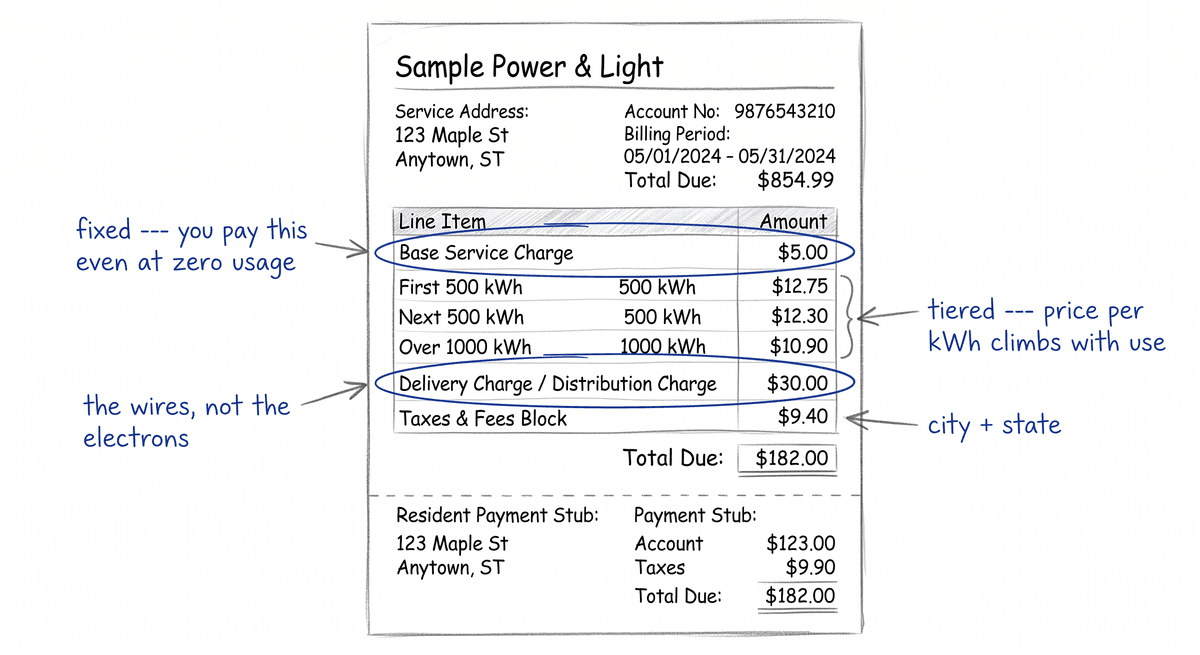
Ho-5: Understanding Your Utility Bill and Energy Options
Strategy: Decode + Research See also: M-6: Financial Coach (for budgeting utilities), Li-9: Making a Household Budget That Holds (utilities as a budget category) My Man Jeeves: It would appear that energy cost burden — the percentage of household income devoted to utilities — falls with particular severity upon low-income households, who expend nearly three times the proportion of their income on energy that median-income households do, while possessing the least access to the rebate programmes designed to address this disparity. The programmes, one should note, do exist. The difficulty presents itself not in their absence but in the rather considerable effort required to locate them. One’s Agent can locate them. The Spec:
I want to understand my utility bill and find out if there are
programs that could lower my costs. I’m in [state].
My situation: [renter/homeowner], household income approximately
[$range or “low income”], type of housing [apartment/house/mobile home].
Please:
1. Explain what the main charges on a typical utility bill mean
2. Tell me what rebate or assistance programs I likely qualify for
3. Give me the steps to apply for the most impactful one
What to do with the Output: Apply for the program your Agent identifies first — the one with the biggest impact and the simplest application. Most assistance programs are first-come, first-served and have enrollment windows. Do it today, not next billing cycle.
Ho-6: Getting a Home
Strategy: Navigate + Research See also: M-3: Mortgages, M-6: Financial Coach, L-1: Negotiating a Contract, Ho-4: Knowing Your Rights as a Renter or Homeowner My Man Jeeves: One might observe that finding a place to live is the most expensive decision most people make under the most considerable time pressure. The real estate industry has, over the years, perfected the art of manufacturing urgency — “multiple offers,” “will not last,” “act now” — in a market where the buyer or renter possesses less information than every other party at the table. The landlord knows the vacancy rate. The seller knows the inspection history. The estate agent knows the comparable sales. One knows, principally, that one requires a place to live by the first of the month. An Agent can level that asymmetry — not, it should be said, by rendering the market fair, but by ensuring that one enters it informed. The Spec:
I need to find a place to live.
My situation:
— What I’m looking for: [renting an apartment / renting a house /
buying my first home / relocating / leaving a bad housing situation /
currently unhoused and need immediate help]
— Location: [city, state, or area]
— Budget: [monthly rent or purchase budget]
— Timeline: [when I need to move by]
— Constraints: [pets, accessibility needs, school district,
commute distance, credit situation, income documentation]
Please help me:
1. Walk me through the process from where I am now to
having a signed lease or closing — what are the steps
and what order should I do them in?
2. What should I know about this specific market right now —
what is realistic for my budget?
3. What are the hidden costs I’m probably not thinking about
— application fees, deposits, moving costs, utilities setup?
4. What red flags should I watch for in listings, landlords,
or contracts?
5. If I’m in a crisis situation, what immediate resources
exist in my area?
What to do with the Output: Start with the financial math — not what you can pay, but what you can carry without stress. Housing cost below 30% of gross income is the standard guideline, but it is a ceiling, not a target. For renters: ask your Agent to help you read the lease before you sign it (see L-1). For buyers: get pre-approved before you start looking, not after you find the place you love (see M-3). For anyone in a housing crisis: 211.org and your local Continuum of Care are the first calls.
Science Note: The National Low Income Housing Coalition’s Out of Reach report puts the 2025 national Housing Wage — what a full-time worker must earn for a modest two-bedroom rental without spending more than 30% of income on housing — at $33.63 per hour, more than four times the federal minimum wage of $7.25. There is no state, metropolitan area, or county in the United States where a full-time minimum-wage worker can afford that unit.[4] When your Agent tells you what you “should” be able to afford at 30% of income, compare it to what’s actually available in your market — the gap is structural, not personal.
Veterans note: If you served on active duty — or as a National Guard or Reserve member with qualifying federal service — you may be eligible for a VA home loan, which requires no down payment, no private mortgage insurance, and no monthly PMI premium at any loan-to-value ratio. Since the Blue Water Navy Vietnam Veterans Act (2020), there is no maximum loan amount for first-time users with full entitlement; VA loans are also assumable by other VA-eligible buyers, which becomes valuable when interest rates rise. The VA funding fee is 2.15% for first use with less than 5% down, lower with a larger down payment or on a refinance, and is waived entirely for veterans with a service-connected disability rating, surviving spouses receiving DIC, and Purple Heart recipients on active duty. The Interest Rate Reduction Refinance Loan (IRRRL) allows streamlined refinancing of an existing VA loan with minimal documentation. VA appraisal standards are stricter than conventional; budget time for that. Ask your Agent: “I’m a [service status] looking to [buy / refinance]. Walk me through VA loan eligibility, the funding fee calculation for my situation, and how a VA loan compares to FHA and conventional for my purchase price and down payment.”[5]
Two more scenarios are worth asking your Agent about directly. First-time buyers should ask it to walk through down payment assistance — these programs exist in every state, and many qualifying buyers don’t know to ask. If you’re relocating rather than staying put, your Agent can generate the full cross-jurisdiction checklist — housing, utilities, vehicle registration and driver’s license, voter registration, a doctor and dentist, school enrollment if you have kids; a move involves roughly 40 administrative tasks across two jurisdictions.
Ho-7: Gardening & Landscaping
Strategy: Diagnose + Research (Expert Role) See also: Ch-3: Identifying and Caring for House Plants (for houseplants), Ho-1: Maintaining Your Home (for broader property care) My Man Jeeves: Master Gardeners are volunteers trained by the Cooperative Extension System to address precisely the questions one has regarding why one’s tomatoes have assumed their present appearance. Their services are provided without charge. They are also, one regrets to note, available by appointment, a fortnight from Tuesday, during business hours. An Agent, by contrast, is available now. The Spec:
Act as an experienced Master Gardener.
Here is my situation:
— Location / climate zone: [e.g., Zone 9b, Northern California]
— What I’m growing: [plant, variety if known]
— The problem: [describe what you’re seeing — yellowing leaves,
spots, wilting, not producing, pest damage, etc.]
— How long it’s been going on: [timeframe]
— Recent changes: [new fertilizer, watering change, weather event, etc.]
What is likely causing this, and what should I do?
What to do with the Output: Start with the least invasive intervention your Agent suggests. If the problem persists after one week, come back and describe what changed (or didn’t). The refinement loop applies to plants as well as paperwork.
Extended Expert Role specs for gardening:
Act as a Master Gardener. I want to start a vegetable garden in
[location, climate zone]. I have [square footage / container space].
I want to grow [goals: food for family / cut flowers / low maintenance].
My experience level is [beginner/intermediate].
What should I plant, when, and in what order of priority?
Act as a Master Gardener specializing in soil health.
My soil is [clay/sandy/unknown]. My plants seem to be
[struggling / doing fine but I want to improve].
What amendments should I add, and how do I apply them?
Ho-8: Household Disaster Preparedness
Strategy: Prepare + Research See also: M-8: Insurance You Actually Need (for documenting what you own before you need to), Ho-1: Maintaining Your Home (preventive maintenance is the first line of defense), IRL-9: Handling a Car Accident (the same “be ready before the crisis” mindset) My Man Jeeves: One observes that the federal government maintains a website — ready.gov — which advises citizens to prepare a 72-hour emergency kit, an evacuation plan, and a communication strategy. One further observes that the overwhelming majority of households have done none of these things, not because the advice is inaccessible but because the task presents itself as a single, undifferentiated mass of anxiety rather than a series of manageable steps. The structural difficulty is familiar: the people best positioned to weather a disaster are those who can afford to outsource the planning, while the people most likely to be displaced by one are expected to assemble the plan themselves, from scattered government PDFs, during a period of calm they cannot quite believe will end. An Agent can convert the undifferentiated mass into a checklist, prioritized by consequence, completed in stages, and tailored to the specific threats that apply where one actually lives. The Spec:
I want to create a household emergency preparedness plan.
My situation:
— Where I live: [city, state]
— Housing type: [apartment / house / mobile home / condo]
— Household: [number of adults, children, elderly, pets]
— Renter or owner: [renter / homeowner]
— Any mobility or medical needs: [describe, or “none”]
— Budget for supplies: [approximate, or “as little as possible”]
Please help me:
1. What are the most likely disasters or emergencies
in my area, ranked by probability?
2. Give me a 72-hour emergency kit list, prioritized
so I can build it over a few weeks, not all at once
3. Walk me through creating an evacuation plan for my
specific housing type — where do I go, what routes,
what do I grab?
4. What documents should I have copies of, and where
should I store them?
5. How do I set up a family communication plan — who
calls whom, what if phones are down?
Give me the most conservative, safety-first answer.
What to do with the Output: Do not try to do everything this week. Pick the three highest-priority items from your Agent’s list and do those first. A partial kit that exists is infinitely better than a complete plan that doesn’t. Store digital copies of your important documents in a cloud account you can access from any device — your Agent can tell you exactly which documents to photograph and how to organize them.
Ho-9: Decluttering and Organizing
Strategy: Diagnose + Navigate See also: Ch-5: Optimizing Manual Chores (for maintaining systems once you build them), Ho-1: Maintaining Your Home (decluttering is maintenance, not renovation) My Man Jeeves: One hesitates to suggest that the billion-dollar decluttering industry has a financial incentive to make the problem feel spiritual rather than logistical, but one does observe that the rhetoric of “sparking joy” has been rather more profitable for its inventor than for the average person standing in a 400-square-foot apartment wondering where the winter coats are meant to reside. The difficulty is not an excess of sentiment. The difficulty is an insufficiency of space, compounded by an absence of systems. An Agent can assess the space one actually has, propose storage arrangements that function within its constraints, and maintain the one-in-one-out discipline that prevents the problem from recurring — all without requiring that one hold each object and interrogate one’s feelings about it. The Spec:
I need help organizing and decluttering my [room / apartment /
house / specific area like garage, closet, kitchen].
My situation:
— Space: [approximate size, or “small apartment” / “house with
no storage” / “one closet for everything”]
— What’s overwhelming me most: [describe — too much stuff in
too little space / can’t find things / just moved / preparing
to move / specific problem area]
— Household: [living alone / with partner / with kids / roommates]
— Budget for storage solutions: [nothing / under $50 / flexible]
— Physical limitations: [if any — can’t lift heavy things,
mobility issues, etc.]
Please help me:
1. Give me a room-by-room (or zone-by-zone) priority list —
where should I start for the biggest impact?
2. For my first target area, give me a step-by-step plan
I can complete in one afternoon
3. What are affordable storage solutions for my specific
space constraints?
4. How do I set up a “one in, one out” system that actually
works for my living situation?
5. What should I donate vs. trash vs. sell, and where
specifically in [my city] can I do each?
What to do with the Output: Start with the first zone your Agent identifies — the one that will make the biggest daily difference. Do not reorganize the garage before you can find your keys. Set a timer for two hours, work the plan, and stop. Decluttering in marathon sessions leads to decision fatigue and a pile of things in the hallway that stays there for a month.
Monica’s systems work because organizing is the right tool for her problem. It isn’t always the right tool.
Ho-10: Home Security and Safety
Strategy: Research + Decide See also: Ho-1: Maintaining Your Home (smoke detector batteries are maintenance, not security), Ho-8: Household Disaster Preparedness (security is one layer of a broader safety plan), Ho-4: Knowing Your Rights as a Renter or Homeowner (what your landlord is legally required to provide) My Man Jeeves: The residential security-alarm industry in the United States generates upwards of $38 billion annually — a figure that should prompt the observation that its primary product is not security but the feeling of security, a distinction upon which rather a lot of profit depends.[11] A deadbolt, properly installed, does more than a subscription camera service. A smoke detector with a functioning battery does more than a monitored alarm system. The fundamentals are mechanical, inexpensive, and effective. The industry prefers to sell past them. An Agent can assess what one actually needs — based on one’s housing type, neighbourhood, and specific concerns — and distinguish the measures that reduce risk from those that merely reduce anxiety at a monthly fee. The Spec:
I want to make my home safer and more secure.
My situation:
— Housing type: [apartment / house / condo / mobile home]
— Renter or owner: [renter / homeowner] (this affects what I
can install)
— Current security: [describe what you already have — locks,
cameras, alarm, smoke detectors, fire extinguisher, or “nothing”]
— Specific concerns: [break-ins / package theft / fire safety /
carbon monoxide / I have kids and want to childproof / general
safety audit / a specific incident happened]
— Budget: [minimal / moderate / flexible]
Please help me:
1. Audit what I currently have — what’s missing from
the basics?
2. Prioritize improvements by actual risk reduction, not
marketing — what makes the biggest real difference
for my housing type?
3. What should I do myself vs. what requires a
professional installation?
4. For any products you recommend, give me the category
and what to look for — not a specific brand
5. If I’m a renter, what am I allowed to install, and
what must my landlord provide?
Give me practical, evidence-based recommendations.
I don’t want to be sold a subscription I don’t need.
What to do with the Output: Start with the items your Agent flags as missing from the basics — working smoke detectors on every level, a CO detector near sleeping areas, a fire extinguisher in the kitchen, and functional deadbolts on exterior doors. These are not optional. They are the safety equivalent of seatbelts. Everything after that is risk-specific and budget-dependent. If you rent, check your Agent’s output against Ho-4 — your landlord may be legally required to provide several of these.
Science Note: The evidence on visible cameras as deterrents is genuinely mixed. Welsh and Farrington’s systematic review of 44 CCTV evaluations found a modest 16% overall reduction in crime in surveilled areas — concentrated in car parks (51% reduction in vehicle crime) and effectively zero for violent crime; a newer 40-year meta-analysis by Piza, Welsh, Farrington, and Thomas found broadly similar results.[13] The honest summary: cameras are better at recording incidents than preventing them, and a doorbell camera is a documentation tool, not a deterrent. Match the tool to the actual risk — package theft (documentation), break-ins (locks and lighting first). Violent confrontation from someone who already has access to your home is a different problem, and hardware isn’t the fix for it.
-
[1] Desmond, M. (2016). Evicted: Poverty and Profit in the American City. Crown. Hepburn, P., Louis, R., & Desmond, M. (2020). “Racial and Gender Disparities among Evicted Americans.” Sociological Science, 7, 649–662. Eviction Lab (2025). “Preliminary Analysis: Eviction Filing Patterns in 2024.” Princeton University.↩
-
[2] Servicemembers Civil Relief Act, 50 U.S.C. §§ 3901–4043. U.S. Department of Justice, Servicemembers and Veterans Initiative, “Financial and Housing Rights.” Military OneSource, “SCRA, The Servicemembers Civil Relief Act.” Rent-ceiling figure under 50 U.S.C. § 3951(a)(1)(A)(ii) from Department of Defense, “Notice of Publication of Housing Price Inflation Adjustment,” 90 Fed. Reg. 21473 (May 20, 2025), effective Jan. 1, 2025.↩
-
[3] National Fair Housing Alliance. Fair Housing Trends Report. Published annually; disability consistently accounts for more than half of all fair housing complaints. HUD Office of Fair Housing and Equal Opportunity, “Assistance Animals,” including FHEO Notice 2020-01 on evaluating reasonable accommodation requests (January 2020). Fair Housing Act disability provisions: 42 U.S.C. § 3604(f).↩
-
[4] National Low Income Housing Coalition (2025). Out of Reach 2025: The High Cost of Housing. Annual report comparing Housing Wage to prevailing wages by state, metro, and county.↩
-
[5] U.S. Department of Veterans Affairs. “VA-backed home loans.” Funding fee rates, exemptions, and IRRRL program details at VA.gov. Blue Water Navy Vietnam Veterans Act of 2019 (Pub. L. 116–23) eliminated the conforming loan limit for first-use borrowers with full entitlement.↩
-
[6] The break-even calculation depends on mortgage rate, home appreciation, investment returns, property taxes, maintenance, and transaction costs; five to seven years is the typical range in moderate-cost markets at historical average rates. For a localized calculation: New York Times, “Is It Better to Rent or Buy?”. For the academic framework: Beracha, E. & Johnson, K.H. (2012). “Lessons from Over 30 Years of Buy versus Rent Decisions.” Real Estate Economics, 40(2), 217–247.↩
-
[7] Federal Emergency Management Agency. (2025). 2024 National Household Survey on Disaster Preparedness — Findings. Fielded Q3–Q4 2024; published 2025. See also the FEMA National Preparedness resources on writing a family emergency plan.↩
-
[8] Klinenberg, E. (2002). Heat Wave: A Social Autopsy of Disaster in Chicago. University of Chicago Press. Bullard, R.D. & Wright, B. (Eds.) (2009). Race, Place, and Environmental Justice After Hurricane Katrina: Struggles to Reclaim, Rebuild, and Revitalize New Orleans and the Gulf Coast. Westview Press.↩
-
[9] Iyengar, S.S. & Lepper, M.R. (2000). “When Choice Is Demotivating: Can One Desire Too Much of a Good Thing?” Journal of Personality and Social Psychology, 79(6), 995–1006. The choice overload effect — decision quality degrades as options increase — applies directly to the hundreds of keep-or-discard decisions decluttering demands.↩
-
[10] Postlethwaite, A., Kellett, S., & Mataix-Cols, D. (2019). “Prevalence of Hoarding Disorder: A systematic review and meta-analysis.” Journal of Affective Disorders, 256, 309–316 (pooled prevalence 2.5%). See also the International OCD Foundation and American Psychiatric Association, “Hoarding Disorder.”↩
-
[11] IBISWorld. (2025). “Security Alarm Services in the US — Industry Analysis.” Industry revenue of approximately $38.6 billion in 2025, not including separate segments such as locksmiths, smart-home security hardware, or monitored fire services.↩
-
[12] McGree, T. (2024). “Smoke Alarms in US Home Fires.” National Fire Protection Association. See also NFPA (2024), “Smoke Alarms at Home” for ownership and testing rates from the September 2024 national survey.↩
-
[13] Welsh, B.C. & Farrington, D.P. (2009). “Public Area CCTV and Crime Prevention: An Updated Systematic Review and Meta-Analysis.” Justice Quarterly, 26(4), 716–745. Piza, E.L., Welsh, B.C., Farrington, D.P., & Thomas, A.L. (2019). “CCTV surveillance for crime prevention: A 40-year systematic review with meta-analysis.” Criminology & Public Policy, 18(1), 135–159.↩
-
[14] National Domestic Violence Hotline. “Technology-Facilitated Abuse.” See also the Safety Net project at NNEDV, which publishes guides on auditing smart-home devices and shared accounts in abusive situations.↩