Chores
The domestic labor that keeps a household running — shopping, cooking, cleaning, maintaining, scheduling — is invisible until it stops happening. It is also where most consumer decisions are made: which products to buy, which contractors to hire, which repairs to attempt, which to outsource. The billionaire class delegates this to staff who comparison-shop, vet vendors, and manage maintenance schedules. Everyone else does it in the margins of a full workday, making decisions under time pressure with whatever information is on the label or the first page of search results. The Skills that follow turn your Agent into the household staff you don’t have.
Ch-1: Shopping Your Values
Strategy: Research + Decide See also: Ch-4: Cooking and Culinary Skills (for what to do with what you bought), Ho-3: Right-to-Repair (for durable goods), H-8: Wellness and Nutrition Coach (for dietary needs) My Man Jeeves: One might observe that every purchase constitutes a small policy decision, conducted under time pressure with information that is, at best, inadequate. The distinction between “free range” and “cage-free” eggs, for instance, is a regulatory matter that costs the consumer $2 per dozen and approximately an hour of research to verify — a ratio that would give any reasonable person pause. The difference between a $40 toaster that expires in two years and a $90 toaster that endures for 15 is, regrettably, invisible at point of sale and conspicuous only in retrospect. In well-staffed households, procurement is handled by persons who source by quality, ethics, durability, and price in whatever combination the household prefers. The remainder of the population is furnished with a label, a search engine optimized for advertising revenue, and 11 minutes before the shop closes. It may be worth noting that one’s Agent is capable of evaluating all four dimensions simultaneously, unencumbered by sponsored results. The Spec:
I need to buy [product or grocery item].
My priorities, in order: [rank these or remove ones you
don’t care about]
— Price: [budget or range]
— Ethics: [labor practices, environmental impact,
animal welfare, local sourcing]
— Durability: [how long should it last, repairability]
— Certifications that matter to me: [organic, Fair Trade,
B Corp, union-made, specific labels]
My constraints: [where I can shop, delivery needs, timeline]
Please:
1. Recommend specific products or brands that match my priorities
2. Explain what the relevant certifications actually mean —
not the marketing, the standard
3. Flag any greenwashing or misleading labels I should watch for
4. If my priorities conflict (e.g., ethical + cheapest),
show me the tradeoff honestly
What to do with the Output: Start with one category you buy regularly — eggs, coffee, cleaning supplies, whatever you spend the most on without thinking. Run it through your Agent once. The research compounds: once you know which brands align with your values, the weekly shop gets faster, not slower.
Ch-2: Understanding a Contractor Bid
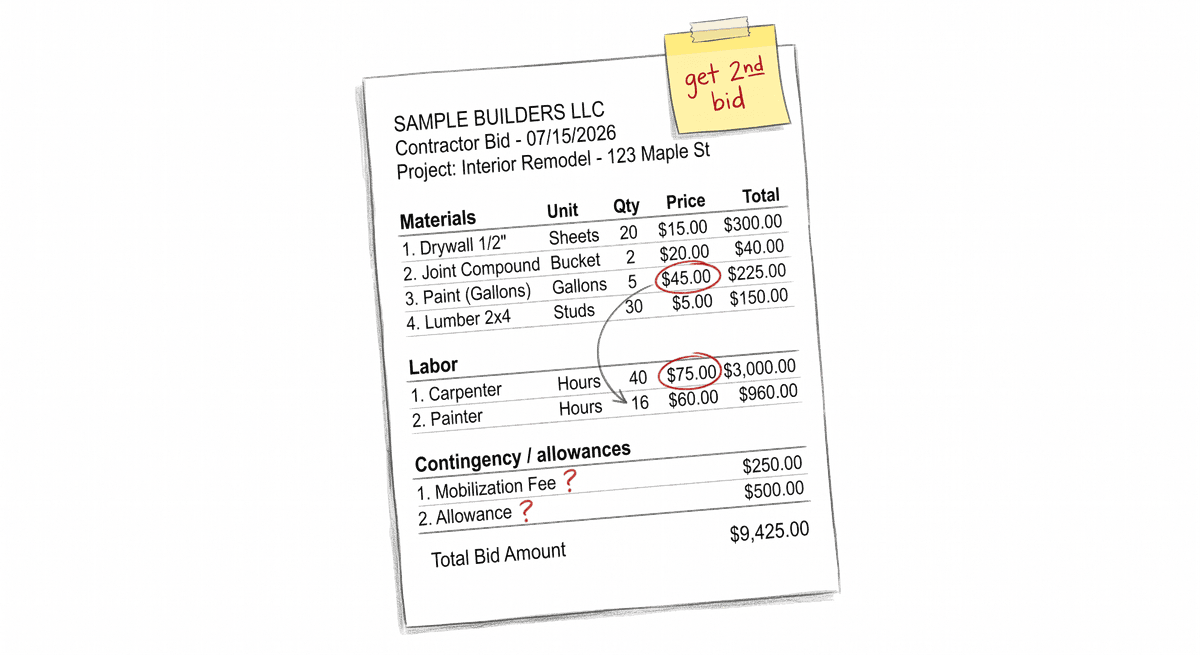
Strategy: Decode + Research See also: L-1: Negotiating a Contract (the bid becomes a contract), Ho-2: Home Repair and DIY (should you even hire someone?), Ho-1: Maintaining Your Home (for diagnosing the problem first) My Man Jeeves: A contractor bid is a document that proceeds on the assumption that one knows what one is looking at. It enumerates materials one cannot evaluate, labour rates one cannot benchmark, and timelines one cannot verify, then requests a signature at the bottom. The contractor, one might note, has composed hundreds of such documents. The homeowner has perhaps encountered three in a lifetime, all for different trades, none of which adequately prepared one for the present specimen. This asymmetry is not, in the main, a matter of dishonesty — the majority of contractors are perfectly reputable — but it does present a difficulty: the honest tradesman and the dishonest one produce documents of remarkably similar appearance, and distinguishing between the two requires research that most households have neither the time nor the background to conduct. One’s Agent, having reviewed thousands of such bids, is rather better positioned to assess what each line item ought to cost in one’s area. The Spec:
I received a contractor bid. [Paste the bid text, or describe
the line items and totals.]
The project: [what the work is — roof replacement, bathroom
remodel, deck repair, HVAC install, etc.]
My location: [city/region, for cost benchmarking]
Please:
1. Explain each line item in plain language — what it is,
why it’s there, and whether the price is in the normal
range for my area
2. Flag anything that seems unusually high, unusually low,
or missing
3. Identify what’s not in this bid that should be —
permits, cleanup, warranty, disposal, contingency
4. Tell me what questions to ask the contractor before signing
5. If this is a “fast, cheap, or done right — pick two”
situation, which two is this bid optimizing for?
What to do with the Output: Get at least two more bids for comparison — your Agent can tell you what to ask for to make the bids comparable. The lowest bid is not the best bid. The bid that accounts for the most contingencies usually is. Before signing, read the bid with L-1: Negotiating a Contract — once you sign, the bid becomes the contract.
Ch-3: Identifying and Caring for House Plants
Strategy: Diagnose + Research (Expert Role) See also: Ho-7: Gardening & Landscaping (for outdoor plants), Ch-1: Shopping Your Values (before buying the next one) My Man Jeeves: It would appear that the houseplant industry sells one a living organism accompanied by a plastic tag reading “bright indirect light” and “water when dry” — instructions of such imprecision that they might apply equally to a cactus or a fern, two species whose survival requirements are, if one may say so, diametrically opposed. The plant then expires, and the owner arrives at the conclusion that they lack a “green thumb,” which is a character trait the horticultural trade appears to have invented to account for the fact that they sold one a tropical understory species and disclosed nothing material about it. An interior landscaper in a properly staffed household would know the species, the light requirements, the humidity range, and the watering schedule. One’s Agent possesses the same knowledge and is, moreover, capable of identifying the plant from a photograph. The Spec:
Act as an experienced indoor plant specialist.
Here is my situation:
— The plant: [name if known, or describe it — leaf shape,
size, any flowers, the tag if you still have it.
Or: send a photo.]
— The problem: [yellowing leaves / brown tips / drooping /
dropping leaves / white spots / bugs / not growing /
just bought it and want to keep it alive]
— My conditions: [which direction do the windows face,
how much light does the spot get, how often do I water,
do I use tap water or filtered, is there a heating vent
or AC draft nearby]
— My skill level: [I’ve killed every plant I’ve owned /
I keep a few alive / I have a collection]
Please:
1. Identify the plant if I haven’t, and tell me its actual
care requirements — not the tag version
2. Diagnose what’s likely wrong based on my description
3. Give me a specific care routine: how often to water,
how to check if it needs water, light and humidity needs
4. Tell me the one thing most people get wrong with this
species
What to do with the Output: Change one variable at a time and wait two weeks before concluding it didn’t work. Plants respond slowly. If the diagnosis is “too much water,” your job is to resist watering for longer than feels comfortable. Most houseplants are killed by overwatering, not neglect.
Ch-4: Cooking and Culinary Skills
Strategy: Research + Diagnose (Expert Role) See also: Ch-1: Shopping Your Values (for sourcing ingredients), H-8: Wellness and Nutrition Coach (for dietary guidance) My Man Jeeves: Culinary school, one might note, costs between $20,000 and $100,000. The core knowledge it transmits — the reasons things cook as they do, the method of correcting a dish that has gone astray, which substitutions succeed and on what principle — is thoroughly documented and has been set forth in considerable detail by every food science writer since Harold McGee. One’s Agent has read Harold McGee. The Spec:
Act as a culinary instructor.
The dish or technique I’m working on: [describe]
What went wrong (or what I want to improve): [describe specifically]
My equipment and skill level: [describe]
What am I doing wrong, and what should I do differently?
What to do with the Output: Follow the technique once exactly as described before adjusting. Cooking is chemistry — changing two variables at once means you will never know which one mattered. Keep a notes file on your phone for what worked and what did not.
Common culinary Expert Role specs:
Act as a culinary instructor. I want to learn [technique:
how to properly sauté / how to make a pan sauce / how to
sharpen a knife / how to make stock from scratch].
Explain the underlying principle and the step-by-step method.
Act as a culinary instructor. My [dish] came out [problem:
too salty / rubbery / bland / fell apart / didn’t set].
What went wrong and how do I fix it — or if it’s too late to fix,
how do I prevent it next time?
Ch-5: Optimizing Manual Chores
Strategy: Diagnose + Navigate (Expert Role) See also: Ho-1: Maintaining Your Home (for home systems maintenance), H-8: Wellness and Nutrition Coach (when physical limitations affect chore capacity). Oliver Burkeman, Four Thousand Weeks (accepting finite capacity instead of optimizing your way to burnout) My Man Jeeves: Domestic labour presents itself as perhaps the only category of work that is simultaneously essential, unpaid, invisible, and expected to organize itself. A factory managing the same number of recurring tasks — laundry, dishes, floors, surfaces, bathrooms, refuse, meals, groceries — would employ a process engineer, maintain a schedule, and follow a workflow. A household, by contrast, has one person who noticed the bathroom required attention and two who did not, together with a vague mutual understanding that “we should be better about this” — an understanding that has not, in recorded history, produced a system. In a properly staffed household, one finds task lists, schedules, and supply inventories. One’s Agent is capable of constructing the same infrastructure for the staff one actually has, which is to say, oneself. The Spec:
Act as a household operations consultant.
My household: [how many people, ages, any mobility or
health limitations, pets]
My living situation: [apartment/house, approximate size]
The chores I’m trying to manage: [list them — laundry,
dishes, floors, bathrooms, kitchen deep clean, trash/recycling,
grocery shopping, meal prep, yard work, etc.]
My biggest pain points: [what falls through the cracks,
what causes friction, what takes the most time]
My schedule constraints: [work hours, when I have time
for chores, how much time per day/week I can realistically
spend]
Please:
1. Build a weekly chore schedule that distributes tasks
across available time — don’t front-load everything
into Saturday
2. For each task, give me the minimum effective version
(how to do it well in the least time) and how often
it actually needs to happen
3. Identify which tasks can be batched, which benefit from
a fixed day, and which are better done in small daily
increments
4. Flag where the household friction is likely coming from
and suggest a system, not a conversation
What to do with the Output: Print the schedule or put it on a shared digital calendar. The system only works if everyone in the household can see it. Run it for two weeks before adjusting — most chore systems fail because they get revised after three days, before anyone has had a chance to build the habit.
Ch-6: Meal Planning and Grocery Shopping
Strategy: Research + Prepare See also: Ch-4: Cooking and Culinary Skills (for what to do once you’re in the kitchen), Ch-1: Shopping Your Values (for sourcing and certification), Li-9: Making a Household Budget That Holds (for the financial side), H-8: Wellness and Nutrition Coach (for dietary needs) My Man Jeeves: One observes that the average household disposes of roughly 30% of the food it purchases — a figure that would prompt an inquiry at any reasonably managed institution. The difficulty is not, in the main, one of appetite or intention. It is a planning problem conducted under conditions that would defeat most logistics professionals: variable schedules, unpredictable preferences, perishable inventory with no standardized shelf life, and a weekly budget that must account for nutrition, taste, household politics, and whatever happens to be on sale. The household that employs a cook also employs a person who plans meals before writing the shopping list, not after. This is the sequence that matters. One’s Agent is capable of working backward from what one wishes to eat, through what one already has, to what one actually needs to buy — a reversal that reliably reduces both the bill and the bin. The Spec:
I need to plan meals for the week and build a grocery list.
My household: [number of people, ages, any dietary
restrictions or preferences]
My budget: [weekly grocery budget, or “as low as reasonable”]
What I already have: [check your fridge, freezer, and pantry
— list anything that needs to be used soon]
My schedule this week: [which nights are busy, when do I
have time to cook, any nights eating out]
My cooking skill and effort level: [be honest — 20 minutes
max on weeknights / I can do an hour on Sunday / I hate
cooking but I need to eat]
Please:
1. Suggest 5–7 dinners that share ingredients to minimize
waste and cost — show me the overlap
2. Build a grocery list organized by store section, with
estimated prices for my area
3. Flag which items are worth buying in bulk or frozen vs. fresh
4. Identify what I should prep on Sunday to make weeknights
faster
5. Estimate total grocery cost for the week
What to do with the Output: The hardest part of feeding a household is not the cooking. It is the deciding — what to make, what to buy, what everyone will eat. That daily cognitive load is what meal planning offloads to your Agent. Start with one week. Do not plan a month — you will not follow it. Run the plan, note what you actually ate and what went to waste, and feed that back to your Agent the following week. The plan improves as the data improves. After three weeks, your Agent knows your household better than any meal kit service.
Ch-7: Cleaning and Laundry
Strategy: Research + Navigate (Expert Role) See also: Ch-5: Optimizing Manual Chores (for scheduling and systems), Ho-1: Maintaining Your Home (cleaning is maintenance) My Man Jeeves: It is perhaps worth observing that garment care labels employ a system of hieroglyphics that the International Organization for Standardization published in 1971 and has not, in any meaningful sense, explained to the public since. The triangle means bleach. The circle means dry clean. The number of dots inside the iron means something one has either memorized or has not — and the consequence of guessing incorrectly is a $60 sweater reduced to a size suitable for a medium-sized cat. Similarly, the cleaning product aisle offers approximately 40 specialized solutions for surfaces that require, in practice, about four. The household that employs staff finds these matters handled by persons who know that wool felts in hot water, that bleach and ammonia must never meet, and that the “stainless” in stainless steel is aspirational. One’s Agent possesses this same knowledge and is available at the moment the red wine hits the white shirt, which is to say, the moment it is actually needed. The Spec:
Act as a textile care and cleaning specialist.
My situation: [choose one or more]
— Stain emergency: [what stain, what fabric, how long ago,
what I’ve already tried]
— Laundry question: [specific garment or fabric I don’t know
how to wash, what the care label says if I can read it]
— Cleaning question: [what surface or area, what the mess is,
what products I have on hand]
— General: I want to understand what cleaning products I
actually need and what’s redundant
Please:
1. Give me the specific fix or method, step by step
2. Explain why it works (the chemistry, briefly) so I can
generalize to similar problems
3. Tell me what will make it worse — the thing most people
try first that sets the stain or damages the surface
4. If I need a product I probably don’t have, tell me what
common household item substitutes
What to do with the Output: For stain emergencies, act immediately — stains set with time and heat. For laundry sorting and product questions, save your Agent’s answers in a note on your phone. You will look this up again. Build a household cleaning reference over time: one conversation for stains, one for surfaces, one for laundry. After a few sessions, you will know 90% of what you need and only consult for the unusual cases.
Ch-8: Pet Care and Training
Strategy: Research + Navigate (Expert Role) See also: H-8: Wellness and Nutrition Coach (same Expert Role pattern for a different species), Ch-1: Shopping Your Values (pet food and products), Li-1: Preparing for a Difficult Conversation (for end-of-life decisions with your vet) My Man Jeeves: The pet industry generates approximately $150 billion in annual revenue in the United States alone — a figure that rather complicates the notion that one is simply caring for an animal. One is, in fact, navigating a market that sells grain-free dog food for $80 a bag on the basis of a theory whose scientific support remains contested (the FDA’s investigation found a correlation with dilated cardiomyopathy but not definitive causation), training services at $150 per session from practitioners who may hold no credential of any kind, and “wellness plans” at the veterinary office that bundle services one’s pet may not require. Meanwhile, the questions that actually determine an animal’s quality of life — appropriate nutrition for the species and breed, exercise requirements, behavioural needs, when a symptom warrants a vet visit and when it does not — are answerable from the veterinary literature, which the average pet owner has neither the time nor the training to consult. One’s Agent has read the literature. It cannot examine one’s pet, but it can prepare one for every conversation with someone who can. The Spec:
Act as a veterinary-informed pet care advisor.
(You are not a veterinarian. You cannot diagnose or treat.
You can help me prepare for vet visits, understand my options,
and make informed decisions.)
My pet: [species, breed if known, age, weight, spayed/neutered,
any known health conditions]
My question: [choose one or more]
— Behavior: [describe the behavior, when it started, triggers,
what I’ve tried]
— Nutrition: [what I’m currently feeding, any concerns, budget]
— Health: [symptom I’m seeing, how long, severity — or:
preparing for a vet visit and want to know what to ask]
— Training: [what I want to teach, what isn’t working,
my pet’s history with training]
— Life stage: [new pet setup / senior care / end-of-life
planning]
Please:
1. Give me the evidence-based answer, not the pet store answer
2. If this warrants a vet visit, say so clearly and tell me
what to tell the vet
3. If this is a training or behavior issue, use positive
reinforcement methods only
4. Tell me what the pet industry is likely to upsell me on
and whether it’s worth it
What to do with the Output: For health concerns, your Agent is triage, not treatment. If it says “see your vet,” see your vet — and bring the Agent’s summary with you. For training, consistency matters more than technique: get everyone in the household on the same protocol before you start. For nutrition, make one change at a time and observe for two weeks. For end-of-life decisions, your Agent can walk you through quality-of-life assessment scales and help you prepare for the conversation with your vet — but it cannot make the decision. See Li-1: Preparing for a Difficult Conversation.
Common pet care Expert Role specs:
Act as a veterinary-informed pet care advisor. I just adopted a
[species, age, breed]. What do I need for the first two weeks —
supplies, vet visit checklist, household setup, and the most
common new-owner mistakes for this species?
Act as a positive-reinforcement animal trainer. My [species]
[behavior: won’t stop barking / scratches furniture / bites /
pulls on leash / won’t use the litter box / is aggressive with
other animals]. What is this behavior communicating, and what’s
the evidence-based approach?
Act as a veterinary-informed pet care advisor. My [species] is
[age] and showing signs of [symptom]. I have a vet appointment
on [date]. Help me prepare: what should I observe and record
before the visit, what questions should I ask, and what tests
or treatments might the vet recommend?
Ch-9: Seasonal Maintenance
Strategy: Prepare + Navigate See also: Ho-1: Maintaining Your Home (for ongoing maintenance), Ho-2: Home Repair and DIY (for when maintenance reveals a repair), Ch-5: Optimizing Manual Chores (for scheduling the recurring tasks) My Man Jeeves: A house, if one may observe, operates on a calendar that its occupants rarely consult. The gutters require attention in autumn. The HVAC filters require replacement quarterly. The water heater requires flushing annually — a task that a vanishingly small fraction of homeowners perform, the remainder discovering the consequence when the unit fails, which it does, on average, at the 10-year mark, on a Saturday, when plumbers charge emergency rates. The difficulty is not that these tasks are complex. Most require 30 minutes and no specialized skill. The difficulty is that no one mentions they need doing until the consequence arrives, at which point the cost of the repair is several multiples of the cost of the prevention. In a properly maintained household, one finds a seasonal checklist and a person who follows it. One’s Agent can produce the checklist. The person, regrettably, must be supplied independently. The Spec:
I need a seasonal home maintenance checklist.
My home: [house / apartment / condo / rental — if renting,
note what maintenance is your responsibility vs. landlord’s]
My region: [city or climate zone — this affects timing for
winterizing, pest prevention, hurricane/wildfire prep, etc.]
My home’s specifics: [age of home, type of heating/cooling,
roof type, basement or crawl space, septic or municipal
sewer, any known issues]
Current season approaching: [spring / summer / fall / winter]
My skill level: [total beginner / can handle basic tools /
fairly handy]
Please:
1. Give me the complete checklist for the approaching season,
in priority order — most consequential if skipped first
2. For each task, tell me: what it prevents, how long it takes,
whether I can do it myself, and estimated cost if I hire out
3. Flag anything that’s time-sensitive — tasks with a deadline
(before first freeze, before rainy season, etc.)
4. Separate “essential” tasks from “ideal” tasks — I may not
get to everything
5. Note which tasks a renter should request from their landlord
and how to make that request
What to do with the Output: Put the deadlines on your calendar now — not the tasks, just the deadlines. “Check gutters before November 15” is more useful than a checklist you save and forget. Set a recurring reminder for each season. After one full year, you will have a personalized maintenance calendar that accounts for your specific home, and the emergency repair calls will drop dramatically. If nobody in your family owned a home before you, none of this was obvious — you learned by emergency, and each emergency cost more than the maintenance would have. This checklist is the institutional knowledge you were not given.
Ch-10: Managing Subscriptions and Recurring Costs
Strategy: Decode + Assert See also: M-1: Banking and Savings (for spotting charges), M-2: Credit Cards and Debt (for the audit trail), IRL-2: Getting Help from Customer Service (for the cancellation call) My Man Jeeves: One might observe that the subscription model has achieved a remarkable efficiency: it converts a single purchasing decision into an indefinite revenue stream, secured by the knowledge that the consumer will, in the majority of cases, forget it exists. The average American maintains approximately 12 paid subscriptions and underestimates the monthly total by roughly 80% — a gap between perception and expenditure that the industry has, one cannot help but notice, very little incentive to close. Cancellation, when attempted, encounters a friction that is precisely calibrated: not so difficult as to invite regulatory scrutiny, but sufficiently inconvenient to discourage all but the most determined. In well-managed households, a financial officer reviews recurring charges quarterly. One’s Agent is capable of conducting this audit in approximately 10 minutes, provided one is willing to look at the number. The Spec:
I need to audit my subscriptions and recurring charges.
Here is my information: [choose one or more]
— I’ll paste my credit card or bank statement showing
recurring charges: [paste the charges]
— Subscriptions I know about: [list them with monthly cost]
— I think I’m paying for things I don’t use but I’m not
sure what
Please:
1. Identify every recurring charge and categorize them:
actively using / occasionally using / forgot I had this /
free trial I never cancelled
2. Calculate my total monthly and annual subscription spend
3. Flag any charges that look like they’ve increased since
I signed up (common with introductory pricing)
4. For each subscription I want to cancel, tell me exactly
how to cancel — website path, phone number, what to say,
and any retention offers I might be offered
5. Identify where I’m paying for overlapping services
(multiple streaming, multiple cloud storage, etc.)
What to do with the Output: Cancel at least one thing today. Not tomorrow, not “this weekend” — today. The activation energy for subscription cancellation drops to zero if you do the first one immediately. For services with cancellation dark patterns (looking at you, every gym and cable company), see IRL-2: Getting Help from Customer Service for the exact script.
-
[1] Rubinstein, J.S., Meyer, D.E. & Evans, J.E. (2001). “Executive control of cognitive processes in task switching.” Journal of Experimental Psychology: Human Perception and Performance, 27(4), 763–797. For the OT application to household activity planning, see Omura, K.M. et al. (2022). “Energy conservation, minimum steps, and adaptations when needed: A scoping review.” Hong Kong Journal of Occupational Therapy, 35(2), 125–136.↩
-
[2] Milkie, M.A., Sayer, L.C., Nomaguchi, K. & Yan, H.X. (2025). “Who’s doing the housework and childcare in America now?” Socius, 11. Using ATUS 2003–2023 data: married women average 17.7 hours/week of housework vs. 11.2 for married men (60.8% women’s share). The gap widens with children.↩
-
[3] U.S. Department of Agriculture, Economic Research Service. “Food Loss and Waste.” ERS estimates that 30–40% of the US food supply is lost or wasted, costing the average household over $1,500 annually.↩
-
[4] NRDC (2017). “Wasted: How America Is Losing Up to 40 Percent of Its Food.” Meal planning consistently appears in food waste reduction literature as among the most effective household-level strategies.↩
-
[5] University extension textile care guides consistently categorize stains by chemistry: protein (cold water + enzyme), tannin (oxidizer), and grease (surfactant). See e.g. University of Missouri Extension, “Stain Removal From Washable Fabrics” (MP663) — a North Central Regional Cooperative Extension stain-care guide.↩
-
[6] Bureau of Labor Statistics, Consumer Price Index for Veterinary Services (see also BLS, “A ‘tail’ of productivity in pet care services”, 2024). Veterinary costs have risen significantly faster than general inflation over the past decade. See also AVMA data on cost as a barrier to veterinary care.↩
-
[7] American Veterinary Society of Animal Behavior. “Position Statement on Humane Dog Training.” AVSAB recommends reward-based training and advises against dominance-based methods.↩
-
[8] Preventive maintenance cost estimates derive from industry consensus (National Association of Home Builders, Freddie Mac Caring for Your Home, Fannie Mae). The 1–4% of home value per year range accounts for home age: newer homes trend toward 1%, older homes toward 3–4%.↩
-
[9] C+R Research. (2022). “Consumer Subscription Spending Report.” Survey of 1,000 US consumers found average monthly subscription spend of $219 vs. self-estimated $86.↩
-
[10] Federal Trade Commission. (2024). “Click-to-Cancel Rule.” Finalized October 2024; vacated by the Eighth Circuit Court of Appeals, July 2025. Status in flux at time of publication.↩