Money
This is capitalism at its purest: every financial product you encounter — the credit card, the mortgage, the retirement account, the insurance policy — was designed by someone with more information than you, priced to extract the maximum you will pay, and marketed to obscure the extraction. That is not conspiracy. It is the system working as intended. The billionaire class navigates it with accountants, attorneys, and fee-only advisors on retainer. The Conners navigated it with a kitchen table, a checkbook, and whatever Dan remembered from his father. Your Agent has read the same financial literature the advisors cite. The Skills that follow are not about beating the system. They are about understanding it well enough to stop losing to it by default.
M-1: Banking and Savings
Strategy: Research + Decide See also: M-2: Credit Cards and Debt (for credit products), Li-9: Making a Household Budget That Holds My Man Jeeves: One might observe that the typical American household leaks $200 to $300 a year in bank fees — maintenance fees, overdraft fees, minimum-balance fees, out-of-network ATM fees — for the privilege of depositing money that the bank then lends out at a considerable multiple. That this arrangement is considered normal would appear to be a triumph of institutional inertia over arithmetic. Credit unions, online banks, and high-yield savings accounts present themselves as alternatives, and yet most individuals remain with the bank at which they opened their first account — a loyalty that, if one may say so, rather resembles dining at the first restaurant one ever visited for the remainder of one’s life. One’s Agent can compare the alternatives in approximately the time it takes the bank to charge the next fee. The Spec:
I want to make sure my banking setup is actually working for me.
My situation:
— Current bank: [name, type — big bank, credit union, online]
— What I use it for: [checking, savings, direct deposit, bill pay]
— What annoys me: [fees, low interest, bad app, minimum balance
requirements, ATM access, customer service]
— Monthly balance range: [rough — this affects what accounts make sense]
Please help me:
1. Understand what I’m currently paying in fees — visible and hidden
2. Compare my options: big bank vs. credit union vs. online bank
— what’s the actual difference for someone like me?
3. Find a high-yield savings account — what’s the current rate
and what should I watch out for?
4. Set up a system: which accounts should I have, what goes where,
and how do I automate it so I don’t think about it?
What to do with the Output: If you are paying monthly maintenance fees, switch. This is not complicated and it is not disloyal. Your bank is not your friend — it is a business, and the fee schedule is where the business model shows.
Where to switch depends on what you need. A credit union is a cooperative owned by its members, which means its incentives are structurally different from a for-profit bank. Online banks (Ally, Marcus, Discover) offer higher interest rates because they have no branches to maintain. If you deposit cash regularly, you need a branch. If you don’t, you probably don’t need a big bank.
M-2: Credit Cards and Debt
Strategy: Decode + Assert See also: M-1: Banking and Savings, M-4: Collections and Bankruptcy (when debt goes wrong) My Man Jeeves: It would appear that credit card statements have been arranged so as to display the minimum payment with some prominence while relegating the total interest one will pay over time to a typeface calibrated, one suspects, to discourage closer inspection. A card at a typical 21% APR — and more than 23% on new offers — transforms a $5,000 balance, at minimum payments, into a repayment spanning decades and costing thousands in interest. The instrument was marketed as a convenience. It was designed as a revenue mechanism. Appreciating the distinction between these two propositions is the first step. Disputing the errors is the second. One’s Agent is prepared to assist with both. The Spec:
I want to understand and manage my credit card and debt situation.
My situation:
— Credit cards: [list cards, balances, APRs if known]
— Other debt: [student loans, car loan, medical debt, personal loans]
— Monthly income after taxes: [amount]
— Minimum payments total: [amount]
— What’s stressing me: [can’t make minimums / drowning in interest /
don’t understand my statements / got a charge I don’t recognize /
want a payoff strategy / need to negotiate with creditors]
Please help me:
1. Understand what I’m actually paying in interest — the real number,
not the minimum payment
2. Build a payoff strategy: which debt to attack first and why
(avalanche vs. snowball, and which is right for me)
3. Identify any charges, fees, or rates I should dispute or negotiate
4. Tell me my rights — what creditors can and cannot do,
what I can negotiate, and what protections exist
Give me the most conservative, legally accurate answer.
I will verify with a nonprofit credit counselor or
consumer rights attorney before acting.
What to do with the Output: If you have a charge you do not recognize, dispute it immediately — you have 60 days under the Fair Credit Billing Act. Call the number on the back of the card, not a number from an email, and put the dispute in writing.
For debt payoff: the avalanche method (highest interest rate first) saves the most money. The snowball method (smallest balance first) builds momentum. The research slightly favors snowball for completion rates because the psychology of small wins matters more than the math of optimal interest.[4] Either is better than paying the minimum on everything.
Financial shame is the most powerful barrier to financial literacy. People who are embarrassed about their debt avoid looking at it; the balance compounds; the shame deepens. The spiral is well-documented.[6] Your Agent is not a spouse, a parent, or a loan officer. It will not sigh at the number. If the hardest part is saying the total out loud, say it to your Agent first: “I have [amount] in credit card debt across [number] cards. I’ve been avoiding looking at it. Walk me through what I’m actually paying in interest and what my options are.” The debt is not a moral failing. It is a mathematical situation with solutions.
Veterans note: If any of your credit card balances were opened before you went on active duty, the Servicemembers Civil Relief Act (50 U.S.C. §§ 3901–4043) caps the interest rate on that debt at 6% for the duration of active service. The excess is to be forgiven, not deferred — no balloon payment at the end. Send the issuer a written request with a copy of your orders. The cap applies retroactively to the date you entered service and covers credit cards, auto loans, personal loans, and student loans opened before service. See M-3 for the SCRA’s mortgage protections.
M-3: Mortgages
Strategy: Decode + Decide See also: L-1: Negotiating a Contract (for the purchase agreement), Ho-6: Getting a Home, M-6: Financial Coach My Man Jeeves: The word “mortgage” derives from the Old French mort gage — literally “death pledge.” The name has endured, one imagines, because it is not inaccurate: one is pledging a considerable portion of one’s future income, for decades, on terms the bank establishes and one signs. The bank is conversant with the rate environment, the property valuation methodology, the insurance requirements, the tax escrow mathematics, and the 17 fees interred within the closing disclosure. The borrower, by contrast, knows principally that one desires the house. An Agent, however, is capable of reading the closing disclosure in the manner the bank’s attorney reads it — which is to say, one may then negotiate in the manner the bank’s attorney negotiates. The Spec:
I am [thinking about buying / in the process of buying / refinancing]
a home.
My situation:
— Income: [annual, pre-tax]
— Savings for down payment: [amount]
— Credit score: [if known]
— Debt: [existing — student loans, car, credit cards]
— Location: [city, state]
— Price range: [what I’m looking at]
Please help me:
1. Understand how much house I can actually afford —
not what the bank will lend me, but what I can carry
without being house-poor
2. Decode the mortgage options: fixed vs. ARM, 15 vs. 30 year,
conventional vs. FHA vs. VA — which makes sense for me?
3. Walk me through the costs beyond the mortgage: closing costs,
PMI, property taxes, insurance, maintenance reserve
4. Identify what’s negotiable in the process and what isn’t
5. Tell me the three most expensive mistakes first-time buyers make
Give me the most conservative answer. I will verify with
a HUD-approved housing counselor before committing to anything.
What to do with the Output: The bank will approve you for more than you should borrow. The general guideline — total housing cost under 28% of gross income — is a ceiling, not a target. Ask your Agent to calculate the full monthly cost including taxes, insurance, PMI, and a maintenance reserve (1–2% of home value per year). That is the real number. If it makes you uncomfortable, listen to the discomfort — it is doing math your optimism is not.
First-time buyer programs are worth knowing before you start shopping: FHA (3.5% down with FICO ≥ 580; 10% down for 500–579), VA (0% down for eligible veterans, active duty, and qualifying surviving spouses; no PMI), USDA Section 502 Guaranteed (0% down in eligible rural areas, income capped at 115% of area median), and Conventional 97 via Fannie Mae HomeReady or Freddie Mac Home Possible (3% down, minimum 620 FICO). HUD’s state-by-state program directory lists down-payment assistance and Mortgage Credit Certificate programs run by state housing finance agencies — frequently worth thousands of dollars and frequently unmentioned by loan officers who earn commission on conventional products.
The disclosure forms themselves are a product of catastrophe. The 2008 financial crisis was, at its core, a mortgage information asymmetry on a systemic scale — lenders knew the risk of the loans they were packaging, borrowers did not, and the rating agencies that were supposed to bridge the gap were paid by the lenders. The Dodd-Frank Act and CFPB were created in response, and the CFPB’s Loan Estimate and Closing Disclosure forms are designed to make mortgage terms comparable and readable. They are better than what existed before. They are still not simple.[8]
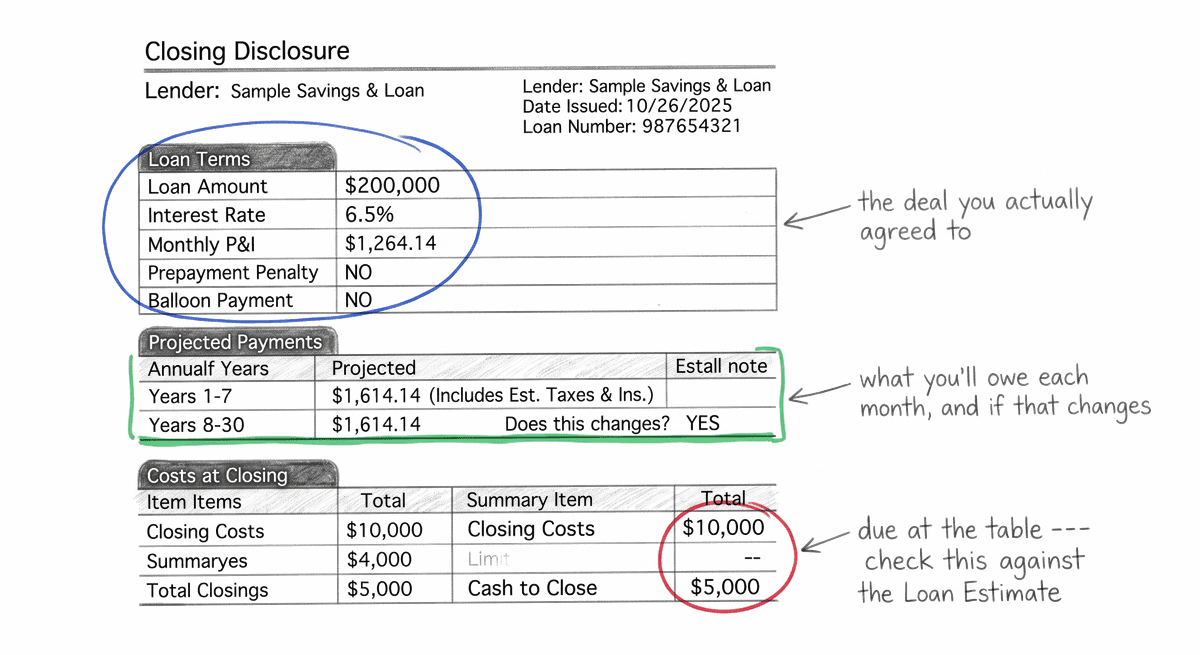
The “American Dream” has been inextricable from the single-family home since the FHA underwrote it into being in the 1930s — a framing that serves the real estate industry, the banking industry, and the construction industry all at once. The FHA’s signature invention, the 30-year fixed-rate mortgage, made homeownership accessible to the middle class — and then became the instrument through which the middle class transferred the largest share of its lifetime wealth to banks in the form of interest: a $350,000 mortgage at 7% over 30 years costs $838,000 in total payments. The house is $350,000. The rest is the price of time. The cultural pressure to buy can be as heavy as the financial decision, and the two are not the same. Renting is not failure. Buying more than you can afford is not success. The Conners owned their house and were still broke. Ask your Agent to separate the two questions: “Help me think about buying a home as a financial decision first — what does the math say? Then help me think about the identity and stability reasons separately, so I know which one is driving me.”
Veterans note: The VA home loan is the single most valuable benefit many eligible veterans never use. Key features: 0% down for full-entitlement borrowers (no VA-imposed loan cap in 2026 — you borrow what you qualify for); no PMI, ever; the loan is assumable by another VA-eligible buyer (a significant asset in a high-rate environment); and a one-time funding fee that is waived entirely for veterans with a service-connected disability rating of 10% or more, for Purple Heart recipients, and for surviving spouses receiving DIC. The IRRRL (Interest Rate Reduction Refinance Loan) streamlines rate-reduction refinances with no new appraisal or credit underwriting in most cases. The catch: VA Minimum Property Requirements are stricter than conventional — roof, HVAC, water, pests, safety hazards must all pass, and failures can kill deals on fixers. Request your Certificate of Eligibility with VA Form 26-1880 or through the VA’s online portal. The SCRA (see M-2) also caps pre-service mortgage interest at 6% during active duty.
M-4: Collections and Bankruptcy
Strategy: Assert + Decode See also: L-3: Writing a Demand Letter, M-2: Credit Cards and Debt, H-6: Understanding What Medicare Actually Covers, H-6b: Understanding What Medicaid Actually Covers (medical debt is the leading cause of bankruptcy) My Man Jeeves: The debt collection industry, if one may characterize it plainly, is constructed upon the assumption that the person receiving the telephone call is unaware of the protections available to them. A collector who rings has, in the ordinary course of events, purchased the debt for pennies on the dollar and is now endeavouring to recover the full amount plus fees. The Fair Debt Collection Practices Act exists to regulate this interaction. That most people in collections have never encountered it is not, one ventures to suggest, accidental — the business model depends rather entirely upon the information gap. An Agent has read the FDCPA. One would recommend doing so oneself as well. The Spec:
I am dealing with [debt in collections / considering bankruptcy /
being contacted by collectors / unsure of my options].
My situation:
— The debt: [amount, type, how old, original creditor]
— What’s happening: [calls, letters, lawsuit threat, garnishment,
or “I’m drowning and don’t know where to start”]
— My state: [state]
— My income and assets: [brief — this affects what strategies work]
Please help me:
1. Understand my rights under the FDCPA — what collectors
can and cannot do, and how to make them stop calling
2. Evaluate whether this debt is still within the statute
of limitations — and what that means practically
3. Walk me through my options: negotiation, settlement,
payment plan, debt validation, bankruptcy
4. If bankruptcy is the right option: explain the difference
between Chapter 7 and Chapter 13, what I’d keep and lose,
and what the actual consequences are — not the stigma,
the facts
Give me the most conservative, legally accurate answer.
I will verify with a consumer rights attorney.
What to do with the Output: If a collector calls you, say this: “Send me a written validation of the debt” — and then put the same request in writing within 30 days of their first written notice. The written dispute is what matters: under the FDCPA, a written request obligates them to stop collection activity until they provide written verification. Saying it on the phone alone does not trigger that protection. This is not a negotiation tactic. It is a legal right. See L-7 for the validation letter itself. Write down the date, time, caller name, and company for every call. If they violate the FDCPA (calling before 8 AM, calling your workplace after you told them not to, threatening actions they cannot take), you can sue them — and the FDCPA provides for statutory damages of up to $1,000 per violation plus attorney’s fees.
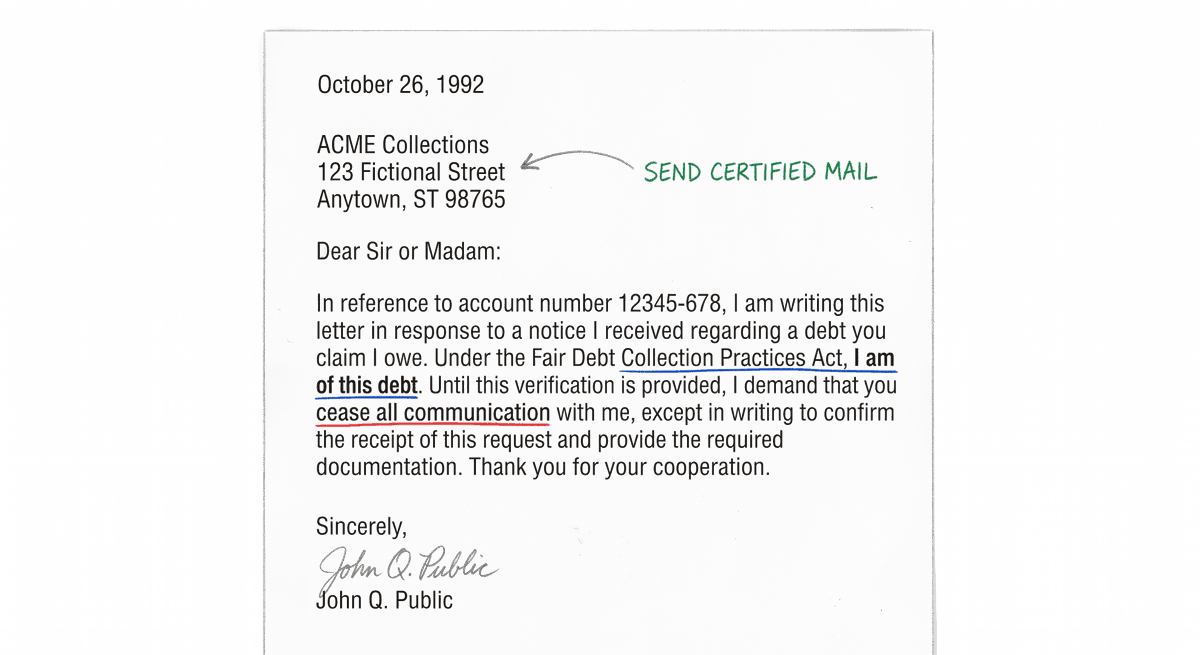
The psychology of being in collections resembles chronic stress in a measurable way: the calls, the fear of a lawsuit, the avoidance of the phone, the sleep loss. Collectors know this; the industry’s practices were abusive enough that Congress wrote the FDCPA specifically to constrain them. You have rights, they have rules, and the rules favor you more than the phone makes it feel. If you can, send every communication in writing from this point forward.
The American framing of debt as moral failure is culturally specific, not universal. Proverbs 22:7 — “the borrower is slave to the lender” — shaped the Protestant tradition that dominates personal-finance advice. Islamic finance prohibits interest entirely (riba). Jewish law includes shmita, debt release every seven years, and the Talmud treats lending as an obligation of community rather than a moral hazard. If you were raised inside one of these frameworks, your feelings about your credit card balance may come from somewhere older and deeper than the APR. That can help — a tradition that treats debt seriously also takes it seriously when you need to get out. It can also hurt, if shame keeps you from opening the envelope. Your Agent is willing to hold the math without holding the judgment. Shame does not pay bills. Strategy does.
M-5: Retirement and Investing
Strategy: Research + Decide See also: M-6: Financial Coach, H-6: Understanding What Medicare Actually Covers, H-6b: Understanding What Medicaid Actually Covers, Li-4: Planning Care for Aging My Man Jeeves: One might note that the retirement system in the United States transferred the risk of retirement from employers to individuals in a single generation. One’s parents may have enjoyed a pension — a defined benefit that guaranteed income for life. One now has, in its place, a 401(k) — a defined contribution that guarantees nothing beyond the certainty that one bears the investment risk, the longevity risk, and the fee structure. The financial services industry collects in excess of $100 billion per year in fees for the management of Americans’ retirement savings.[12] An Agent, it is perhaps worth observing, charges no fee whatever and has read the same research the fee-charging advisors cite. The Spec:
I want to understand and improve my retirement situation.
My situation:
— Age: [X]
— Retirement accounts: [401k, IRA, Roth, pension, none — with
approximate balances]
— Employer match: [if applicable — percentage and whether you’re
getting the full match]
— Other savings/investments: [if any]
— Social Security: [have checked my estimate / haven’t / worried
about it being there]
— Biggest concern: [haven’t started / started late / don’t understand
my options / worried I don’t have enough / don’t trust financial
advisors / overwhelmed by choices]
Please help me:
1. Tell me honestly where I stand — am I on track, behind, or
in trouble? Use real numbers, not reassurance.
2. Explain my accounts in plain language — what is a 401k actually
doing, what’s the difference between traditional and Roth,
and which should I prioritize?
3. If I have an employer match I’m not getting: tell me that first,
because it is free money I am leaving on the table
4. Help me understand investment options without jargon —
what are index funds, why do people recommend them,
and what should I actually choose in my 401k?
5. What are the biggest mistakes people my age make with
retirement planning?
Give me the most conservative answer. I will verify with
a fee-only fiduciary advisor or my plan administrator
before moving any money.
What to do with the Output: If your employer offers a 401(k) match and you are not contributing enough to get the full match, fix that this week. It is a 50–100% guaranteed return on your money — there is no investment on Earth that competes with it. After that, the priority order is generally: full employer match → high-interest debt payoff → Roth IRA (if eligible) → max 401(k) → taxable brokerage. Your Agent can customize this for your situation.
The anxiety of not having saved enough is one of the most pervasive financial stresses in American life, and it is often silent — the people who feel it the most are the most likely to stop looking. The Federal Reserve’s Survey of Consumer Finances puts the median retirement savings for Americans aged 55–64 at roughly $185,000, which is well below what most financial-planning rules of thumb recommend and above zero, where many people assume “everyone but me” must be.[15] The gap between “what experts say you need” and “what most people have” is large enough to induce paralysis, which is its own cost. If you are behind, the starting position is the number you have today, not the number you wish you had started with. Every dollar compounds. Perfectionism is the enemy of progress in finance exactly as it is everywhere else. Ask your Agent: “I’m [age] with [amount] saved. Stop telling me what I should have done and help me plan from here.”
Veterans note: If you are on active duty, federal civilian service, or a reservist with federal TSP access, the Thrift Savings Plan is the largest and lowest-cost defined-contribution plan in the country. Its core funds — G (government securities), F (bond index), C (S&P 500), S (extended U.S. market), I (international), and the L (lifecycle) target-date funds — carry expense ratios in the single basis points. The Blended Retirement System, mandatory for servicemembers who entered on or after January 1, 2018, adds a 1% automatic agency contribution plus a match of up to 4% for a total of 5% when you contribute at least 5% yourself. Getting the full match is the first-priority retirement move for any servicemember the BRS applies to — turning it down is turning down pay. The reduced defined-benefit multiplier (2.0% per year of service vs. the legacy 2.5%) is the trade. The Survivor Benefit Plan election at retirement pays a surviving spouse 55% of the retired-pay base you elect; the decision is made once, on DD Form 2656, and it is commonly misunderstood — walk your Agent through your specific situation before you sign.[18]
M-6: Financial Coach
Strategy: Decide + Research (Expert Role) See also: Li-9: Making a Household Budget That Holds, M-1: Banking and Savings My Man Jeeves: A fee-only financial advisor charges $200 to $400 per hour and is of greatest utility when one has significant assets requiring management. For the financial questions that most people actually possess — whether a debt merits early repayment, whether savings are optimally situated, whether an insurance policy represents sound value, whether one is, to put the matter delicately, being overcharged — an Agent covers the ground at no cost. The operative phrase is “fee-only”: an advisor who earns commissions on the products they recommend labours under a structural conflict of interest that no quantity of good faith can altogether eliminate. The Spec:
Act as a fee-only financial coach with no products to sell.
My situation: [brief description of income, debts, savings, goals]
My question: [specific financial decision or question]
My concern: [what you’re worried about getting wrong]
Please give me the honest analysis, including what you’d
want to know more about before giving a final recommendation.
What to do with the Output: For any financial decision over $1,000, ask the calibration question: “How confident are you in this recommendation, and what should I verify with a professional?” Your Agent is good at explaining options and running numbers. It is not a fiduciary — it has no legal obligation to act in your interest. A fee-only CFP (Certified Financial Planner) does. For complex situations — estate planning, tax optimization, business finances — the cost of a professional consultation is almost always worth it.
Common financial Expert Role specs:
Act as a tax advisor. I [got married / had a kid / bought a house /
started freelancing / got an inheritance]. What changes about
my tax situation, and what should I do before the end of the year?
Act as an insurance advisor with no commission. I’m paying [amount]
for [type of insurance]. Is this a good deal? What coverage do I
actually need vs. what I’m paying for? Am I over- or under-insured?
Act as a financial coach. Someone is offering me [investment /
business opportunity / loan / deal]. Walk me through the red flags
and the legitimate questions I should ask before committing any money.
M-7: Understanding Your Taxes
Strategy: Decode + Prepare See also: M-1: Banking and Savings (for account types that affect taxes), W-7: Freelancing (1099 vs. W-2 and self-employment tax) My Man Jeeves: One observes that the United States is among the very few nations that requires its citizens to calculate what they owe, despite the government already possessing the relevant figures. The Internal Revenue Service knows what one earned — the W-2 and 1099 forms were filed months prior. It knows what one paid in mortgage interest, what one contributed to retirement, what one earned from a savings account. It could, if permitted, simply present the bill. That it does not is the result of a lobbying effort by the tax preparation industry — Intuit, H&R Block, and their associates — which has spent hundreds of millions of dollars ensuring that the process remains sufficiently opaque to require their services. The complexity is the product. One’s Agent, however, has read the tax code in the manner the preparers have, and charges rather less for the privilege of explaining it. The Spec:
I want to understand my tax situation better and make sure
I’m not overpaying or missing anything.
My situation:
— Filing status: [single / married filing jointly / married filing
separately / head of household]
— Income: [W-2 salary / 1099 freelance / both / other sources]
— Major life changes this year: [new job / marriage / child / home
purchase / retirement contributions / none]
— What I did last year: [standard deduction / itemized / not sure]
— What I’m confused about: [deductions vs. credits / whether to
itemize / what I can write off / whether I need a CPA / estimated
taxes / why I owed last year / what my W-2 actually means]
Please help me:
1. Walk me through my W-2 (or 1099) — what each box means
in plain language and which ones matter most
2. Explain the difference between deductions and credits,
and which ones I likely qualify for
3. Help me figure out whether I should itemize or take
the standard deduction — what’s the actual math?
4. Identify things I might be missing: retirement contributions,
education credits, state-specific deductions, the EITC
5. Tell me honestly: do I need a CPA, or can I do this myself?
What’s the threshold where professional help pays for itself?
Give me the most conservative, legally accurate answer.
I will verify anything consequential with a tax professional.
What to do with the Output: If your Agent says you qualify for a credit or deduction, verify it against the IRS website before filing. Credits reduce your tax dollar-for-dollar. Deductions reduce your taxable income. That distinction is worth thousands of dollars and most people conflate the two. The standard deduction increases most years — check the current figures at irs.gov before filing. If your itemizable expenses do not exceed the standard deduction, itemizing costs you time and gains you nothing.
The recent history of free filing shows how deliberately the complexity is maintained. Intuit (TurboTax) and H&R Block have spent more than a decade lobbying Congress to keep the IRS out of the free-filing business. The IRS launched Direct File as a pilot in 2024 with 12 states, expanded to 25 states for the 2025 season, and processed nearly 300,000 returns with a 90% user satisfaction rate. In November 2025, the Trump administration announced that Direct File “will not be available in Filing Season 2026,” citing low uptake and cost. The agency already had your numbers — the W-2 and 1099 forms were filed months ago — and was briefly willing to show them to you for free. That is no longer an option for 2026. IRS Free File (for taxpayers under the AGI threshold, around $84,000) and Free File Fillable Forms remain. The tax preparation industry’s position is that the government should not compete with private enterprise. The government just conceded the point.[20]
Tax anxiety is real, and it is not irrational. The IRS is the only creditor in American life that can garnish your wages, seize your assets, and file criminal charges without a separate civil judgment. The fear is proportional to the power. The IRS processes roughly 150 million returns a year and audits well under 1% of them, with the audit rate concentrating lower on the income distribution than its enforcement budget would suggest — EITC recipients, for example, have historically been audited at rates approaching those of millionaires, a disparity that is itself a class analysis. Filing honestly, on time, and to the best of your understanding is the strongest protection available. If you made a mistake, file an amended return (Form 1040-X) before anyone notices — penalties are smaller on self-disclosed errors, and the IRS’s stated position is that it prefers corrections to investigations. Your Agent can walk you through the amendment. Doing it tonight is better than the number you are afraid of growing in the background.[21]
M-8: Insurance You Actually Need
Strategy: Research + Decide See also: M-3: Mortgages (homeowners insurance required for mortgage), H-4: Appealing an Insurance Denial (the appeal process applies to all insurance), Tr-1: Car Ownership (auto insurance) My Man Jeeves: The insurance industry presents itself as protection against catastrophe — and it is, in the narrow sense that a policy, properly configured, prevents a single event from destroying one’s financial position. What the marketing omits, with some care, is that the industry’s profit model depends on collecting premiums from the many and paying claims to the few, and that a considerable apparatus of adjusters, exclusions, riders, and deductibles exists to widen the gap between what one believed was covered and what is. A typical American household spends several thousand dollars a year on insurance premiums outside of health coverage, a figure that varies enormously based on decisions most people made once and have not revisited. One’s Agent is rather well suited to the task of revisiting them. The Spec:
I want to make sure I have the right insurance and am not
overpaying or underinsured.
My situation:
— Life stage: [single / married / kids / homeowner / renter /
nearing retirement]
— Current insurance: [list what you have — auto, renters,
homeowners, life, umbrella, and approximate monthly premiums]
— What I’m not sure about: [do I need life insurance / is my
coverage enough / am I paying too much / what’s an umbrella
policy / do I need renters insurance / my landlord says
I don’t need it]
— Assets to protect: [rough — savings, home equity, car value]
— Dependents: [who relies on your income]
Please help me:
1. Walk me through what I actually need at my life stage —
and what I can probably skip
2. For each type I need: what coverage amounts make sense
given my situation? Not the minimum, not the maximum —
the rational amount.
3. Am I overpaying? What should someone like me expect to pay
for [auto / renters / homeowners / life] in [my state]?
4. Explain deductibles and coverage limits in plain language —
when does a higher deductible save me money vs. expose me
to risk?
5. What are the most common coverage gaps — the things people
don’t realize aren’t covered until they file a claim?
Give me the most conservative interpretation of what I need.
I would rather be slightly over-covered than discover a gap
during a crisis.
What to do with the Output: Insurance is one of the few financial products where the decision you made three years ago may be costing you money today. Get quotes annually. Not because loyalty should be punished — although the insurance industry does penalize loyalty, charging existing customers more than new ones for identical coverage — but because your situation changes. The car is worth less. The apartment has more stuff in it. You had a kid. Review the output, then call your current insurer and ask them to match the best quote. They usually will, because acquiring a new customer costs them more than keeping you.
Renters insurance costs $15–$30 per month and covers your belongings, your liability if someone is injured in your apartment, and your living expenses if your unit becomes uninhabitable. Roughly four in ten renters do not have it. Your landlord’s insurance covers the building. It does not cover your laptop, your furniture, or the fact that you need somewhere to sleep while the water damage dries. The landlord who tells you that you “don’t need renters insurance” is telling you that they don’t need you to have it. Your interests differ.
Insurance is one of the few products you buy hoping never to use. Every month you pay a premium and nothing happens, the emotional math feels like a loss — a running total in your head of money spent on nothing. The month something happens, the math reverses in a single phone call. Insurance is not an investment, and evaluating it that way will steer you wrong. It is the purchase of not-being-ruined by a single bad day. The value is not in the payout. It is in the sleep. If you have been debating whether to buy or upgrade coverage, the right question is not “what return do I get on this?” It is “what does my household look like the day after the worst realistic thing happens, with this coverage and without it?” Your Agent can model both scenarios.
Veterans note: If you are on active duty, SGLI (Servicemembers’ Group Life Insurance) gives you up to $500,000 of term coverage automatically at approximately $0.06 per $1,000 per month — $30/month for the full $500K — plus a $1/month TSGLI rider for qualifying traumatic injuries. Coverage ends 120 days after separation. Within 240 days of separation you can convert to VGLI (Veterans’ Group Life Insurance) at your SGLI amount with no medical underwriting; the outer window is 1 year + 120 days (480 days) with proof of insurability. FSGLI covers your spouse up to $100,000 (not exceeding your SGLI) and each dependent child for $10,000 at no cost. Forms: SGLV 8286 to elect or change SGLI, SGLV 8714 for VGLI, SGLV 8600 for TSGLI claims. Apply through va.gov/life-insurance.[25]
M-9: Navigating Financial Aid and Student Loans
Strategy: Navigate + Assert See also: M-2: Credit Cards and Debt (debt management strategies), M-4: Collections and Bankruptcy (when student loans go to collections) My Man Jeeves: One notes that Americans carry approximately $1.75 trillion in student loan debt — a figure that exceeds the total credit card debt of the nation and is borne disproportionately by those who were told, with some conviction, that higher education was the path to the middle class. The system for managing this debt — loan servicers, income-driven repayment plans, forgiveness programmes, forbearance options — is of a complexity that rather suggests it was not designed for the benefit of the borrower. One’s loan servicer, to take a single instance, is a private company paid by the government to manage one’s account. Its incentive is to minimize its own cost of servicing, not to guide one toward the optimal repayment strategy. An Agent labours under no such conflict of interest, and is conversant with every repayment plan the Department of Education offers. The Spec:
I need help understanding and managing my student loans.
My situation:
— Loans: [federal / private / both — amounts and servicer if known]
— Current repayment plan: [standard / income-driven / not sure /
in forbearance / in default]
— Income: [approximate annual — this determines IDR eligibility]
— Family size: [for IDR calculations]
— Employment: [public service / nonprofit / private sector —
this affects forgiveness eligibility]
— What I’m dealing with: [can’t afford payments / confused by
options / want a forgiveness program / got a letter from my
servicer I don’t understand / considering going back to school /
in default and don’t know what to do]
Please help me:
1. Explain my repayment options in plain language — standard,
graduated, extended, and the income-driven plans (IBR, PAYE,
REPAYE/SAVE) — and which one minimizes what I pay over time
2. Am I eligible for any forgiveness programs? Walk me through
PSLF, income-driven forgiveness, and any others
3. If I’m in default or behind: what are my options to get back
on track, and what are my rights?
4. Should I consolidate? What are the actual pros and cons —
not the servicer’s sales pitch
5. Is refinancing with a private lender ever a good idea,
and what do I lose if I do?
Give me the most conservative, legally accurate answer.
I will verify with my servicer and studentaid.gov.
What to do with the Output: Never refinance federal loans into private loans without understanding what you are giving up. Federal loans come with income-driven repayment, forgiveness programs, deferment, forbearance, and discharge options. Private loans come with none of these. Refinancing may lower your interest rate. It will also eliminate your safety net. If your Agent recommends refinancing, follow up: “What protections do I lose by converting these federal loans to private? Give me the complete list.”
The emotional weight of student loan debt is qualitatively different from credit card debt. A credit card balance tends to feel like a mistake. A student loan balance can feel like a betrayal — you did what you were told, invested in yourself, went to college, and the price of that investment tripled in two decades while the return on it stagnated. The anger is rational. An entire generation was sold a narrative it is still paying off. Honor the anger. Also: do not let it paralyze you. The debt is real, the rules are current, and the tools work — imperfect, politically contested tools, but tools — even when the system that created the debt was unjust. Your Agent can hold both things at once. So can you.
The parent who co-signed. Parent PLUS loans are federal loans taken out by parents for a child’s education. They carry higher interest rates than student loans, cannot be transferred to the student, and have historically been locked out of most income-driven plans — though a “double consolidation” workaround can make them eligible for ICR, and RAP will be available for Parent PLUS loans consolidated before the July 2026 deadline in some cases. Many parents signed these loans without understanding the terms because the child needed them and the financial-aid office presented the offer as routine. The shame runs both ways: the parent feels they failed to save enough; the child feels they burdened their family. Neither is a moral failure. Both are a structural consequence of a system that prices college beyond what most American families can pay. If this is your situation, ask your Agent: “I took out Parent PLUS loans for [child’s name] in [years]. Walk me through my consolidation and IDR options specifically for Parent PLUS debt, and tell me whether consolidating before July 2026 changes what I’m eligible for.”
Veterans note: Education benefits, for many servicemembers, eliminate the need to borrow in the first place — or pay off debt that is already there. The Post-9/11 GI Bill (Chapter 33, 38 U.S.C. § 3311) pays full in-state tuition and fees at public schools (with a 2026–27 cap of $29,920.95/year at private and foreign schools), a monthly housing allowance at the E-5-with-dependents BAH rate for the school’s ZIP code, and up to $1,000 per year in books. Service ending on or after January 1, 2013 carries unlimited time to use the benefit (the “Forever GI Bill”). Transferability to a spouse or children requires 6+ years of service and a commitment to four more at the time of transfer — the request goes through the milConnect portal before separation. The Yellow Ribbon Program covers the gap above the private/out-of-state cap at participating schools. Alternatives: Montgomery GI Bill (Chapter 30), MGIB-SR for Reservists (Chapter 1606), and VR&E / VetSuccess (Chapter 31) for service-connected disabled veterans, which covers tuition, fees, subsistence, and vocational counseling. Apply through va.gov/education using VA Form 22-1990 or 22-1990e for dependents. Your Agent can model which benefit gives you the most value for your actual enrollment plan.[28]
M-10: Evaluating a Big Purchase
Strategy: Research + Decide See also: Tr-1: Car Ownership (the single most common big purchase), Ch-1: Shopping Your Values (for evaluating who you’re buying from), Ho-3: Right-to-Repair (for durability and long-term cost) My Man Jeeves: One has observed that the phrase “0% APR for 36 months” appears in advertising with a frequency that suggests, to the casual observer, that financing large purchases at no cost has become a simple act of generosity on the part of retailers. It has not. The 0% offer is a customer acquisition tool: the retailer has calculated that a meaningful percentage of purchasers will miss a payment, triggering deferred interest — in some cases retroactively applied to the entire original balance at rates exceeding 25%. The furniture, the appliance, the automobile — whatever the object, the financing is not a courtesy extended to the buyer. It is a bet placed against them. One’s Agent is rather useful for reading the terms of that bet before one accepts it. The Spec:
I’m considering a major purchase and I want to make sure
I’m thinking about it clearly.
The purchase:
— What: [car / appliance / furniture / electronics / home
renovation / other]
— Price: [sticker price or range]
— Financing offered: [0% APR / store credit card / loan /
paying cash / not sure yet]
— Timeline: [need it now / can wait / replacing something broken]
— New vs. used: [considering both / committed to one / not sure]
Please help me:
1. Calculate the total cost of ownership — not just the price tag,
but maintenance, insurance, depreciation, energy costs,
and anything else I’ll pay over the life of this thing
2. Decode the financing: if there’s a 0% APR offer, what are
the actual terms? What happens if I miss a payment?
What’s the deferred interest clause?
3. Help me compare: new vs. used vs. refurbished — what’s the
real cost difference when I factor in lifespan and repair?
4. Am I buying at the right time? Are there seasonal patterns
or model-year transitions that affect price?
5. What’s the “walk away” number — at what price does this
stop making financial sense for someone in my situation?
What to do with the Output: The sticker price is not the price. For a car, the total cost of ownership includes insurance, fuel, maintenance, registration, depreciation, and financing. A $30,000 car at 7% APR over 72 months costs $36,500 in payments. If it depreciates to $12,000 in six years, the total cost of having the car was $24,500 plus insurance and gas. Your Agent can run this math for any purchase. The question is not “can I afford the payment?” — that is the question the salesperson wants you to ask. The question is “what does this actually cost me over the time I’ll own it?”
For any brand-level decision, check measured reliability instead of marketing. Brand perception diverges from measured reliability more often than advertising suggests: Samsung and LG, both heavily advertised in major appliances, score poorly on icemaker and compressor failure rates; quieter brands routinely outperform them. Consumer Reports pools member survey data with in-lab testing and is the single most-cited source on consumer product reliability; the full rankings require a subscription (roughly $39/year digital), but the methodology is public and your Agent can summarize what reviewers and J.D. Power have published in their free tiers. For cars specifically, RepairPal gives free reliability scores and realistic repair-cost estimates by make, model, and year.[30]
Big purchases carry emotional weight that financial analysis does not capture. The new couch is not just a couch; it is the feeling of having made it, of deserving something nice, of the apartment finally looking like an adult lives there. The salesperson knows this. Retail financing exists because the emotional urgency of “I want this now” reliably overrides the rational calculation of “this will cost me 28% more if I finance it.” The point is not to shame the desire — the desire is real, and frequently earned. The point is to let the desire and the math negotiate honestly. Ask your Agent: “I want [item] and I can feel myself wanting to rationalize the price. Show me the five-year total cost under each financing option, and tell me what I’d have to give up this year to pay cash or save for six months.” Sometimes the answer is buy it, you can afford it, and you worked for it. Sometimes the answer is wait six weeks, and you’ll save $800. Either way, the decision is now yours instead of the salesperson’s.
-
[1] CFPB, “Overdraft/NSF Revenue in 2023 Down More Than 50% Versus Pre-Pandemic Levels.” See also S.J.Res. 18, P.L. 119-10 (Congressional Review Act repeal of CFPB overdraft rule, signed May 9, 2025).↩
-
[2] NCUA, “Credit Union and Bank Rates 2025 Q4.” Credit union charter authority: 12 U.S.C. § 1752.↩
-
[3] Fair Credit Billing Act, 15 U.S.C. § 1666; implementing regulation at 12 C.F.R. § 1026.13. Fair Debt Collection Practices Act, 15 U.S.C. § 1692. CFPB, “Debt Collection Rule FAQs.”↩
-
[4] Gal, D., & McShane, B.B. (2012). “Can Small Victories Help Win the War? Evidence from Consumer Debt Management.” Journal of Marketing Research, 49(4), 487–501. Besharat, A., Carrillat, F.A., & Ladik, D.M. (2014). “When Motivation Is Against Debtors’ Best Interest: The Illusion of Goal Progress in Credit Card Debt Repayment.” Journal of Public Policy & Marketing, 33(2), 143–158.↩
-
[5] Federal Reserve Board. (2024). Consumer Credit — G.19 Statistical Release. Average credit card interest rate data.↩
-
[6] Shapiro, G.K., & Burchell, B.J. (2012). “Measuring Financial Anxiety.” Journal of Neuroscience, Psychology, and Economics, 5(2), 92–103.↩
-
[7] Freddie Mac, “Primary Mortgage Market Survey.” Historical rate data: FRED, 30-Year Fixed Rate Mortgage Average (MORTGAGE30US).↩
-
[8] The Dodd-Frank Wall Street Reform and Consumer Protection Act (2010) created the CFPB and standardized mortgage disclosure requirements. The Loan Estimate and Closing Disclosure replaced the prior GFE and HUD-1 forms in 2015.↩
-
[9] CFPB, “Data Point: 2023 Mortgage Market Activity and Trends.” See also Urban Institute, “Mortgage Credit Availability Index” and Federal Reserve Bank of Boston research on denial-rate disparities.↩
-
[10] CFPB, “What is a statute of limitations on a debt?” CFPB, “My debt is several years old. Can debt collectors still collect?” Debt Collection Rule: 12 C.F.R. Part 1006.↩
-
[11] Himmelstein, D.U. et al. (2019). “Medical Bankruptcy: Still Common Despite the Affordable Care Act.” American Journal of Public Health, 109(3), 431–433.↩
-
[12] Estimated from US retirement-asset totals ($44.1 trillion at year-end 2024, with IRAs and employer-sponsored defined-contribution plans accounting for 67%) and industry-average expense ratios (typically 0.3–1.0%). See Investment Company Institute, 2025 Investment Company Fact Book, ch. 8 (US Retirement Market).↩
-
[13] S&P Dow Jones Indices. SPIVA U.S. Scorecard. Published annually. The 15-year data consistently shows 85–92% of actively managed large-cap funds underperforming the S&P 500.↩
-
[14] Buffett, W.E. (2017). Berkshire Hathaway Annual Letter to Shareholders. The bet, made in 2007, was against Protégé Partners’ selection of hedge funds.↩
-
[15] Federal Reserve Board. “2022 Survey of Consumer Finances.” Retirement account balance by age, Table 2.↩
-
[16] Social Security Board of Trustees (2025). The 2025 OASDI Trustees Report. CBO, “Increase the Maximum Taxable Earnings That Are Subject to Social Security Payroll Taxes.”↩
-
[17] FTC (2025). “Reported Losses to Fraud: $12.5 Billion in 2024.” FTC (2024). “Multi-Level Marketing Income Disclosure Statements: An FTC Staff Report.”↩
-
[18] Thrift Savings Plan, Summary of the Thrift Savings Plan. Blended Retirement System overview: militarypay.defense.gov. Survivor Benefit Plan: militarypay.defense.gov/Benefits/Survivor-Benefit-Program.↩
-
[19] IRS. (2024). “Tax Gap Estimates for Tax Years 2021.” EITC participation estimates from IRS Taxpayer Advocate Service annual report.↩
-
[20] IRS, “IRS announces first day of 2026 filing season.” Coverage of Direct File cancellation: Federal News Network, “IRS Direct File will not be available in 2026, agency tells states.” Intuit lobbying profile at OpenSecrets.org.↩
-
[21] IRS, “Tax Return Audit Selection Process.” TRAC analysis of audit-rate disparities: Syracuse University, “IRS Audits Poorest Families at Five Times the Rate for Everyone Else.”↩
-
[22] Insurance Information Institute, “Automobile financial responsibility limits by state.” New Hampshire RSA 264 (NH DMV Financial Responsibility).↩
-
[23] Insurance Information Institute. (2024). “Understanding Umbrella Insurance.” Liability gap data from National Association of Insurance Commissioners annual report.↩
-
[24] Insurance Information Institute, “How much life insurance do I need?” NAIC, Life Insurance Buyer’s Guide. LIMRA 2024 Insurance Barometer Study.↩
-
[25] VA, “Servicemembers’ Group Life Insurance (SGLI).” VA, “Veterans’ Group Life Insurance (VGLI).” VA, “Traumatic Injury Protection (TSGLI).”↩
-
[26] Department of Education, “U.S. Department of Education Announces Next Steps for Borrowers Enrolled in the Unlawful SAVE Plan.” Federal Student Aid, “Income-Driven Repayment Plans.” NASFAA, “Welcome to 2026: Some Student Loan Forgiveness Is Now Taxable.”↩
-
[27] Department of Education. (2024). “Biden-Harris Administration Has Approved $69 Billion in Student Debt Relief.” PSLF historical rejection rates from Government Accountability Office, “Public Service Loan Forgiveness: Education Needs to Provide Better Information for the Loan Servicer and Borrowers.” (2018).↩
-
[28] VA, “About GI Bill Benefits: Post-9/11 GI Bill.” VA, “Post-9/11 GI Bill Rates.” VA, “Transfer Post-9/11 GI Bill Benefits.”↩
-
[29] CFPB. (2023). “The Consumer Credit Card Market.” Deferred interest findings from CFPB supervisory examinations and enforcement actions. See also CFPB, “GE CareCredit to refund up to $34.1 million for deceptive health care credit card enrollment” (2013).↩
-
[30] Consumer Reports, “2026 Automotive Brand Report Card.” J.D. Power, “2025 U.S. Appliance Reliability & Service Study.”↩