Strategy 4: Navigate
Find the path through a multi-step process you have never done before.
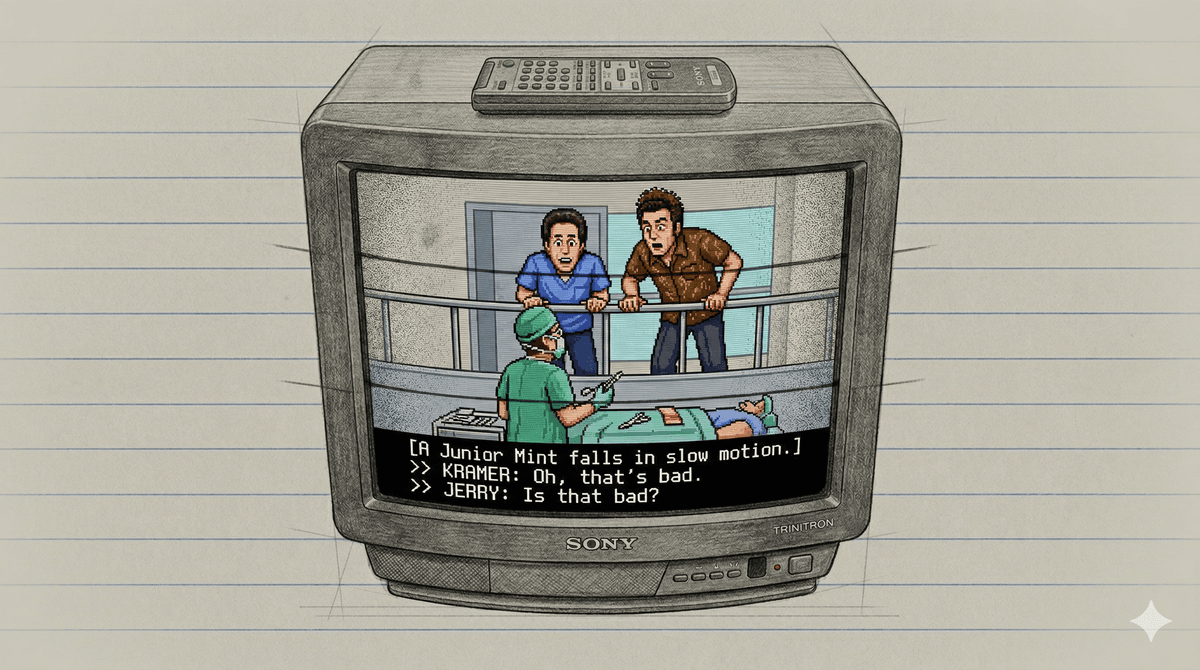
The episode: Jerry and Kramer end up in a hospital observation gallery, watching a surgical procedure. Kramer, leaning too far over the railing, accidentally drops a Junior Mint into the open body cavity. The correct process in this situation is immediate and obvious: tell the surgeon. Instead, they say nothing. They hope the mint will be absorbed. The patient nearly dies. Then, improbably, recovers — the surgeon, who never learns about the mint, credits the recovery to “something from above.” Only Jerry and Kramer know what it was.
The recovery is luck. The navigation failure was a choice. The process existed. Step one was “tell someone immediately.” Nobody took step one, and the subsequent steps — monitoring the situation, hoping for the best, not telling anyone — were an improvised sequence invented in the absence of the correct one.
The lesson: Large institutions rely on the fact that most people have never filed a small claims case, appealed an insurance denial, or contested a property tax assessment before. The process is not secret. It is just nowhere near you. Your Agent has read it and will give you the steps in the correct order, with the deadlines flagged, from wherever you currently are. You do not have to invent the sequence. You just have to follow it.
My Man Jeeves: When the correct procedure is unknown to those present, the incorrect procedure is improvised on the spot with considerable confidence. The matter is not, one should note, that the procedure was unpublished — procedures of this kind are almost invariably a matter of public record — but rather that no one had troubled to locate it before it was urgently required. This has always been the difference between an institution and an individual: one knows where its own forms are kept.
What Navigate is for: Any multi-step process you’ve never done before where the sequence matters and missing a step has consequences.
The core spec pattern:
I need to [accomplish specific goal] through [institution/system].
I have never done this before.
My current situation is [where you are in the process, if anywhere].
Please give me numbered steps in the exact order I need to do them,
including any deadlines or time-sensitive elements I should know about.
In the Field Guide: W-2 (Leaving a Job), H-4 (Insurance Appeals), L-2 (Small Claims Court), Ho-6 (Getting a Home), IRL-1 (Government Offices).
Example 1: Filing for Unemployment Benefits
The situation: you were let go last Friday. An email from the CEO said “position eliminated, replaced by AI.” You have never filed for unemployment. You don’t know if you qualify, where to start, or what the deadlines are.
Your opening message:
I just lost my job. I think I can file for unemployment
but I don’t know how.
Your Agent’s clarifying questions:
I can help you navigate this. A few questions first:

1. What state are you in?
2. Were you laid off, fired, or did you resign?
3. How long were you employed at this job?
4. Were you a W-2 employee or a contractor (1099)?
5. Have you filed for unemployment before?
Your answers:
1. California
2. Laid off — they said “position eliminated.”
3. About two and a half years.
4. W-2 employee.
5. Never. I have no idea how this works.
Your Agent proposes the navigation:
Here’s your step-by-step path. California unemployment
is handled through the EDD (Employment Development
Department). You qualify based on what you’ve described.

STEP 1: File your initial claim online at UI Online
(edd.ca.gov). Do this NOW — benefits are backdated to
the week you file, not the week you lost the job.
Every week you wait is a week of benefits you lose.

STEP 2: You’ll need the following to complete the form:
— Social Security number
— Driver’s license or state ID number
— Your last employer’s name, address, and phone number
— Your employment dates and last day worked
— Reason for separation (select “laid off / lack of work”)

STEP 3: After filing, EDD will mail you a paper form
(DE 4581) within 5–7 days. Fill it out and return it.
This is a required identity verification step — your
claim stalls if you skip it.

STEP 4: Wait for your EDD Award Letter. This tells you
your weekly benefit amount and the duration.

STEP 5: Certify for benefits every two weeks. This is
the step people miss — you must log in to UI Online
every two weeks and confirm you are still looking for
work. If you forget, you don’t get paid for those weeks.

Deadlines:
— File within your first week if possible (benefits
don’t backdate before your filing date)
— Certify every two weeks, no exceptions
— You have 10 days to respond to any EDD requests
for additional information

Does this match your situation? Anything I should
adjust — for example, did you receive any severance?
Your correction:
Yes, I did get two weeks severance. Does that change anything?
Your Agent adjusts:
Severance can delay when benefits start, depending on
how your employer reports it. In California, if the
severance is allocated as “continued pay” for specific
weeks, benefits won’t start until those weeks end. If
it’s a lump sum, it usually doesn’t affect your claim.

When you file, report the severance honestly. EDD will
determine how it applies. The important thing: file NOW
even with the severance. Don’t wait until the severance
runs out — the claim date still matters.
Example 2: Filing a First-Level Insurance Appeal
The situation: your insurance denied coverage for an MRI your doctor ordered. The letter says “not medically necessary.” You know you can appeal but have no idea what the process looks like or how long you have. If you read Strategy 3: Draft, this is the step that example assumed had already happened — the first-level appeal, seen from the beginning.
Your opening message:
My insurance denied my MRI. The letter says I can appeal.
How do I do this?
Your Agent’s clarifying questions:
I’ll walk you through the process. Let me ask:

1. Is this employer-provided insurance, marketplace
(ACA), Medicare, or Medicaid?
2. What’s the insurance company?
3. Does the denial letter mention a specific appeals
deadline?
4. Has your doctor said anything about next steps?
5. Is the MRI for something urgent, or can it wait
a few weeks while the appeal is processed?
Your answers:
1. Employer-provided — through work.
2. Anthem Blue Cross.
3. It says I have 180 days to file an internal appeal.
4. My doctor’s office said they’d provide a letter of
medical necessity if I need one.
5. My doctor wants it done within a month but it’s not
an emergency.
Your Agent proposes the navigation:
Good — you have time and your doctor is willing to
support the appeal. Here’s the path:

STEP 1: Call your doctor’s office TODAY and request
the letter of medical necessity. Ask them to include:
— the diagnosis and clinical rationale for the MRI
— why alternative imaging (X-ray, CT) is insufficient
— any relevant clinical guidelines that support the MRI

STEP 2: While you wait for the letter, call the number
on your denial letter and ask for:
— the specific clinical criteria they used to deny
— the name and credentials of the reviewer who denied
— the exact address to send the appeal
These three things give you the frame for your letter.

STEP 3: Write the appeal letter. I’ll draft this for
you once you have the info from Steps 1 and 2. It will:
— reference the denial by claim number and date
— attach the letter of medical necessity
— cite the clinical criteria and explain why you meet them
— request expedited review given your doctor’s timeline

STEP 4: Send the appeal by certified mail with return
receipt. Keep the tracking number. Also submit it
through the online portal if Anthem has one — belt
and suspenders.

STEP 5: If the internal appeal is denied, you have the
right to an external review by an independent third
party. Anthem is required to tell you how to request
this. This is the step most people don’t know exists.

Timeline:
— Anthem must respond to the internal appeal within
30 days (15 for urgent/pre-service)
— You have 180 days to file, but sooner is better
— External review adds another 45 days

Want me to draft the appeal letter now, or do you want
to gather the information from Steps 1 and 2 first?
Your evaluation:
I’ll get the info first. But — what if the external
review also denies it?
Your Agent:
After external review, you have two more escalation
paths most people never reach:

1. File a complaint with your state’s Department of
Insurance (CDI in California). This creates a
regulatory record and can reopen the case.
2. If your plan is employer-provided (ERISA), you
may have the right to file in federal court, though at
that point you want a patient advocate or attorney.

The escalation ladder exists. The insurance company is
betting you’ll stop at step one.
Example 3: Filing a Small Claims Case
The situation: your former landlord kept your $2,400 security deposit. It’s been 45 days. You sent a demand letter (see Strategy 3: Draft). No response. You want to take them to small claims court but have never done it.
Your opening message:
My landlord kept my security deposit. I sent a demand
letter three weeks ago, no response. I want to file
in small claims court. I’ve never done this.
Your Agent’s clarifying questions:
Small claims court is designed for exactly this. Let me
confirm a few details:

1. What state and county are you in?
2. How much is the deposit?
3. Do you have documentation — move-in photos,
move-out photos, the lease, the demand letter?
4. Did the landlord send you an itemized deduction
statement?
5. Do you know the landlord’s legal name and address
for service?
Your answers:
1. Santa Clara County, California.
2. $2,400.
3. I have photos from both, the lease, and a copy of
the demand letter I sent certified mail.
4. No itemized statement. Nothing.
5. Yes, it’s on the lease.
Your Agent proposes the navigation:
You have a strong case. In California, a landlord must
return the deposit OR provide an itemized statement of
deductions within 21 days of move-out. Failure to do so
entitles you to up to 2x the deposit in bad faith
penalties. You’re past 45 days with no communication.

STEP 1: Fill out form SC-100 (Plaintiff’s Claim and
ORDER to Go to Small Claims Court). Available at
courts.ca.gov or the Santa Clara County Superior Court
clerk’s office. List the amount as $2,400 (deposit) plus
up to $2,400 (bad faith penalty under Civil Code §1950.5)
— the judge decides the penalty, but you claim it.

STEP 2: File the form at the Santa Clara County Superior
Court clerk’s office. Filing fee is $75 for claims
under $5,000. Pay it — you can request this back if
you win.

STEP 3: Serve the landlord. You CANNOT serve them
yourself. Options:
— Have any adult who is not a party to the case hand-
deliver the papers (free but requires coordination)
— Use the sheriff’s office ($40, reliable)
— Use a registered process server ($50–100)
Get proof of service — you’ll need to file form SC-104.

STEP 4: Prepare your evidence packet:
— Lease showing deposit amount
— Move-in and move-out photos (dated)
— Copy of demand letter + certified mail receipt
— Calendar showing 21-day deadline and 45-day gap
— Screenshot or record of no response

STEP 5: Show up on your court date. Small claims has
no lawyers — it’s you and the landlord in front of a
judge. Present your case in order: amount paid, lease
terms, condition at move-out, photos, demand letter
sent, no response, no itemized statement, time elapsed.
Be factual. Be brief. Let the evidence do the work.

Deadlines:
— File SC-100 within 2 years of move-out (you’re fine)
— Serve the landlord at least 15 days before the
hearing (30 days if they’re out of county)
— Bring 2 copies of everything to court

Want me to help you fill out the SC-100 form?
-
[1] Herd, P., & Moynihan, D.P. (2018). Administrative Burden: Policymaking by Other Means. Russell Sage Foundation.↩