Strategy 6: Diagnose
Triage the problem before you call someone expensive.
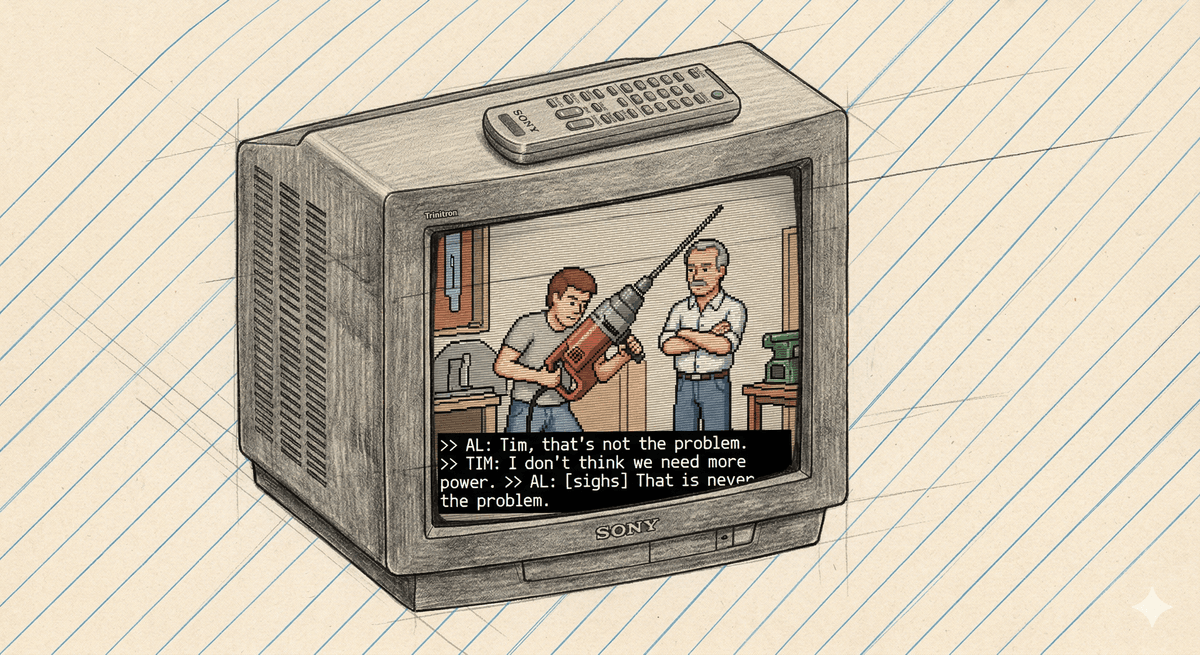
The episode: Every episode. Tim Taylor, host of the fictional home improvement show Tool Time, approaches every domestic repair with a consistent methodology: form a confident theory about what’s wrong, skip the diagnostic step entirely, and apply maximum power. The theory is always wrong. The power makes it worse. Al Borland identifies the actual problem correctly before Tim begins, states it clearly, and is ignored. The repair escalates to a small disaster. Tim is mildly surprised.
The repair manual existed. The diagnostic question existed. Al existed. Tim had a drill and a theory and a show to tape.
The lesson: The repairperson, the specialist, and the contractor all charge from the moment of contact. Getting the diagnosis wrong before you call them costs you the price of the wrong fix plus the price of the right one. Your Agent has read the repair manual. It will ask the diagnostic questions Al always asked. Unlike Tim, you are going to listen.
My Man Jeeves: Mr. Taylor’s approach, which consists of forming a confident theory, proceeding at maximum torque, and occasionally destroying the object under repair, has the advantage of being entirely within his control; it has, regrettably, no other advantages. The diagnostic remark that would have corrected him was, on every occasion, spoken politely and immediately by Mr. Borland and treated as an interruption. Mr. Borland was, throughout, available at ordinary volume and without charge.
Knowing what the problem actually is before you call the repairperson, the specialist, the contractor, or the lawyer is worth money directly — and it also tells you whether you need to call at all.
What Diagnose is for: Any situation where something is wrong and you don’t know what it is or how serious it is, and finding out requires either expertise or a bill.
The core spec pattern:
[Thing] is doing [behavior]. It started [when].
Other relevant details: [what changed recently, what you’ve tried].
I want to understand: what is likely causing this, how serious is it,
and what is the first step I should take — including whether
I actually need a professional or can handle this myself.
In the Field Guide: Ho-1 (Home Maintenance), Ho-2 (Home Repair), Tr-2 (Car Maintenance), Ch-3 (House Plants), Ch-5 (Optimizing Chores).
Example 1: A Washing Machine Making a Grinding Noise
The situation: your washing machine started making a loud grinding noise during the spin cycle two days ago. It still runs. You don’t know if it’s about to die, if you can fix it, or if you need to call someone. A repair visit starts at $150.
Your opening message:
My washing machine is making a grinding noise during
the spin cycle. It started two days ago. I don’t know
if this is serious or something I can fix.
Your Agent’s clarifying questions:
I can help you narrow this down before you call anyone.
A few questions:

1. Is it a front-loading or top-loading machine?
2. Approximately how old is it, and do you know the
brand and model?
3. Does the grinding happen only during the spin cycle,
or also during wash or drain?
4. Has anything changed recently — new type of load,
moved the machine, any repairs?
5. Does it grind the entire spin cycle, or only at
high speed?
6. Any other symptoms — vibration, leaking, clothes
not getting fully spun out?
Your answers:
1. Front-loading.
2. About six years old. It’s a Samsung — I don’t know
the exact model but I can check.
3. Only during spin.
4. Nothing changed. Same laundry we always do.
5. Mostly at high speed.
6. It vibrates more than it used to. No leaking.
Clothes seem fine.
Your Agent’s diagnosis:
Based on what you’ve described, the most likely causes
in order of probability:

1. WORN DRUM BEARINGS (most likely). Front-loaders
rely on bearings that support the drum as it spins.
After 5–7 years of regular use, they wear out. The
grinding at high speed + increased vibration is the
classic signature. This will get worse over time
and can eventually damage the drum or outer tub.
2. FOREIGN OBJECT between the drum and outer tub.
A coin, bra wire, or small item can slip through
the door seal and rattle during spin. Less likely
since it’s grinding, not clinking, but worth
ruling out.
3. WORN DRIVE BELT. Less common on newer Samsungs
(many use direct drive), but if yours has a belt,
wear can cause grinding and vibration.

HOW SERIOUS: Not an emergency, but don’t ignore it.
Worn bearings won’t destroy the machine tomorrow, but
running it for weeks will damage other components and
turn a $200–300 repair into a $600+ one or a
replacement.

First steps you can do now:
— Check the model number (sticker inside the door
frame) — I can tell you if it’s direct drive or belt
— Run an empty spin cycle and listen — does the
grinding change if there’s no load?
— Pull back the rubber door gasket and look for
any foreign objects lodged in the gap
— Check if the machine is level — all four feet
should be firmly on the floor

What to tell the repair tech if you call:
“Front-loader, six years old, grinding at high speed
during spin cycle with increased vibration. No leaks.
Started two days ago. I suspect drum bearings.”

That sentence saves you the $150 diagnostic visit on
most calls — many techs will quote the bearing
replacement over the phone if you describe it that
specifically.
Your follow-up:
I checked — there’s a small wire stuck in the gasket.
Could that be it?
Your Agent:
Very possibly. Remove it carefully with needle-nose
pliers, run a short empty cycle, and listen. If the
grinding stops, you just saved yourself a repair call.
If it continues, it’s the bearings — but now you know,
and you’ve ruled out the cheap fix first.
Example 2: Persistent Headaches That Started Two Weeks Ago
The situation: you’ve had headaches nearly every day for two weeks. They weren’t there before. You’re caught between “it’s probably nothing” and “what if it’s serious” — the exact paralysis that makes people either ignore symptoms for months or go to the ER for something that’s a Tuesday PCP visit.
Your opening message:
I’ve been having headaches almost every day for about
two weeks. This isn’t normal for me. I don’t know if
I should be worried.
Your Agent’s clarifying questions:
I can help you think through this, though I want to be
clear: I’m not diagnosing you. I’m helping you figure
out what kind of medical attention this warrants and
what to tell your doctor. A few questions:

1. Where is the pain — forehead, temples, back of
head, one side, all over?
2. How would you describe it — throbbing, squeezing,
sharp, dull pressure?
3. How severe on a 1–10 scale, and does it vary?
4. Any of these: sudden onset (like a thunderclap),
worst headache of your life, vision changes,
numbness, neck stiffness, fever, confusion?
5. What time of day are they worst?
6. Anything that changed around two weeks ago — stress,
sleep, new medication, screen time, caffeine,
head injury?
7. What have you tried — OTC pain meds, rest,
hydration? What helped?
Your answers:
1. Mostly temples and forehead.
2. Dull pressure, like a band around my head.
3. About a 4–5 most days. Some days a 6.
4. None of those, no.
5. Worse in the afternoon and evening.
6. Now that you mention it — I started a new job two
weeks ago. A lot more screen time. I’ve also been
drinking more coffee.
7. Ibuprofen helps for a few hours.
Your Agent’s assessment:
Based on your description, this pattern is most
consistent with tension-type headaches — the most
common headache type, and the one most strongly linked
to the combination of factors you just described:
increased screen time, postural stress (new desk setup),
higher caffeine intake, and general life stress from
a job transition.

RED FLAGS: None present. You answered no to all the
urgent screening questions (question 4). That’s the
most important finding — the things that would send
you to urgent care tonight are not in your picture.

WHAT THIS LIKELY IS: Tension headaches from a
combination of ergonomic, lifestyle, and stress changes
that all started at the same time. This is a PCP visit,
not an urgent care visit.

Before your appointment, try:
— Reduce caffeine gradually (don’t quit suddenly —
caffeine withdrawal causes headaches too)
— Check your desk ergonomics: screen at eye level,
arms at 90 degrees, take a 5-minute break every hour
— Hydrate — coffee is a diuretic, and new-job stress
often means forgetting to drink water
— If you wear glasses, check if your prescription
is current — increased screen time reveals outdated
prescriptions fast

What to tell your doctor:
“New daily headaches for two weeks. Bilateral, pressure-
type, 4–6/10, worse in afternoon, responsive to
ibuprofen. Coincided with a new job with significantly
more screen time and increased caffeine. No red flags —
no sudden onset, no visual changes, no neck stiffness.”

That description uses the vocabulary your doctor uses
and saves the first five minutes of the appointment.
Example 3: An HVAC Quote That Seems High
The situation: your air conditioning stopped cooling. You called an HVAC company. The technician came out, spent 20 minutes, and quoted you $8,200 to replace the entire system. You have no idea if the system actually needs replacing or if the quote is fair. You’re about to spend more than you’ve ever spent on a single purchase based on one person’s assessment.
Your opening message:
I got a quote for $8,200 to replace my HVAC system.
The tech said the compressor is shot and it’s not
worth repairing. I don’t know if that’s true or if
this price is reasonable.
Your Agent’s clarifying questions:
That’s a big number to commit to on one opinion.
Let me help you evaluate it. A few questions:

1. How old is the current system?
2. Do you know the brand, model, or tonnage? (Check
the label on the outdoor unit if you can.)
3. What exactly stopped working — no cool air at all,
weak cooling, strange noises?
4. Did the tech explain what’s wrong with the
compressor specifically?
5. What’s included in the $8,200 — equipment only,
or equipment + labor + permits + disposal?
6. Did they give you a written quote with line items,
or just a verbal number?
7. Is this a company you’ve used before?
Your answers:
1. About 14 years old.
2. It’s a Carrier — I can go look at the label.
3. Blowing air but not cold.
4. He said the compressor failed and the refrigerant
leaked out. Said it’s an R-22 system and they don’t
make that refrigerant anymore so repair isn’t worth it.
5. I’m not sure. He just said $8,200 installed.
6. Verbal. He said he’d email the written quote.
7. No, first time. Found them on Google.
Your Agent’s diagnosis of the quote:
The tech may be right about the compressor, but there
are several things to check before committing to $8,200.

The diagnosis:
The R-22 detail is real and important. R-22 (Freon) was
phased out in 2020. If your system uses R-22, recharging
it is expensive ($75–150/lb, and a full charge can be
10–15 lbs). A compressor replacement on an R-22 system
at 14 years old is genuinely a borderline repair-vs-
replace situation. The tech isn’t necessarily wrong.

But — what to verify:
1. Is the compressor actually failed, or is this a
refrigerant leak that could be repaired? A leak
and a compressor failure are different problems
with different costs. Ask the tech to specify.

2. Get the written quote with line items. It should
break down:
— Equipment (brand, model, tonnage, SEER rating)
— Labor (hours, rate)
— Permits and inspection
— Removal/disposal of old system
— Warranty terms (parts AND labor, how many years)
— Ductwork modification (if any)
If any of those are missing, that’s a red flag.
3. Check the tonnage. Your home’s square footage
determines what size system you need. A common
upsell is quoting a larger system than necessary.
What’s the square footage of your home?

What $8,200 should get you:
For a standard 3-ton, 14–16 SEER system with
installation in most markets, $7,000–10,000 is a
normal range. So $8,200 isn’t outrageous — but you
can’t evaluate it without line items.

Your next steps:
1. Wait for the written quote. Do not sign anything
verbal.
2. Get a second quote. Call a different company and
describe the symptoms — don’t say “I was told I
need a new system.” Let them diagnose independently.
3. Ask both companies: “Is there a repair option, and
if so, what would it cost vs. replacement?” Make
them justify the replace recommendation.
4. Check if your utility offers rebates for high-SEER
replacements — many do, and it can knock $500–1,500
off the price.

Want me to help you evaluate the written quote once
you receive it?
Your follow-up:
He also mentioned something about a “conversion to
R-410A” — is that a thing?
Your Agent:
Yes. R-410A is the current standard refrigerant. Any
new system will use it. The “conversion” isn’t an
upsell — it’s what happens when you replace an R-22
system. But make sure the quote includes new refrigerant
lines compatible with R-410A. Some contractors reuse
old lines, which can cause problems. That should be a
line item on the written quote.
-
[1] The red-flag screening questions in this example are drawn from standard clinical triage protocols for headache evaluation, including the SNOOP mnemonic (Systemic symptoms, Neurological signs, Onset sudden, Older age, Pattern change) used in primary care. Your Agent has read these protocols. Your Agent is not licensed to apply them. The distinction matters.↩
-
[2] Langewitz, W., Denz, M., Keller, A., Kiss, A., Rüttimann, S., & Wössmer, B. (2002). “Spontaneous talking time at start of consultation in outpatient clinic.” BMJ, 325(7366), 682–683.↩