Work
The labor market is an information asymmetry with a dress code. The employer knows the salary range, the real reason the last person left, and what the role actually entails. The candidate knows what was in the job posting, which was written by HR to attract applicants and reviewed by legal to limit liability — two goals that have nothing to do with telling you what the job is. Once you’re hired, the asymmetry continues: performance reviews, promotion criteria, benefits enrollment, and termination procedures are all systems the company designed and you inherited. The Skills that follow are the preparation the billionaire class’s career coaches provide.
W-1: Getting a Job
Strategy: Draft + Prepare See also: L-1: Negotiating a Contract (for offer letters and non-competes), Li-1: Preparing for a Difficult Conversation (same preparation technique) My Man Jeeves: One might observe that the job search is a system designed by employers, for employers, in which the candidate is expected to perform enthusiasm for a position required for survival while conducting oneself as though the power dynamic did not exist. The résumé, it would appear, is a marketing document upon which judgment is passed in approximately six seconds. The cover letter is a genre governed by rules that are nowhere made explicit. The salary negotiation rewards the party in possession of superior information regarding the market rate. One’s Agent addresses this information asymmetry — which is, one ventures to suggest, the entire purpose of this volume. The Spec:
I am looking for a job in [field/role]. My experience: [brief summary].
What I’m working with: [currently employed / unemployed / career change /
re-entering the workforce]
What I need help with:
— Résumé: [need to update / need to customize for a specific posting /
starting from scratch]
— Cover letter: [have a posting to respond to / general template]
— Interview: [have an interview on [date] / want to prepare generally]
— Salary: [have an offer to evaluate / want to research market rate]
Please [customize my résumé for this posting / draft a cover letter /
prepare me for common interview questions / analyze this offer].
[Paste the job posting or offer if applicable.]
What to do with the Output: For résumés and cover letters, edit the output into your own voice — recruiters can spot AI-generated text, and your Agent writes like an Agent, not like you. For salary negotiation, the key question is: “What is the market rate for [role] at [company size] in [city] for someone with [X years] of experience?” The answer is the floor, not the target. Checking current market data requires web search, which is free in Gemini, ChatGPT, and Copilot; in Claude it requires the paid tier — see Appendix G.
Science Note: Prolonged unemployment is a medical-grade stressor. Paul and Moser’s meta-analysis of 237 cross-sectional and 87 longitudinal studies found that unemployed individuals show significantly elevated depression, anxiety, and somatic symptoms, with effects that intensify past the six-month mark,[1] and Eisenberger’s fMRI work on social exclusion found that physical and social pain share neural circuitry.[2] Using your Agent to reduce the mechanical burden of the search — drafting, researching, preparing — is not cheating. It is reserving cognitive and emotional bandwidth for the parts of the search that actually require you.
The “skills gap” employers complain about is frequently a wages gap in a better suit: Peter Cappelli’s Why Good People Can’t Get Jobs made the case that the shortage is usually of workers willing to take the job at the wage being offered, not of qualified candidates.[3] The Agent that helps you upskill also helps you read the posting — if the employer lists five years of experience for an entry-level title, they are not looking for a candidate. They are looking for a volunteer.
Veterans note: Veterans receive Federal Veterans’ Preference in competitive federal hiring: 5 points for honorable discharge, 10 points for a service-connected disability or an eligible surviving spouse or parent. The VEOA (Veterans Employment Opportunities Act) opens internal-only federal postings to eligible veterans, and the VRA (Veterans Recruitment Appointment) authority allows agencies to hire eligible veterans non-competitively up through GS-11.[6] The GI Bill also funds civilian certifications, licensure exams, and registered apprenticeships — not just degrees. Ask your Agent to identify the authority that applies to your discharge status and the specific postings you are considering.
W-2: Leaving a Job
Strategy: Assert + Decode See also: L-1: Negotiating a Contract (for the severance agreement), M-1: Banking and Savings (emergency fund while unemployed), W-5: Unions (if you have a CBA) My Man Jeeves: It would not be inaccurate to observe that employment law is among those areas in which the distance between what most employees believe their rights to be and what those rights actually are is widest — and where the consequences of the misapprehension are most immediate. The severance agreement carries a signing deadline. The WARN Act notice carries a claim deadline. The clock, one feels compelled to note, begins whether the individual is aware of it or not. One’s Agent can read the agreement and identify the deadlines before they expire. The Spec:
I was just [laid off / fired / asked to resign] from my job at [type of company]
in [state]. I was there for [X years]. I was given [severance offer / no offer].
I want to understand:
1. What are my legal rights in this situation?
2. Is the severance offer I was given typical, low, or negotiable?
3. Are there any deadlines I need to know about right now?
4. What should I NOT sign until I understand it better?
Give me the most conservative answer. I will verify with
an employment attorney or legal aid organization.
What to do with the Output: Do not sign anything yet. You usually have 21 days (45 days if part of a group layoff) to review a severance agreement.[7] Print the output, highlight the deadlines, and call an employment attorney — many offer a free 30-minute consultation. The clock is real but it is longer than your employer implies.
W-3: Working with Human Resources
Strategy: Draft + Assert See also: W-2: Leaving a Job, Li-1: Preparing for a Difficult Conversation My Man Jeeves: It may be useful to note that Human Resources exists to protect the company. This is not a matter of cynicism — it is the department’s actual mandate. An HR representative who assists an employee does so because assisting the employee also serves the company’s interest, which is, one acknowledges, frequently the case. An understanding of this alignment — the occasions upon which one’s interests and the company’s overlap, and those upon which they diverge — represents the difference between employing HR effectively and finding oneself somewhat surprised by the outcome. One’s Agent can help one prepare for the interaction with a clear understanding of which category it falls into. The Spec:
I need to deal with an HR situation at work.
My situation: [performance review / workplace conflict /
harassment or discrimination / requesting accommodation /
documenting something / asking about benefits or policy]
What happened: [describe factually — dates, people, what was
said or done]
What I want to happen: [specific outcome]
Please help me:
1. Understand how HR is likely to view this situation
2. Draft what I should say or write — factual, professional, documented
3. Tell me what to put in writing vs. what to say in person
4. Flag anything I should be careful about
Give me the most conservative answer. I will verify with
an employment attorney if this escalates.
What to do with the Output: Put everything in writing. Email yourself a summary after every meeting. Use the phrase “per our conversation on [date]” in follow-up emails. This is not paranoia — it is the documentation standard that HR itself uses. Match their rigor.
W-4: Work from Home or RTO?
Strategy: Research + Decide See also: Li-1: Preparing for a Difficult Conversation (if you need to negotiate) My Man Jeeves: One could not help but observe that the remote work debate is conducted primarily by executives possessed of home offices and opinion columnists enjoying flexible schedules, regarding employees whose commute carries a financial cost and whose childcare arrangements permit no margin. The research on productivity, collaboration, and wellbeing is, it would appear, rather more nuanced than either party to the argument is inclined to acknowledge. One’s Agent may be of assistance in evaluating the evidence, weighing the specifics of one’s situation, and — should the need arise to present a case to one’s employer — constructing one that relies upon data rather than preference. The Spec:
My company is [requiring return to office / offering hybrid /
I’m choosing between a remote and in-office role / debating
whether to push for remote work].
My situation: [commute time and cost, childcare needs, home
workspace quality, team dynamics, role requirements]
What I want to understand:
1. What does the actual research say about remote vs. in-office
productivity for my type of work?
2. What are the real trade-offs — not the talking points?
3. If I need to negotiate, what’s my strongest case?
4. What should I be honest with myself about — the parts of
remote work that don’t serve me?
What to do with the Output: If you need to make the case to your manager, copy the data points into a one-page memo. Lead with the business case (productivity, retention, cost savings), not the personal case. The personal case is why you want it. The business case is why they will say yes.
Both questions matter for the decision in front of you: whether your employer’s case for presence is legitimate, and whether presence is something you personally need.
W-5: Unions
Strategy: Navigate + Assert See also: C-6: Advocating for Change (same organizing skills), L-1: Negotiating a Contract (for reading the CBA) My Man Jeeves: A union is, at its foundation, a group of employees who arrived at the conclusion that negotiating individually was not producing satisfactory results. The information asymmetry between an employer and a single employee is structural and permanent — the employer is aware of the budget, the market rate, the headcount plan, and the legal landscape. The employee is aware of one’s own salary. The union exists to address this disparity. One might gently observe that everything one has been told about unions — whether favourable or otherwise — was communicated by a party holding a position on whether that disparity ought to close. One’s Agent holds no such position. It has the NLRA, the relevant case law, and the current data. The Spec:
I want to understand [my rights regarding unionizing / how to
start a union / how my existing union works / how to get involved
in union leadership / how to read my collective bargaining agreement].
My situation: [industry, state, company size, current union status]
My specific question: [describe]
Please:
1. Explain my legal rights under the NLRA (or relevant law)
2. Walk me through the practical steps for [what I want to do]
3. Tell me what my employer can and cannot legally do in response
4. Flag the common mistakes people make in this process
Give me the legal answer, not the political one — the most
conservative, legally accurate reading. I will verify with
a labor attorney or my regional NLRB office.
What to do with the Output: If you are organizing, do not discuss it on company devices, in company channels, or during work hours until you understand your protections. Your Agent can explain the legal framework, but a labor attorney or your regional NLRB office is the authoritative source for your specific situation. Many labor attorneys offer free initial consultations for organizing questions.
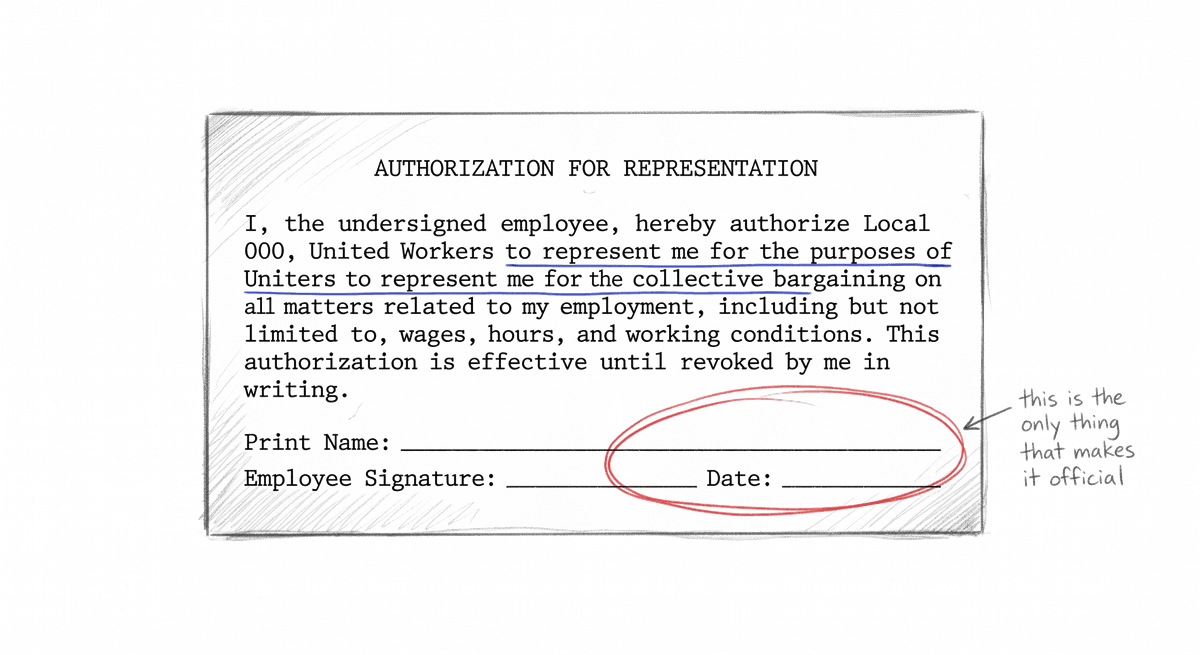
A CBA sits on top of the baseline protections federal law already guarantees, not instead of them.
The organizing wave of the last decade illustrates the point: Starbucks Workers United has organized hundreds of stores, the Amazon Labor Union won its first election at a Staten Island warehouse in 2022, Apple retail workers in Towson, Maryland, voted to unionize the same year, and graduate students and newsroom workers have organized across dozens of institutions. The tactics are old. The group chats are new. Your Agent can read the NLRB filings, the petition outcomes, and the contracts that resulted — and translate what your employer is likely to try next.
W-6: Workplace Safety
Strategy: Assert + Navigate See also: W-2: Leaving a Job (if retaliation follows), L-3: Writing a Demand Letter My Man Jeeves: One’s body is, if one may be permitted the observation, the asset one brings to work. The employer’s obligation not to damage it is codified in law, implemented through OSHA, and enforced through a system that requires the worker to know it exists and how to employ it. Workers’ compensation is insurance the employer is required to carry. Filing a claim is not an adversarial act — it is the use of the system as designed. The adversarial dimension, one regrets to note, tends to present itself later, should the claim be denied, and it is denied with a frequency that warrants preparation. One’s Agent has read the relevant OSHA regulations and can assist with both the filing and the appeal. The Spec:
I have a workplace safety concern [or: I was injured at work].
My situation: [describe — unsafe conditions, injury type, when it
happened, what I’ve reported so far]
My state: [state]
My employer’s response so far: [cooperative / dismissive /
retaliatory / I haven’t reported yet]
Please help me:
1. Understand my rights under OSHA and state workers’ comp law
2. Walk me through the reporting and filing process step by step
3. Tell me what deadlines I cannot miss
4. Explain what protections I have against retaliation —
and be honest about how strong those protections actually are
Give me the most conservative, legally accurate answer.
I will verify with my state workers’ comp board or
an employment attorney.
What to do with the Output: Document everything. Photograph conditions. Save communications. If you are injured, report to your employer in writing, seek medical attention, and file a workers’ comp claim — in that order, and the first 24 hours set the trajectory of the entire case. Your state’s workers’ comp board website has the specific filing forms and deadlines.
Reporting is only the first hurdle. What happens after you file follows a pattern worth knowing in advance.
W-7: Freelancing and Self-Employment
Strategy: Navigate + Prepare See also: M-7: Understanding Your Taxes (1099 complexity is a different animal), L-1: Negotiating a Contract (every engagement needs one), M-8: Insurance You Actually Need (no employer, no group rate) My Man Jeeves: One might observe that the freelancer occupies a position of some structural peculiarity in the American labour market — performing the same work as an employee while receiving none of the infrastructure that employment provides. There is no HR department to explain the benefits, because there are no benefits to explain. There is no payroll department to withhold taxes, because the withholding is now the freelancer’s responsibility, as is the estimation, the quarterly filing, and the penalty for underestimation. The 1099 form, one ventures to suggest, is not merely a tax classification but a transfer of administrative burden from the entity that profits from the work to the individual who performs it. One’s Agent can assist in managing that burden — the contracts, the invoices, the rate calculations, the quarterly estimates — so that one’s attention remains upon the work itself rather than the paperwork surrounding it. The Spec:
I am [freelancing / self-employed / considering going independent]
in [field or industry].
My situation: [full-time freelance / side work while employed /
just starting out / have been doing this for X years]
What I need help with:
— Contracts: [reviewing a client contract / drafting my own
standard agreement / understanding a non-compete or IP clause]
— Rates: [setting my rate for the first time / raising my rate /
evaluating whether a project is worth the quoted rate]
— Taxes: [understanding 1099 vs. W-2 / setting up quarterly
estimated payments / what I can deduct]
— Invoicing: [creating a professional invoice template /
dealing with a client who won’t pay]
— Insurance: [health insurance options without an employer /
liability insurance for my work]
Please [help me with the specific item above]. Give me the most
conservative tax and legal answer. I will verify with an
accountant or attorney.
What to do with the Output: For contracts, never sign a client’s template without running it through your Agent first — the IP assignment clause alone can sign away work you have not yet created. For rates, the calculation is not “what feels reasonable” but: (target annual income + self-employment tax + health insurance + retirement contribution + business expenses) / billable hours per year. Most new freelancers undercharge by 30–40% because they calculate from a salary number that already had those costs hidden inside it. Remember that your Agent generates legal language, not legal advice — a contract it drafts may miss jurisdiction-specific requirements or enforceability provisions. For engagements over $5,000, an attorney review is worth the cost; it’s a deductible business expense.
Isolation isn’t the only underpriced cost of independence — taxes are the more literal one.
W-8: Navigating a Performance Review
Strategy: Prepare + Assert See also: W-3: Working with Human Resources (when the review triggers an HR process), W-2: Leaving a Job (if the review is the writing on the wall), Li-1: Preparing for a Difficult Conversation (same preparation framework) My Man Jeeves: The performance review is an exercise in which the employee is asked to demonstrate, retroactively and on a deadline, that the work performed over the preceding 12 months was both valuable and visible — two qualities that are, one notes, not always correlated. The criteria by which one is evaluated are frequently unwritten. The rating scale compresses a year of labour into a number that determines the raise, the bonus, and the promotion timeline. The manager, who is often conducting the review with limited memory and considerable time pressure, relies upon whatever documentation exists — and if the employee has not provided it, the documentation that exists is whatever the manager recalls, which is to say, the last six weeks. One’s Agent can ensure that the documentation is complete, the accomplishments are quantified, and the self-review is written with the precision the process rewards but never teaches. The Spec:
I have a performance review coming up [or: I just received
a performance review I want to respond to].
My role: [job title, brief description]
My situation: [annual review / mid-year check-in / PIP /
I disagree with the rating I received]
What I have: [list of accomplishments, projects, metrics,
feedback from colleagues — paste notes if available]
What I need help with:
— Self-review: [draft from my notes, quantify my impact,
frame accomplishments in business terms]
— Preparation: [anticipate what my manager will say,
prepare responses to likely criticism]
— Pushback: [I received a rating I believe is unfair —
help me draft a professional, documented response]
Please help me write this in first person, with specific
metrics and business impact where possible.
What to do with the Output: For self-reviews, edit the output into your voice — your manager knows how you write, and a suddenly polished self-review raises questions you do not want. For pushback, the key is documentation: specific examples, dates, and outcomes that contradict the rating. The phrase “I would like to understand the specific examples that led to this assessment” is both professional and impossible to answer without evidence. If they do not have evidence, the rating is a feeling. Feelings can be revised.
Science Note: Recency bias dominates performance evaluations — managers disproportionately weight events from the most recent 2–3 months, regardless of the review period.[22] The countermeasure is a running document, updated monthly, of accomplishments, metrics, and positive feedback: “Here are my notes from this month. Add them to my running accomplishments document and flag anything that needs a metric attached.”
The review’s design compounds the problem. The performance review was invented in the 1940s by the U.S. military to identify officers for promotion — designed for a hierarchical institution with clear metrics and a chain of command. Corporate America adopted it unmodified for knowledge workers whose output is ambiguous, whose managers change annually, and whose “metrics” are whatever the company decided to measure this quarter. The tool was not designed for you. Prepare accordingly.
W-9: Dealing with Workplace Conflict
Strategy: Prepare + Navigate See also: W-3: Working with Human Resources (when the conflict reaches the threshold for HR involvement), Li-1: Preparing for a Difficult Conversation (the underlying skill), W-6: Workplace Safety (when conflict becomes harassment or threats). Russ Harris, The Happiness Trap (accepting the discomfort of having the conversation instead of avoiding it) My Man Jeeves: It would not be unreasonable to suggest that the modern workplace places individuals of varying temperaments, incentives, and communication styles into sustained proximity and then expresses surprise when friction results. The passive-aggressive email. The manager who provides feedback through silence. The colleague who takes credit in meetings with the casual confidence of someone who has never been questioned. These are not, one hastens to observe, HR matters — they are below the threshold of formal complaint but above the threshold of comfort, which is to say, they occupy precisely the space in which no institutional mechanism exists to address them. One’s Agent can assist in preparing for the conversation one has been avoiding — drafting the language, anticipating the responses, and distinguishing between the conflicts worth addressing and those best managed through strategic indifference. The Spec:
I am dealing with a workplace conflict that I need to handle
myself — it is not an HR-level issue (yet).
The situation: [describe — who, what happened, how long it has
been going on, what I’ve tried so far]
The other person is: [coworker / direct manager / skip-level
manager / direct report / client]
The dynamic: [passive aggression / credit-taking / micromanaging /
exclusion / communication style clash / workload imbalance]
What I want: [specific outcome — the behavior to change, the
boundary to set, the conversation to have]
Please help me:
1. Assess whether this is a conversation I should have or
a situation I should manage around
2. If I should address it, draft what I would say — direct,
professional, and focused on behavior not character
3. Anticipate how they are likely to respond and prepare me
for each scenario
4. Tell me at what point this becomes an HR matter (W-3)
What to do with the Output: Have the conversation in person or on a call — not over email or Slack, where tone is lost and screenshots are forever. But after the conversation, send a brief follow-up email: “Per our conversation today, I understand that we agreed to [specific outcome].” This is documentation, not aggression. If the behavior continues, that email is the foundation of your case should you need to escalate to W-3.
Science Note: The body doesn’t scale its stress response to the stakes of the moment. Eisenberger, Lieberman, and Williams found that social rejection activates the same neural circuitry as physical pain — the anterior cingulate cortex and right ventral prefrontal cortex.[27] A passive-aggressive email ruins a Tuesday because the nervous system can’t tell a social threat from a physical one. Prepare with your Agent before the conversation, then walk in calibrated, not while the stress response is still running the show.
W-10: Understanding Your Benefits
Strategy: Decode + Decide See also: M-5: Retirement and Investing (the 401(k) match is free money — literally), M-8: Insurance You Actually Need (the full picture beyond employer-provided), H-6: Medicare and H-6b: Medicaid (for comparison if you are approaching 65 or qualifying by income) My Man Jeeves: It has been one’s observation that the benefits enrolment period is a masterwork of information asymmetry, in which the employee is presented with a 40-page document, given 14 days to make decisions that will affect one’s financial position for the following 12 months, and offered as guidance a 30-minute webinar conducted by a vendor whose incentives are not, one feels, perfectly aligned with one’s own. The HSA and the FSA sound similar but differ in ways that cost the inattentive reader several thousand dollars. The vesting schedule appears generous until one calculates the probability of remaining at the firm long enough to collect. The disability insurance that seemed optional becomes, upon reflection, the only benefit that replaces income when the others cannot. The money left on the table, compounded over a career, is quietly staggering. One’s Agent can read the benefits summary, explain what each option actually does, and calculate which combination serves one’s specific situation — which is, one gathers, what the benefits webinar was meant to accomplish. The Spec:
I need to understand my workplace benefits and make decisions
about them.
My situation: [open enrollment coming up / just started a new job /
never really understood what I signed up for / life change
(marriage, baby, diagnosis) that changes my needs]
What I have access to (paste your benefits summary if possible):
— Health insurance: [plan options if known]
— Retirement: [401k, 403b, pension — employer match details]
— HSA / FSA: [available? current balance?]
— Other: [dental, vision, life insurance, disability,
stock options / RSUs, tuition reimbursement, commuter benefits]
What I need:
1. Explain each benefit in plain language — what it does,
what it costs me, and what I am leaving on the table
if I skip it
2. For health plans, compare my options based on my actual
usage: [how often I see doctors, any prescriptions,
any planned procedures]
3. For retirement, tell me the minimum contribution to get
the full employer match — and what I lose if I don’t
4. Flag anything with a deadline, a vesting schedule,
or a “use it or lose it” rule
5. Tell me what most people in my situation get wrong
What to do with the Output: Make the enrollment decisions during enrollment, not after. The most expensive benefit mistake is not choosing the wrong plan — it is not choosing at all and defaulting into whatever the company selected for you, which is optimized for the company’s cost, not your coverage. The second most expensive mistake is not contributing enough to get the full employer match. That is a 50–100% return on your money, guaranteed. No investment you will ever make beats it.
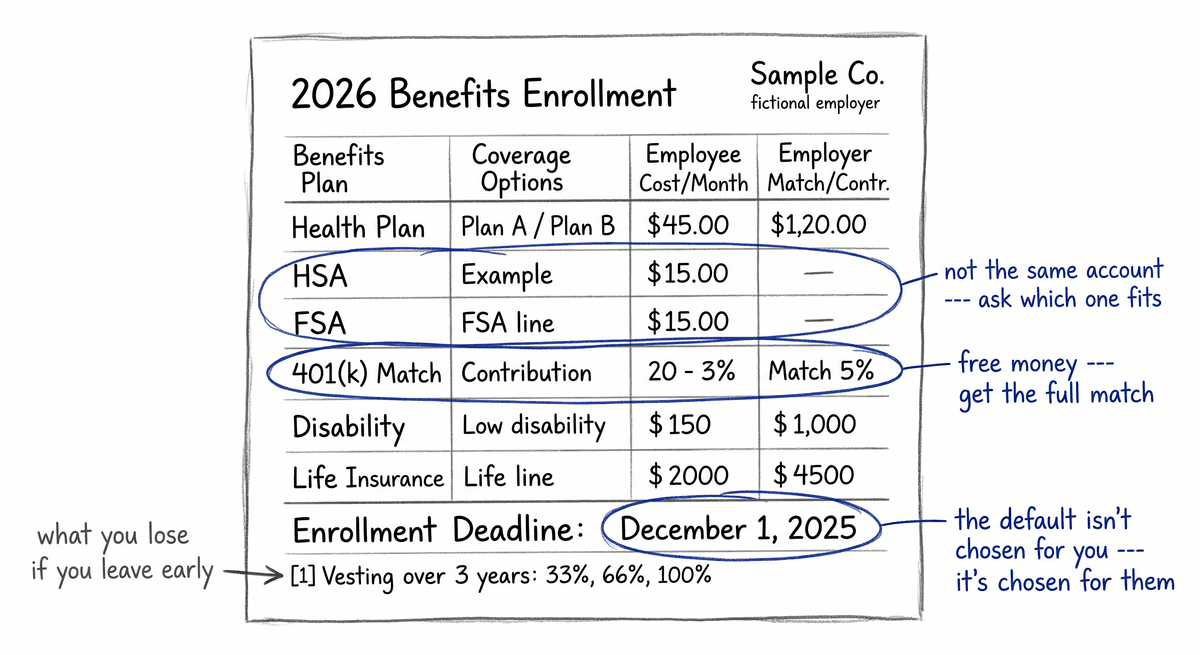
Open enrollment is the company’s annual reminder that they have structured your compensation so that a meaningful percentage of it requires you to read a 40-page PDF, attend a webinar scheduled during your busiest week, and make irrevocable financial decisions in a two-week window. The C-suite has a benefits consultant who does this for them. You now have your Agent.
The HSA and FSA sound similar but reward opposite instincts. The Health Savings Account is the single most tax-advantaged account in the U.S. tax code when it fits: deductible contribution, tax-free growth, tax-free withdrawal for qualified medical expenses. It requires a high-deductible health plan and is not right for everyone. The Flexible Spending Account is the one your HR pairs with a conventional plan — and it carries a “use it or lose it” rule, with a limited rollover or grace period depending on your employer’s election. Many employees default into the FSA because it is what appears next to the conventional plan, not realizing the HSA is portable, investable, and follows them when they leave. If both are offered with compatible plans, ask your Agent to model which one serves you given your actual annual medical spending. Verify current contribution limits with the IRS; they are updated each fall for the following plan year.[32]
Vesting schedules convert “total compensation” into actual dollars — and the gap is often substantial. A 401(k) employer match vests on either a cliff schedule (0% until a specific year, then 100%) or a graded schedule (a fraction per year until fully vested); ERISA caps these at six and seven years respectively for most plans. Stock options and RSUs follow their own schedules, typically four years with a one-year cliff. “Golden handcuffs” is the phenomenon of employees staying at jobs they dislike because unvested compensation represents tens of thousands of dollars that vanish on departure. Before you make a career decision, ask your Agent to calculate the specific dollar amount at stake given your grant schedule and vesting calendar — so the choice is informed, not emotional.
Veterans note: Service members and veterans have a parallel benefits track worth naming. TRICARE (for active-duty members, retirees, and eligible family) is separate from VA healthcare. Military service credit applies toward both Social Security and federal civilian retirement under FERS. The Thrift Savings Plan and the Blended Retirement System — effective for those who entered service after January 1, 2018, and opt-in-eligible for certain earlier cohorts — include up to a 5% government match,[33] the same dynamic as a 401(k) match. Contribute at least 5% or you are declining free compensation. The Survivor Benefit Plan election at retirement is once-and-done: the default is SBP coverage, and declining it requires spousal consent.
-
[1] Paul, K. I., & Moser, K. (2009). “Unemployment impairs mental health: Meta-analyses.” Journal of Vocational Behavior, 74(3), 264–282.↩
-
[2] Eisenberger, N. I., Lieberman, M. D., & Williams, K. D. (2003). “Does Rejection Hurt? An fMRI Study of Social Exclusion.” Science, 302(5643), 290–292.↩
-
[3] Cappelli, P. (2012). Why Good People Can’t Get Jobs: The Skills Gap and What Companies Can Do About It. Wharton Digital Press.↩
-
[4] Babcock, L., & Laschever, S. (2003). Women Don’t Ask: Negotiation and the Gender Divide. Princeton University Press.↩
-
[5] Dastin, J. (2018). “Amazon scraps secret AI recruiting tool that showed bias against women.” Reuters, October 10, 2018.↩
-
[6] U.S. Office of Personnel Management, “Vet Guide for HR Professionals.” See also 5 U.S.C. §§ 2108, 3304, 3309–3320 (Veterans’ Preference), and U.S. Department of Veterans Affairs, “About GI Bill Benefits,” covering degree programs, certifications, apprenticeships, and licensure exams.↩
-
[7] The 21-day (or 45-day) review period is required by the Older Workers Benefit Protection Act (OWBPA), 29 U.S.C. § 626(f). See also EEOC, “Understanding Waivers of Discrimination Claims in Employee Severance Agreements,” EEOC-NVTA-2009-3.↩
-
[8] U.S. Department of Labor, Veterans’ Employment and Training Service, “USERRA: Uniformed Services Employment and Reemployment Rights Act,” codified at 38 U.S.C. §§ 4301–4335.↩
-
[9] U.S. Equal Employment Opportunity Commission, “Retaliation,” and “Facts About Retaliation.” Statutory basis: Title VII of the Civil Rights Act of 1964, 42 U.S.C. § 2000e-3(a).↩
-
[10] EEOC, “Time Limits for Filing a Charge.”↩
-
[11] Bloom, N. et al. (2015). “Does Working from Home Work? Evidence from a Chinese Experiment.” Quarterly Journal of Economics, 130(1), 165–218. The 2024 follow-up: Bloom, N., Han, R., & Liang, J. (2024). “Hybrid Working from Home Improves Retention Without Damaging Performance.” Nature, 630, 920–925.↩
-
[12] Office of the U.S. Surgeon General (2023). “Our Epidemic of Loneliness and Isolation: The U.S. Surgeon General’s Advisory on the Healing Effects of Social Connection and Community.”↩
-
[13] National Labor Relations Act, 29 U.S.C. § 157. See NLRB, “Concerted Activity,” and “Employer/Union Rights and Obligations.” Confidentiality policies that prohibit wage discussion are generally unlawful.↩
-
[14] Bronfenbrenner, K. (2009). “No Holds Barred: The Intensification of Employer Opposition to Organizing.” Economic Policy Institute Briefing Paper #235, May 20, 2009.↩
-
[15] Western, B., & Rosenfeld, J. (2011). “Unions, Norms, and the Rise in U.S. Wage Inequality.” American Sociological Review, 76(4), 513–537.↩
-
[16] Saad, L. (2023). “More in U.S. See Unions Strengthening and Want It That Way.” Gallup, August 30, 2023.↩
-
[17] AFL-CIO, “Death on the Job: The Toll of Neglect.” The report is issued annually; staffing-to-workplace ratios and the years-to-inspect figure are published each spring.↩
-
[18] U.S. Bureau of Labor Statistics, “Census of Fatal Occupational Injuries,” tables by worker characteristics. See also Loh, K., & Richardson, S. (2004). “Foreign-born workers: trends in fatal occupational injuries, 1996–2001.” Monthly Labor Review, 127(6), 42–53.↩
-
[19] U.S. Department of Labor, “Employee or Independent Contractor Classification Under the Fair Labor Standards Act,” 89 Fed. Reg. 1638 (January 10, 2024). The rule applies a six-factor economic-reality test. See also IRS, “Independent Contractor (Self-Employed) or Employee?”↩
-
[20] Upwork, “Freelance Forward,” annual editions. The headline figure counts anyone who did paid freelance work during the preceding 12 months; full-time independent workers are a subset.↩
-
[21] IRS, “Self-Employment Tax (Social Security and Medicare Taxes),” and “Estimated Taxes,” Form 1040-ES. Current thresholds, wage-base caps, and penalty rates are updated annually; verify each tax year.↩
-
[22] Murphy, K. R. (2020). “Performance Evaluation Will Not Die, But It Should.” Human Resource Management Journal, 30(1), 13–31. On recency effects specifically, see also Thorsteinson, T. J. (2000). “A Meta-Analysis of Recency Effects in Performance Appraisal,” unpublished paper presented at the Society for Industrial and Organizational Psychology conference.↩
-
[23] Clance, P. R., & Imes, S. A. (1978). “The Imposter Phenomenon in High Achieving Women: Dynamics and Therapeutic Intervention.” Psychotherapy: Theory, Research & Practice, 15(3), 241–247. Prevalence estimate from Sakulku, J., & Alexander, J. (2011). “The Impostor Phenomenon.” International Journal of Behavioral Science, 6(1), 75–97.↩
-
[24] Cappelli, P., & Tavis, A. (2016). “The Performance Management Revolution.” Harvard Business Review, October 2016.↩
-
[25] Murphy, K. R., & Cleveland, J. N. (1995). Understanding Performance Appraisal: Social, Organizational, and Goal-Based Perspectives. Sage.↩
-
[26] Thomas, K. W., & Kilmann, R. H. (1974). Thomas-Kilmann Conflict Mode Instrument. Xicom. For meta-analytic evidence on conflict style effectiveness, see De Dreu, C. K. W., & Van Vianen, A. E. M. (2001). “Managing Relationship Conflict and the Effectiveness of Organizational Teams.” Journal of Organizational Behavior, 22(3), 309–328.↩
-
[27] Eisenberger, N. I., Lieberman, M. D., & Williams, K. D. (2003). “Does Rejection Hurt? An fMRI Study of Social Exclusion.” Science, 302(5643), 290–292. See also American Psychological Association, Stress in America (annual report).↩
-
[28] Livingston, R. W., Rosette, A. S., & Washington, E. F. (2012). “Can an Agentic Black Woman Get Ahead?” Psychological Science, 23(4), 354–358. See also Amanatullah, E. T., & Morris, M. W. (2010). “Negotiating Gender Roles: Gender Differences in Assertive Negotiating Are Mediated by Women’s Fear of Backlash.” Journal of Personality and Social Psychology, 98(2), 256–267.↩
-
[29] Financial Engines. (2015). “Missing Out: How Much Employer 401(k) Matching Contributions Do Employees Leave on the Table?” The $1,336 figure is the average annual uncollected match; actual amounts vary by salary and match structure.↩
-
[30] Social Security Administration, “Disability Benefits / Basic Facts,” SSA Publication No. 05-10029. The disability-before-retirement estimate is drawn from SSA’s Office of the Chief Actuary projections.↩
-
[31] TIAA Institute & Global Financial Literacy Excellence Center (GFLEC), “Personal Finance Index (P-Fin Index),” annual survey.↩
-
[32] IRS, “Publication 969: Health Savings Accounts and Other Tax-Favored Health Plans,” and IRS Revenue Procedures (issued annually) for inflation-adjusted limits.↩
-
[33] Department of Defense, “Blended Retirement System,” and Thrift Savings Plan, “Contribution Types,” at tsp.gov.↩